
SmartBAN Open Framework High-Level Architecture Explained

Smart Body Area Networks (SmartBANs) are really changing how we think about healthcare, the Internet of Things (IoT), and the next wave of telecom systems. They enable our wearables and sensors to connect in a really smooth way. However, with the growing variety of devices and the complexity of services we need, there’s a clear demand for a structured open framework.
The SmartBAN open framework offers several key benefits:
It allows devices and applications to communicate more effectively.
It helps us make sense of health and sensor data.
It streamlines how we manage and schedule services.
And it ensures different systems can work together, no matter the variety of devices involved.
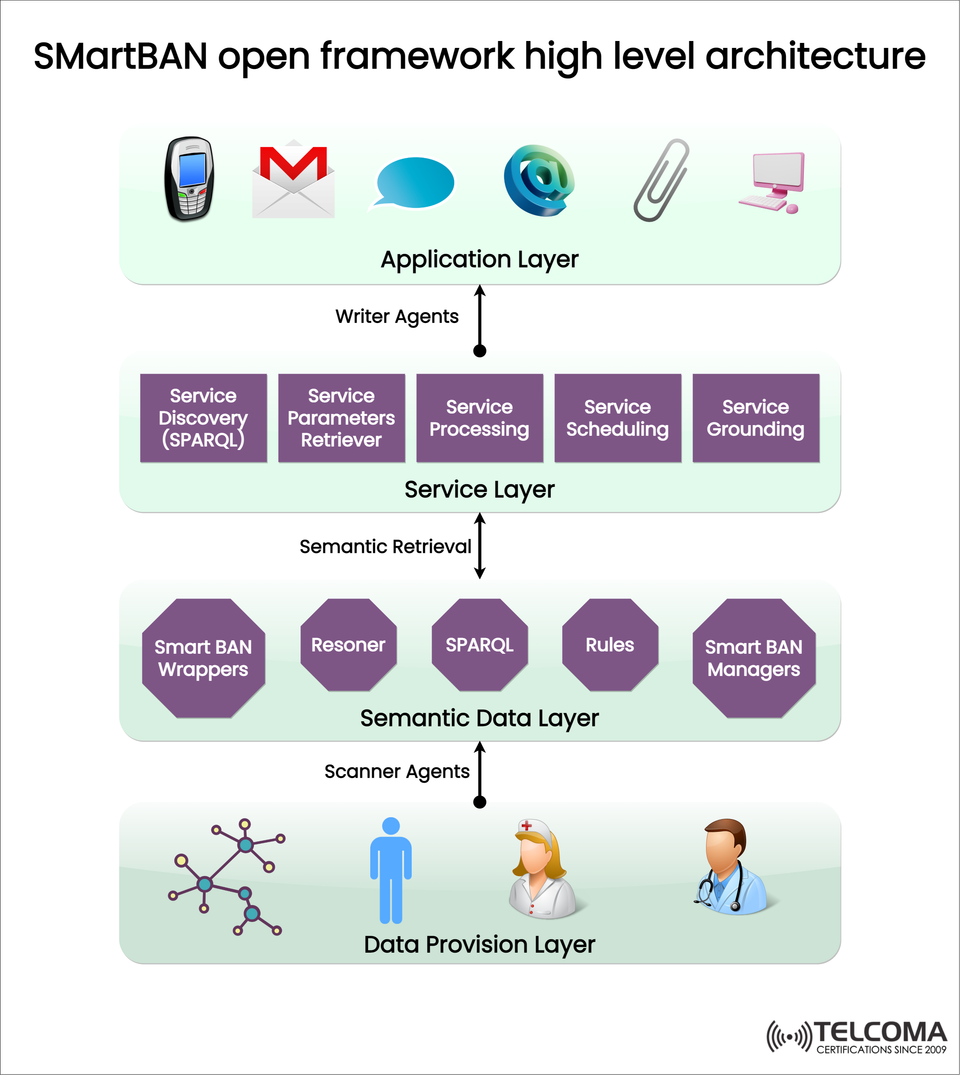
Check out the diagram that outlines the high-level architecture, which is built on four main layers: Data Provision Layer, Semantic Data Layer, Service Layer, and Application Layer.
Layer 1: Data Provision Layer – The Foundation
At the base of the SmartBAN framework is the Data Provision Layer. This layer is crucial because it lays the groundwork for everything above it.
Key Features:
It gathers raw data from sensors, wearables, and medical gadgets.
It connects directly with patients, healthcare professionals, and monitoring systems.
Scanner Agents sift through data and send it up for deeper processing.
Examples of Inputs:
Vital signs like ECG, blood pressure, and glucose levels.
Movement and activity information.
Real-time updates from medical staff during monitoring sessions.
Basically, this layer makes sure a variety of data sources can reliably feed into the SmartBAN system.
Layer 2: Semantic Data Layer – Adding Meaning to Data
Raw data alone just doesn’t cut it for SmartBAN applications. That’s where the Semantic Data Layer steps in. It organizes and enriches the data with meaning for better interoperability and context-aware processing.
Core Components:
Smart BAN Wrappers: These convert raw data into standardized formats.
Reasoner: This applies logic to help interpret and draw new insights from the data.
SPARQL: A query language used to manage and retrieve semantic info.
Rules: They set the groundwork for how we interpret the data.
Smart BAN Managers: These keep the flow of semantic information organized.
Role of Semantic Retrieval:
This layer allows for semantic queries and reasoning, ensuring that data doesn’t just get moved around but actually gets understood. For example, if a heart rate reading spikes, the semantic layer can recognize that as a potential risk and push for immediate action.
Layer 3: Service Layer – Managing Services Efficiently
The Service Layer acts as a bridge between understanding the data semantically and delivering it through applications. It’s all about ensuring that SmartBAN systems can grow and provide services consistently.
Key Modules:
Service Discovery (SPARQL): This helps find available services from the semantic layer.
Service Parameters Retriever: Gathers what’s needed to tailor services.
Service Processing: Responsible for running the service logic based on the data retrieved.
Service Scheduling: Manages when and how services are delivered for optimal performance.
Service Grounding: This connects services to actual resources.
Example in Healthcare:
If a patient’s wearable device spots an irregular heartbeat:
Service Discovery finds the monitoring services.
The Parameters Retriever collects threshold values.
Service Processing assesses the data.
Service Scheduling prioritizes the alert.
Service Grounding sends an alert to the healthcare team.
That’s how the SmartBAN framework stays responsive and context-aware.
Layer 4: Application Layer – User-Facing Services
At the top of the framework, we have the Application Layer, where data and services come together to create actionable outputs for users.
Features:
It connects with healthcare professionals, patients, and others involved.
Applications can range from health monitoring apps to medical alerts and communication tools.
It utilizes Writer Agents to push information up from the service layer.
Example Outputs:
Doctors receive real-time alerts about patient ECGs.
Patients get personalized health tips via a mobile app.
Hospital IT systems log and analyze SmartBAN data for ongoing monitoring.
This layer turns the technical aspects of SmartBAN into real, practical benefits.
SmartBAN Open Framework Workflow
To see how these layers come together, here’s a simplified workflow:
Data Capture: Sensors in the Data Provision Layer gather patient information.
Semantic Processing: The Semantic Data Layer interprets the raw data using rules and reasoning.
Service Orchestration: The Service Layer identifies, processes, and schedules the necessary services.
Application Delivery: Finally, results are delivered to end-users via the Application Layer.
This structured approach creates a modular, scalable, and interoperable ecosystem for SmartBANs.
Advantages of the SmartBAN Open Framework
- Interoperability Across Devices
It can manage data from various devices and vendors.
Uses semantic reasoning for consistent understanding.
- Scalability and Flexibility
The modular design makes adding new services a breeze.
It can easily incorporate new devices or protocols.
- Improved Healthcare Outcomes
Supports real-time alerts and personalized health monitoring.
Boosts interactions between doctors and patients with reliable data flow.
- Efficient Resource Management
Service scheduling helps make the best use of network and processing resources.
Critical tasks, like emergency alerts, are prioritized over routine checks.
Use Cases of SmartBAN Architecture
Healthcare Monitoring Systems
Continuous tracking of patients’ vital signs.
Auto alerts for emergencies.
Sports and Fitness
Uses wearables for performance tracking.
Semantic analysis of activity and physiological data.
Defense Applications
Monitors soldier health and stress in real-time.
Coordinated alerts during missions.
IoT Ecosystems
Integrates SmartBANs into smart homes and cities.
The semantic layer supports data exchange across domains.
Comparison of SmartBAN Layers
| Layer Function | Example Use Case |
| Data Provision | Gathers raw data from sensors/devices | ECG monitor, step tracker |
| Semantic Data | Adds meaning, applies reasoning | Infers cardiac risk from heart rate data |
| Service Layer | Coordinates service processing & delivery | Schedules urgent alerts |
| Application Layer | User-facing apps & outputs | Doctor’s alert system, patient app |
Why This Architecture Matters for Telecom Professionals
For telecom engineers and IoT specialists, the SmartBAN open framework provides:
A reliable model for incorporating BANs into 5G and 6G networks.
Guidelines to ensure quality of service in body-centric communication.
A path toward achieving interoperability across domains – critical for healthcare, IoT, and defense.
Conclusion
The SmartBAN open framework high-level architecture connects raw sensor data with real-world applications. Its layered design—comprising Data Provision, Semantic Data, Service, and Application layers—ensures smooth interoperability, scalability, and delivery of context-aware services.
For those in telecom and IoT, this architecture points to the future of body-centric communication systems. As SmartBANs continue to expand into fields like healthcare, sports, defense, and IoT ecosystems, adopting this open framework will be key for achieving reliable, scalable, and smart networks.