
Spectrum Bands for 5G and 6G: Frequency, Propagation, and Future Potential

The Essential Role of Spectrum in 5G and 6G
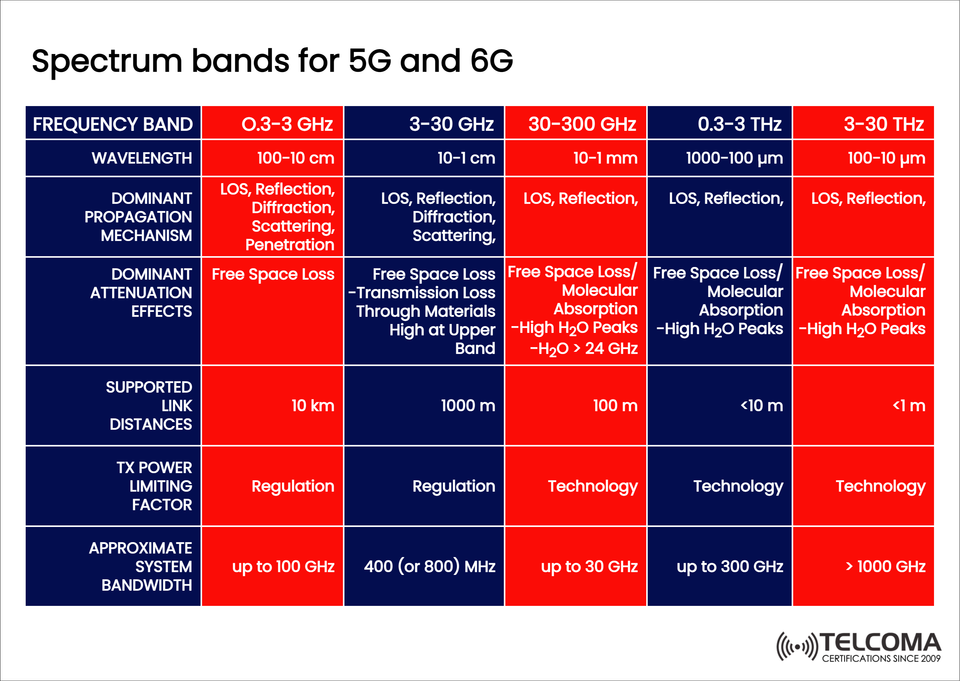
When we look at the progress in mobile communication, from 2G up to 5G, there's one key element that stands out—spectrum. As we move from 5G toward 6G networks, the different spectrum bands will play a huge role in defining things like coverage, performance, and capabilities. The image above outlines the spectrum ranges from 0.3 GHz to 30 THz and dives into how signals travel, attenuation effects, link distances, and system bandwidths.
This blog post takes a closer look at these spectrum bands, illustrating how they contribute to the development of 5G and 6G technologies, and what obstacles we might encounter along the way.
Spectrum Bands for 5G and 6G: A Quick Overview
The spectrum allocation for 5G and 6G covers a broad range of frequencies, from the sub-6 GHz (which is utilized in 4G and 5G) all the way to terahertz (THz) waves, which are being considered for 6G ultra-high-capacity networks.
Here’s a brief rundown:
Frequency Band Wavelength Supported Link Distance System Bandwidth Typical Use Case0.3–3 GHz100–10 cm~10 kmup to 100 GHz Wide coverage, mobile broadband3–30 GHz10–1 cm~1000 m400–800 MHz5G mid-band (C-band), high capacity30–300 GHz10–1 mm~100 mup to 30 GHz mmWave 5G, dense urban, hotspots0.3–3 THz1000–100 µm<10 mup to 300 GHz6G short-range ultra-fast links3–30 THz100–10 µm<1 m>1000 GHz Experimental 6G, extreme data rates
Sub-6 GHz Bands (0.3–3 GHz): The Backbone of 5G
Wavelength: 100–10 cm
Propagation: Line of sight (LOS), reflection, diffraction, scattering, and penetration
Attenuation: Free space loss
Link Distance: Up to 10 km
System Bandwidth: Up to 100 GHz
These lower-frequency bands work great for providing wide coverage and can easily penetrate walls and obstacles. They form the foundation of current 4G LTE and early 5G deployments. Since they can link over longer distances, they’re also more affordable to set up in rural and suburban areas.
Examples of use cases include nationwide 5G coverage, IoT connectivity, and mobile broadband.
Mid-Band Spectrum (3–30 GHz): The Workhorse of 5G
Wavelength: 10–1 cm
Propagation: LOS, reflection, diffraction, scattering
Attenuation: Free space loss + transmission loss through materials
Link Distance: ~1000 m
System Bandwidth: 400–800 MHz
This band includes C-band (3.5 GHz), which many consider the “sweet spot” for 5G. It strikes a good balance between coverage and capacity, making it a key contributor to enhanced mobile broadband (eMBB).
Examples of use cases: Urban 5G deployments, private enterprise networks, and AR/VR applications.
mmWave Spectrum (30–300 GHz): Reaching Ultra-Fast 5G
Wavelength: 10–1 mm
Propagation: LOS, reflection
Attenuation: Free space loss + molecular absorption (especially water vapor at >24 GHz)
Link Distance: ~100 m
System Bandwidth: Up to 30 GHz
The mmWave spectrum is where 5G hits gigabit-level speeds. But its short range and high attenuation mean it’s mostly deployed in crowded urban areas like stadiums and airports.
Challenges include: A tendency to suffer from rain fade, oxygen absorption, and obstructions like trees and buildings.
Examples of use cases: Fixed wireless access (FWA), high-speed hotspots, and immersive XR experiences.
Terahertz Spectrum (0.3–3 THz): Paving the Way for 6G
Wavelength: 1000–100 µm
Propagation: LOS, reflection
Attenuation: Free space loss + molecular absorption (notably high peaks in H₂O)
Link Distance: <10 m
System Bandwidth: Up to 300 GHz
Terahertz frequencies have the potential for incredible capacity and low-latency communications. However, their severe attenuation and limited range mean they’re best suited for indoor settings and short-distance communications.
Examples of use cases: Ultra-high-speed wireless backhaul, holographic communications, and chip-to-chip wireless links.
Beyond Terahertz (3–30 THz): Exploring Experimental Spectrum for 6G
Wavelength: 100–10 µm
Propagation: LOS, reflection
Attenuation: Free space loss + significant molecular absorption
Link Distance: <1 m
System Bandwidth: >1000 GHz
This ultra-high-frequency range is still in the experimental stage, with possible applications in wireless cognition, quantum communications, and extremely fast data transfers.
Challenges include the fact that technology for generating, modulating, and detecting at THz frequencies is still in early development.
Propagation Mechanisms: Effects of Higher Frequencies
Sub-6 GHz → Good penetration, wide coverage, but bandwidth is limited.
Mid-band (3–30 GHz) → Balanced coverage and capacity, moderate penetration.
mmWave (30–300 GHz) → High capacity but limited coverage and very sensitive to blockage.
THz (0.3–30 THz) → Extremely high capacity, very short range, and still largely experimental.
As frequencies go up, bandwidth capacity increases, but coverage shrinks, necessitating denser network configurations and new technologies like reconfigurable intelligent surfaces (RIS), advanced beamforming, and integration of satellite and terrestrial systems.
Key Challenges in Using Spectrum for 6G
Propagation Losses: Higher frequencies face issues with free space and molecular absorption losses.
Short Link Distances: THz links are limited to very short distances.
Regulation and Standardization: There’s a need for government action to allocate spectrum while considering existing systems.
Hardware Limitations: Antennas, RF front-ends, and power amplifiers encounter difficulties at THz frequencies.
Energy Efficiency: Operating at higher frequencies typically requires more power, which raises sustainability concerns.
Real-World Uses of 5G Spectrum
Sub-6 GHz: The Core of 5G Rollouts
These days, a lot of commercial 5G networks are built on sub-6 GHz spectrum. For instance:
2.5 GHz (Sprint/T-Mobile, USA) → This band is used for nationwide coverage and gets great indoor penetration.
3.5 GHz C-Band (Europe, Asia, USA) → Often called the 5G mid-band sweet spot, it strikes a nice balance between coverage and speed.
700 MHz and 800 MHz bands → These are perfect for rural areas, making sure 5G can reach those remote spots.
It highlights why low- and mid-band frequencies really matter for broad adoption—people want fast speeds not just in city centers but also dependable service in the suburbs and out in the countryside.
Conclusion: Spectrum as the Backbone of 6G Innovation
The journey from 5G to 6G spectrum bands illustrates a classic trade-off: lower frequencies offer greater range and reliability, while higher frequencies provide more capacity and speed.
For those in telecom, understanding these spectrum properties is crucial for building future-ready networks. For technology enthusiasts, it sheds light on how 6G will enable applications that seem straight out of science fiction, like holographic communication, autonomous systems, and hyperconnected environments.
At the end of the day, spectrum isn’t just a technical detail—it’s the foundation of our connected future, influencing how societies will communicate, innovate, and thrive in the 6G era.