
Spectrum Ranges for 5G: From Sub-1 GHz to mmWave and Beyond

Spectrum Ranges for 5G: From Sub-1 GHz to mmWave and Beyond
The launch of 5G technology goes beyond just faster download speeds. At its essence, 5G stands out for its capability to function over a broad spectrum range, from low frequencies under 1 GHz to millimeter waves exceeding 30 GHz. Each of these ranges comes with unique trade-offs between coverage and capacity, influencing how 5G is rolled out in cities, rural areas, and industry-specific networks.
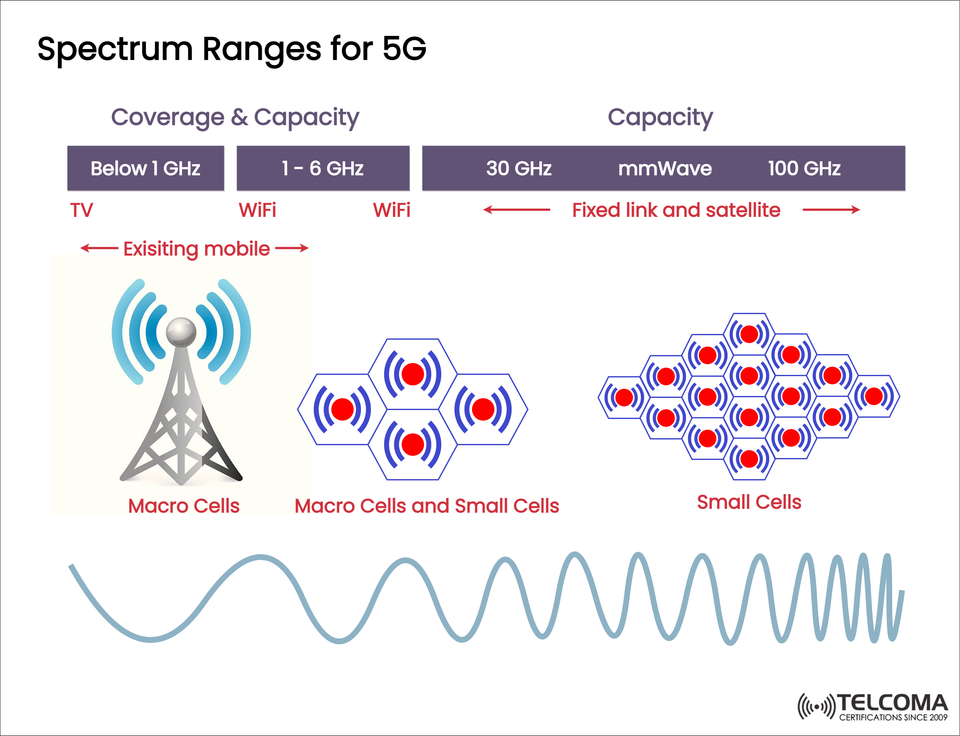
The diagram above sums up this evolution of spectrum: it starts with macro cells that cover wide areas at low frequencies and moves to dense small-cell setups at mmWave frequencies. In this blog, we’re going to break down these spectrum ranges for 5G, what they entail, and how they cater to different use cases.
Understanding 5G Spectrum Bands
5G's spectrum is divided into three main categories:
Low-Band Spectrum (Below 1 GHz)
This legacy spectrum comes from earlier generations like 2G, 3G, and 4G.
It offers great coverage but has limited capacity.
It’s perfect for connecting broad rural and suburban areas.
Mid-Band Spectrum (1–6 GHz)
Often considered the “sweet spot” for 5G, providing a balance of coverage and capacity.
Includes bands like C-Band (3.5 GHz) and 2.5 GHz.
Best suited for urban and suburban settings.
High-Band Spectrum (Above 24 GHz / mmWave)
Encompasses 30 GHz, mmWave, and beyond.
It delivers very high capacity but has limited coverage.
It necessitates dense small-cell deployments.
Let’s dig deeper into each band.
Below 1 GHz: The Coverage Layer
The sub-1 GHz range (often referred to as the low-band spectrum) has been the foundation of mobile communications for many years.
Characteristics:
Longer wavelengths travel further and can penetrate obstacles effectively.
Works well for macro cell deployments.
Ensures nationwide coverage with fewer base stations.
Examples:
600 MHz (used for 5G in North America).
700 MHz (repurposed digital dividend spectrum).
Use Cases:
Providing connectivity in rural areas.
Offering IoT coverage over wide areas (like sensors for agriculture).
Supporting mobility on highways and in remote locations.
Trade-off: While it excels in coverage, the capacity is lacking. This spectrum struggles to meet high data demands in crowded urban environments.
1–6 GHz: The Capacity-Coverage Balance
The mid-band spectrum finds a sweet spot between coverage and capacity. It’s the most commonly used frequency range for 5G deployments worldwide.
Characteristics:
Higher frequencies than sub-1 GHz, which leads to more bandwidth.
Offers moderate propagation characteristics, resulting in decent coverage and better capacity.
Works well with a mix of macro and small cell setups.
Examples:
3.5 GHz (C-Band): The workhorse for global 5G.
2.5 GHz: An older LTE band repurposed for 5G.
4.9 GHz: Used in some regions for private 5G networks and public safety.
Use Cases:
Mobile broadband in urban and suburban settings.
Networks for businesses and campuses.
Enhanced Mobile Broadband (eMBB).
Trade-off: While the mid-band spectrum offers a balanced option, it still can’t compete with the extreme capacity of high-band mmWave for hotspot scenarios.
30 GHz and Above: High-Band and mmWave
The high-band spectrum, especially millimeter wave (mmWave), is where 5G reaches its gigabit speeds and ultra-low latency.
Characteristics:
Operates in the range of 30 GHz to 100 GHz.
Provides extremely high capacity thanks to wide channels (up to 400 MHz+).
Struggles with propagation; signals can have a hard time with distance and obstacles.
Needs dense small-cell deployments.
Examples:
28 GHz (a pioneering band in the U.S. and Asia).
39 GHz (licensed in the U.S.).
60 GHz (unlicensed) used for WiGig and specialized 5G applications.
Use Cases:
Hotspot coverage in places like stadiums, airports, and downtown areas.
Fixed Wireless Access (FWA).
Industrial applications that require ultra-high bandwidth.
Trade-off: While mmWave provides huge capacity, its coverage is limited, making it a pricier option for wide-area service.
Coverage vs. Capacity: The Spectrum Trade-Off
The allocation of 5G spectrum is really about finding a balance between coverage (how far the signal goes) and capacity (how much data it can carry).
Here’s a quick look:
Spectrum Range Coverage Quality Capacity Potential Cell DeploymentSub-1 GHz (Low-Band)Excellent Low Macro cells1–6 GHz (Mid-Band)Moderate Moderate to High Macro + Small cells30+ GHz (mmWave)Poor Very High Small cells
This balance is why 5G providers are using a layered spectrum strategy, mixing different bands for smooth coverage and performance.
The Role of Macro and Small Cells
The diagram also highlights how cell types play into the different bands:
Macro Cells:
Used in sub-1 GHz and mid-band.
They cover large areas with fewer sites.
They’re crucial for mobility and widespread coverage.
Small Cells:
Heavily utilized in mid-band and mmWave.
They offer dense coverage and address capacity demands.
They help with applications like AR/VR, smart factories, and FWA.
In 5G networks, macro and small cells collaborate within a heterogeneous network (HetNet) to provide both broad coverage and high-speed services.
Beyond 100 GHz: The Future of 6G
The diagram gives a nod to frequencies reaching up to 100 GHz—far beyond what we see in current 5G deployments. Researchers are exploring these terahertz frequencies for 6G networks.
Potential:
Terabit-per-second data rates.
Use cases like holographic communications, digital twins, and advanced IoT.
Challenges:
Major propagation loss.
Hardware limitations in radio design.
Even if it’s a ways off, these frequencies show the evolutionary path beyond 5G.
Why Spectrum Diversity Matters in 5G
One of the key strengths of 5G is its flexibility across different spectrum bands. Unlike earlier generations that were tied to specific bands, 5G covers a wide range to meet various needs.
Low-band guarantees nationwide coverage.
Mid-band provides urban capacity and is useful for businesses.
High-band (mmWave) fuels hotspots and cutting-edge applications.
This layered approach ensures a smooth user experience, whether you're streaming videos in rural places or running XR applications in a smart factory.
Conclusion
The spectrum ranges for 5G are crucial for its performance and adaptability. From sub-1 GHz bands delivering extensive coverage to mmWave offering gigabit capacity, each range has a strategic purpose.
5G networks depend on a layered spectrum model, combining macro cells for wide coverage and small cells for high-capacity areas. And as research ventures into 100 GHz and more, the future opens up even more exciting possibilities for 6G and terahertz communication.
For telecom professionals and tech enthusiasts alike, grasping these spectrum ranges is key to understanding how 5G will shape industries and daily life.