
Split-RAN Processing Pipeline: CU, DU, and RU Roles in 5G Architecture

Introduction: Why Split-RAN Matters in 5G
Moving from 4G LTE to 5G networks isn’t just about faster speeds; it’s about bringing in flexibility, scalability, and efficiency. Unlike traditional RAN (Radio Access Network), which was all integrated, 5G takes a different approach by breaking RAN into modular units:
Central Unit (CU)
Distributed Unit (DU)
Radio Unit (RU)
This Split-RAN processing pipeline helps telecom operators place resources closer to users, cut down on latency, and set up cloud-native, software-defined networks.
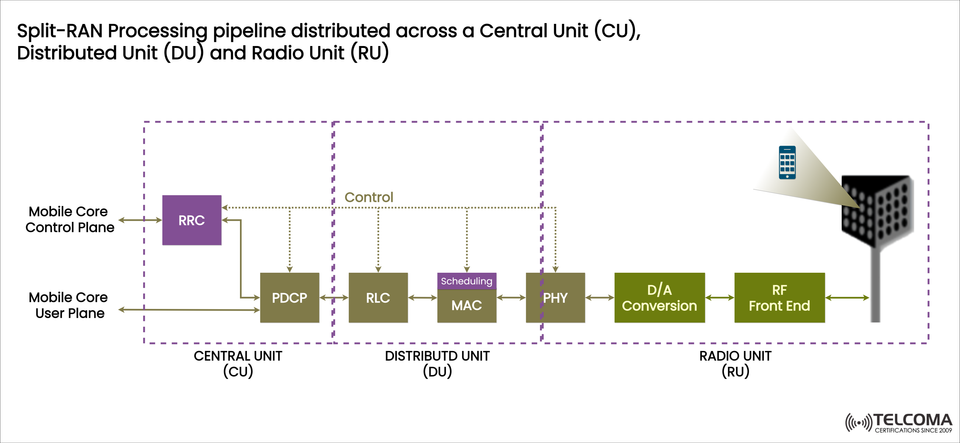
The image uploaded shows how the control and user plane functions are spread across the CU, DU, and RU. Let’s unpack that.
The Concept of Split-RAN
In traditional RAN setups, both baseband and radio functions were kept in one unit right at the cell site. With Split-RAN, they’re separated into distinct components, making way for:
Centralization: Higher-level operations are managed in a CU, which is often hosted in a centralized data center.
Distribution: Time-sensitive functions are handled in the DU, usually closer to the edge.
Radio Access: The RU takes care of the physical transmission at the cell tower.
This modular approach aligns with O-RAN Alliance standards, which support interoperability and cost savings.
Breakdown of the Split-RAN Processing Pipeline
- Central Unit (CU)
The CU’s job is to manage higher-layer processing functions, and it’s typically virtualized in cloud setups.
RRC (Radio Resource Control):
Lives in the control plane.
Overlooks signaling, mobility (handover), connection setups, and security.
PDCP (Packet Data Convergence Protocol):
Operates across both user and control planes.
Functions include header compression, ciphering, integrity protection, and handover support.
CU Advantages:
Centralized resource management.
Less complexity at the cell site.
Perfect for cloud deployment.
- Distributed Unit (DU)
The DU focuses on real-time, lower-layer tasks and is positioned closer to the edge to cut down on latency.
RLC (Radio Link Control):
Responsible for segmentation/reassembly of PDCP packets.
Handles error correction via ARQ.
Ensures data reliability.
MAC (Medium Access Control):
Takes care of scheduling, dynamically assigning spectrum resources to UEs.
Responsible for multiplexing data streams.
Implements HARQ for fast retransmission.
DU Advantages:
Quick response for real-time applications.
Efficient radio scheduling.
Scales well for massive IoT and URLLC (Ultra-Reliable Low Latency Communication).
- Radio Unit (RU)
The RU is set up at the cell tower, closest to the user equipment (UE).
PHY (Physical Layer):
Manages channel coding, modulation, and MIMO operations.
Converts MAC data into symbols for sending out.
D/A Conversion (Digital-to-Analog):
Turns processed digital signals into analog waveforms.
RF Front End:
Amplifies signals, filters out interference, and transmits/receives over-the-air signals.
RU Advantages:
Better use of the spectrum.
Less hardware needed at the tower.
Upgrades for new frequency bands are simpler.
Control and User Plane Separation
Control Plane (RRC, PDCP-C): Manages signaling, session handling, and mobility.
User Plane (PDCP-U, RLC, MAC, PHY): Handles real user data, focusing on throughput and latency.
This separation boosts network slicing and allows operators to scale control and user functions separately.
Benefits of the Split-RAN Processing Pipeline
Lower Latency: With DU functions positioned near the edge, applications sensitive to latency, like AR/VR and self-driving vehicles, can perform better.
Cloud-Native Architecture: CU functions can be run on virtualized platforms in data centers, leading to cost savings.
Scalability: CU, DU, and RU functions can be scaled independently.
Flexibility: Operators can tailor their setups for urban, suburban, or rural areas.
Interoperability: Standards-based disaggregation supports multi-vendor environments.
Split-RAN in Practice: Use Cases
Urban Dense Deployments: Positioning DU close to users, CU centralized, and RU at towers for maximum efficiency.
Enterprise Private 5G: On-site DU and RU, with CU hosted within the enterprise cloud.
Rural Deployments: Centralized CU managing multiple distributed DUs and RUs to cut costs.
Split-RAN vs. Traditional RAN
Aspect | Traditional RAN | Split-RAN
Architecture | Integrated BBU + Radio | Disaggregated CU, DU, RU
Flexibility | Limited | High – supports multi-vendor systems
Latency Optimization | Less efficient | Edge DU reduces latency
Cloud Deployment | Not supported | CU is cloud-native
Scalability | Hardware-dependent | Software-driven and scalable
Future of Split-RAN in 5G and Beyond
O-RAN Integration: Paving the way for vendor-neutral solutions.
AI-Powered Scheduling: Enhancing DU functions through predictive algorithms.
6G Evolution: Expanding DU/RU roles to utilize the terahertz spectrum.
Virtualization Expansion: Fully cloudifying CU/DU for ultimate flexibility.
O-RAN Functional Splits in Practice
The O-RAN Alliance lays out a few different options for splitting RAN functions, depending on what’s needed for deployment. The division between CU, DU, and RU is often called the “7-2x split,” which gives a standard way to separate PHY functions:
Split 7-2x (Most Popular in 5G):
CU takes care of higher-layer functions like PDCP and RRC.
DU is responsible for MAC and some parts of the PHY.
RU looks after the lower PHY and RF tasks.
There are other splits too, like Split 6 (which separates MAC from PHY) and Split 2 (separating PDCP from RLC), but the 7-2x split is really taking off because it strikes a good balance between latency needs and bandwidth efficiency.
Conclusion
The Split-RAN processing pipeline signifies a major shift in mobile network architecture, distributing roles across the CU, DU, and RU.
CU centralizes core functions for greater flexibility.
DU provides real-time scheduling and reliability right at the edge.
RU manages the physical transmission and radio tasks.
This framework creates low-latency, scalable, and cloud-native 5G networks that are poised to accommodate future needs like IoT, smart cities, and autonomous transport.
For professionals in the telecom industry, grasping the ins and outs of Split-RAN is critical for rolling out and fine-tuning next-gen networks.