
SRS-based vs PMI-based SU-MIMO: Key Differences in 5G MIMO Performance

Comparing SRS-based and PMI-based SU-MIMO for 5G Networks
Massive MIMO (Multiple Input Multiple Output) is central to 5G New Radio (NR), providing high capacity, great spectral efficiency, and improved coverage. In this setup, Single-User MIMO (SU-MIMO) is key for optimizing resources for individual users.
When it comes to channel state acquisition in SU-MIMO, two main techniques are typically used:
SRS-based SU-MIMO (Sounding Reference Signal)
PMI-based SU-MIMO (Precoding Matrix Indicator)
Both techniques aim for accurate channel state information (CSI), which is crucial for optimal beamforming and throughput. However, they significantly vary in implementation, overhead, accuracy, and supported modes.
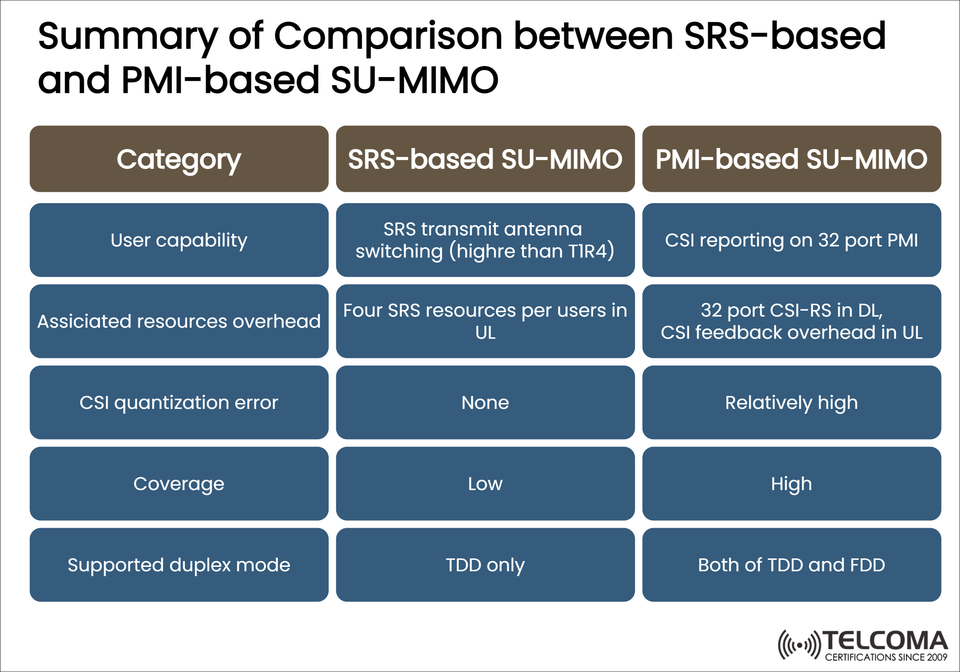
The image above offers a quick comparison, and in this blog, we’ll dive into a more detailed technical explanation to clarify things.
Getting to Know SU-MIMO in 5G
Before jumping into the comparison, let’s revisit what SU-MIMO is all about:
MIMO basics: Having multiple antennas at both the transmitter and receiver enhances capacity and reliability.
SU-MIMO vs MU-MIMO: Unlike MU-MIMO, which caters to multiple users simultaneously, SU-MIMO focuses resources on a single user to maximize throughput.
Importance of CSI: Good Channel State Information (CSI) is vital for adjusting transmissions based on radio conditions.
This is where SRS-based and PMI-based CSI acquisition techniques come into play.
SRS-based SU-MIMO
The SRS (Sounding Reference Signal) is sent in the uplink (UL) by the UE (User Equipment), allowing the base station (gNB) to estimate the channel.
Key Features of SRS-based SU-MIMO:
User capability: Depends on SRS transmit antenna switching (greater than TIR4).
Resource overhead: Needs four SRS resources per user in the uplink.
CSI quantization error: None – CSI is derived straight from SRS.
Coverage: Low, because it relies on uplink transmissions.
Duplex mode: Operates only in TDD (Time Division Duplex).
✅ Advantages:
Zero quantization error means very accurate CSI.
Minimal feedback needed since gNB directly measures the channel.
❌ Disadvantages:
Coverage is limited by uplink constraints.
Not usable in FDD networks.
Higher resource demand per user.
PMI-based SU-MIMO
PMI (Precoding Matrix Indicator) is a downlink (DL)-focused method where the gNB sends CSI-RS (Channel State Information Reference Signals). The UE assesses the channel and sends back the PMI index.
Key Features of PMI-based SU-MIMO:
User capability: Requires CSI reporting on 32 port PMI.
Resource overhead:
32-port CSI-RS in the downlink.
CSI feedback overhead in the uplink.
CSI quantization error: Relatively high due to PMI quantization.
Coverage: High, as downlink is generally more robust than uplink.
Duplex mode: Works in both TDD and FDD.
✅ Advantages:
Greater coverage thanks to downlink measurements.
Flexible, operating in both TDD and FDD modes.
Well-supported in real-world applications.
❌ Disadvantages:
Quantization error in CSI feedback.
Higher signaling overhead for both DL and UL.
Quick Comparison Table
Here’s a brief comparison of SRS-based and PMI-based SU-MIMO:
Category SRS-based SU-MIMOPMI-based SU-MIMO User Capability SRS transmit antenna switching (high TIR4)CSI reporting on 32 port PMI Resource Overhead4 SRS resources per user (UL)32-port CSI-RS in DL, CSI feedback in ULCSI Quantization Error None Relatively high Coverage Low High Supported Duplex Mode TDD only Both TDD and FDD
Choosing Between SRS-based and PMI-based SU-MIMO
Different network operators might lean towards SRS-based or PMI-based SU-MIMO based on their network designs and spectrum availability.
When to go with SRS-based SU-MIMO:
Networks with good uplink performance.
Users in low mobility situations where uplink estimation is reliable.
TDD-only setups.
When to opt for PMI-based SU-MIMO:
Networks needing wide coverage.
Mixed FDD/TDD environments.
Cases where flexible CSI acquisition is required at scale.
Looking Ahead: SU-MIMO in 5G and Beyond
As 5G progresses toward 6G and more advanced MIMO techniques, we might see hybrid methods emerging:
Hybrid CSI acquisition: Blending SRS-based and PMI-based techniques for the best performance.
Machine learning for CSI prediction: This could minimize overhead by intelligently forecasting channel states.
Massive MIMO and beamforming: Integration with multi-user scheduling to boost spectral efficiency.
In the end, finding the right balance between accuracy (SRS-based) and coverage (PMI-based) will shape future optimization strategies.
Key Takeaways
SRS-based SU-MIMO delivers accurate CSI without quantization error but has limited coverage and only works with TDD.
PMI-based SU-MIMO offers better coverage and duplex flexibility, but comes with quantization error and increased signaling overhead.
The choice depends on the operator’s spectrum, deployment type (TDD/FDD), and coverage needs.
Future 5G/6G deployments may see hybrid CSI methods that leverage the strengths of both approaches.
Wrapping Up
In the realm of 5G MIMO optimization, both SRS-based and PMI-based SU-MIMO techniques come with unique advantages and challenges.
SRS-based SU-MIMO is precise but has its limitations.
PMI-based SU-MIMO is flexible but can be resource-intensive.
For telecom professionals, making the right choice hinges on deployment goals:
Accuracy versus Coverage
TDD-only versus TDD/FDD flexibility
Resource efficiency versus signaling overhead
As operators seek to strike the best balance between performance, coverage, and capacity, SU-MIMO strategies will keep evolving, playing a crucial role in realizing the full potential of 5G and beyond.