
Star Topology in IoT Networks: How Sensor Devices Connect via Local Gateways to Base Stations
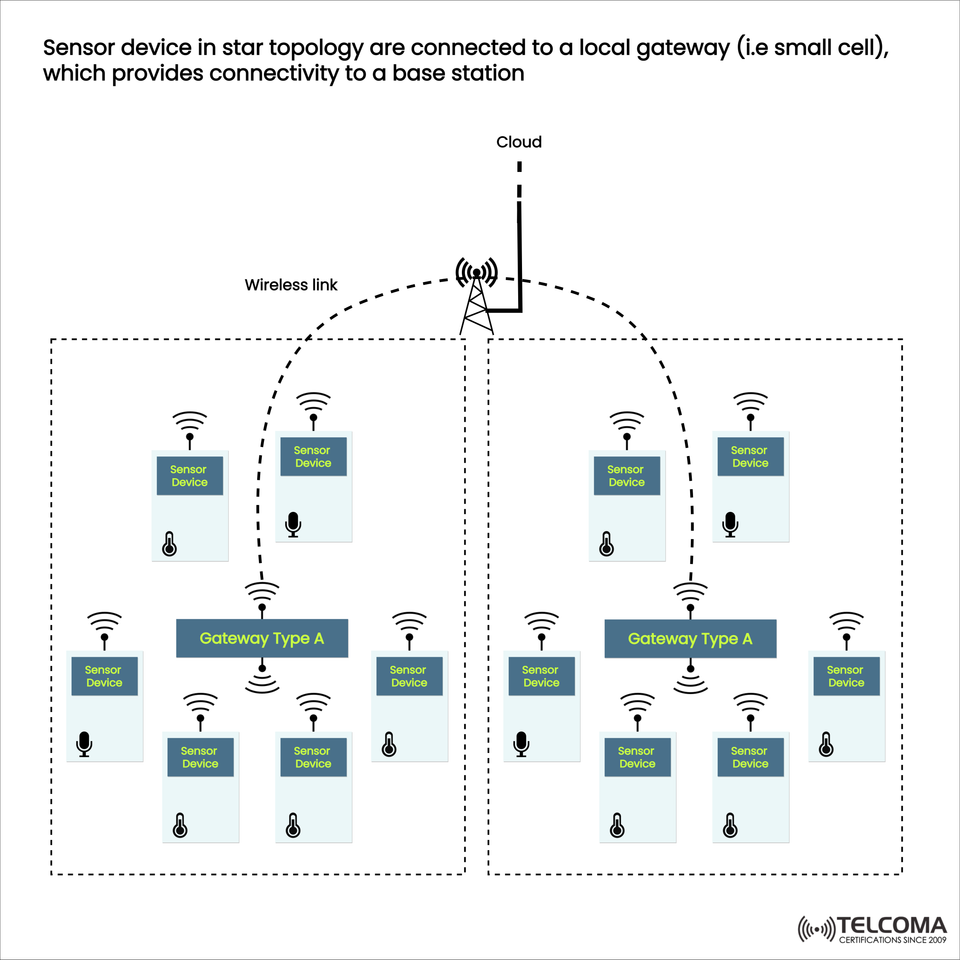

Star Topology in IoT Networks: How Sensor Devices Connect to Gateways and Base Stations
The Internet of Things (IoT) is growing rapidly, creating the need for strong, scalable, and energy-efficient communication systems. One of the most popular network layouts for IoT is star topology. In this setup, multiple sensor devices connect to a central point—a local gateway. This gateway then sends data to a base station and ultimately to the cloud.
The illustration above clearly shows the concept: several sensor devices are arranged in a star layout, all tied to a Gateway Type A (which acts like a small cell). This gateway creates a wireless connection to a base station, allowing for cloud access. This setup is essential for IoT applications in areas like smart cities, agriculture, industrial automation, and healthcare monitoring.
In this article, we’ll dive into the architecture, advantages, and technical aspects of star topology-based IoT networks, particularly focusing on how sensors communicate with gateways.
Understanding Star Topology in IoT
In star topology, every sensor device, whether it's a temperature sensor, microphone, or motion detector, communicates directly with a single central point—the gateway. Unlike mesh networks, where data has to jump from node to node, star topology simplifies matters by cutting out those extra hops, which reduces both complexity and delays.
Key Features of Star Topology
Centralized Communication: All devices talk straight to the gateway.
Low Complexity: No complex multi-hop routing is required.
Energy Efficient: Devices only send data when necessary, which saves battery life.
Scalable: It’s easy to add new devices without messing with the existing setup.
The Role of the Local Gateway (Small Cell)
The gateway acts as the hub of the network, collecting data from various sensors and sending it to the base station via a wireless connection. Sometimes, gateways are set up as small cells to boost coverage, especially in crowded IoT settings.
Functions of the Gateway
Data Collection: Gathers sensor readings and may compress or pre-process data before sending it on.
Protocol Conversion: Changes local communication methods (like LoRa, Zigbee, BLE) into cellular or IP-based signals for the uplink.
Edge Processing: Makes local decisions to cut down on unnecessary data back and forth.
Network Security: Takes care of authentication, encryption, and secure data forwarding to the base station.
Connecting to the Base Station and Cloud
The gateway links up with the base station through a wireless connection, which could be LTE, NB-IoT, or 5G NR. After that, the base station sends the data to the cloud platform where applications can analyze and visualize the information.
This three-layer setup (sensors → gateway → base station/cloud) ensures:
Reliable Data Delivery: Even in tough radio frequency conditions.
Centralized Management: Makes it easier to monitor and maintain devices.
Low Latency: Allows for near real-time IoT applications.
Advantages of Star Topology for IoT Sensor Networks
Advantage Explanation Energy Efficiency Direct communication cuts down on retransmissions, saving battery life. Simplified Deployment Easy to set up and expand without reworking routing protocols. Low Latency Direct communication ensures quick data transfer to the gateway. Scalability Can support many devices per gateway.
| Centralized Security | Security measures and updates can be handled at the gateway.
Use Cases for Star Topology with Gateways
This setup is commonly used across various industries that require low-power wide-area networks (LPWAN) or short-range IoT communication.
Smart Agriculture: Soil moisture and weather sensors send info to a gateway, which passes it to a cloud analytics system to manage irrigation.
Smart Cities: Parking sensors, streetlights, and environmental monitors link to gateways to enable citywide monitoring.
Industrial IoT: Vibration, pressure, and temperature sensors communicate with gateways for predictive maintenance of machinery.
Healthcare: Wearable devices connect to a local gateway in a hospital or home, allowing for continuous remote patient monitoring.
Challenges and Considerations
While star topology has many benefits, it’s not without its drawbacks and design hurdles:
Single Point of Failure: If the gateway goes down, all connected devices lose communication. Having backup gateways or failover strategies can help reduce this risk.
Range Limitations: Sensors need to be within the gateway's coverage area, so careful planning of deployment density is key.
Capacity Constraints: Each gateway can only support a limited number of devices and data throughput.
When designing a star topology network, it’s important to strike a balance between coverage, capacity, redundancy, and cost.
Star Topology vs. Mesh Topology
Feature Star Topology Mesh Topology Communication Path Single-hop (direct to gateway)Multi-hop (via neighboring nodes)Complexity Low High (requires routing protocols)Energy Consumption Low Higher due to multi-hop relays Scalability High (easy to add devices)Moderate (grows with routing tables)Fault Tolerance Low (gateway failure critical)High (multiple paths available)
For IoT uses that value low energy consumption and straightforward network management, star topology is usually the go-to choice.
Security in Star Topology IoT Networks
Security is super important, especially since gateways are the connectors to the internet. Some good practices include:
Mutual Authentication: Between sensors and gateways.
End-to-End Encryption: To keep data safe from prying eyes.
Regular Firmware Updates: For both devices and gateways.
Gateway Firewalls: To block unauthorized access.
Conclusion
Star topology, paired with local gateways, stands as a fundamental part of modern IoT network design. It supports reliable, low-power, and scalable connections. By collecting data from multiple sensors and sending it off to base stations and the cloud, this setup serves as a strong foundation for various applications—from smart cities to industrial automation.
Telecom experts and IoT solution architects need to think carefully about where to place gateways, how to plan for capacity, and what security measures to put in place to ensure smooth operation. As 5G and LPWAN technologies keep advancing, star topology will continue to play a vital role in connecting millions of IoT devices around the globe.