
Subscription-Based MDT in Telecom: Architecture, Workflow, and Benefits

Introduction
As telecom networks adapt to the growing need for fast, dependable, and smart connectivity, keeping an eye on network performance has become super important. In the past, operators depended on drive tests, where engineers gathered network data by driving around in their cars. But let’s be real—these methods are pricey, take a lot of time, and are pretty limited.
To tackle these issues, 3GPP came up with MDT (Minimization of Drive Tests). MDT lets operators use real-time data from users' devices, so they can skip the extensive drive testing. A key part of MDT is Subscription-Based MDT (SB-MDT).
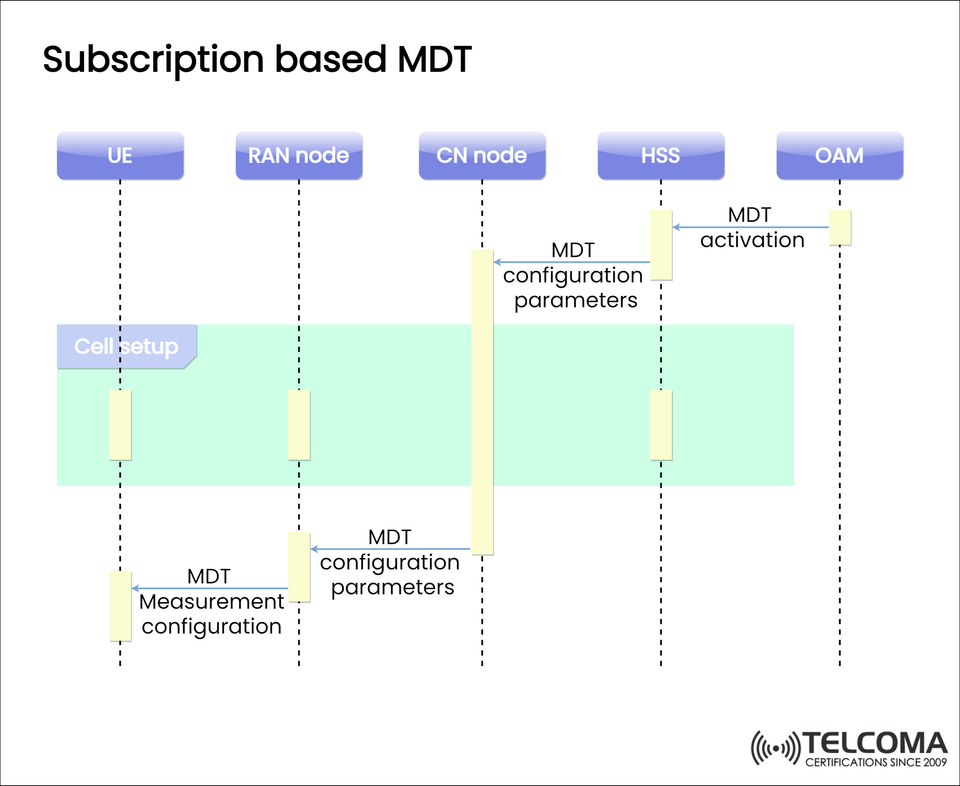
The diagram uploaded shows the workflow for Subscription-Based MDT, illustrating how different parts of the network, like UE, RAN node, CN node, HSS, and OAM, work together during the measurement process.
What is Subscription-Based MDT?
Subscription-Based MDT is a system where measurement collection kicks in based on a user’s subscription profile. Instead of triggering MDT on the fly like event-based methods, SB-MDT makes sure that measurements are set up whenever the subscriber’s session is active.
To put it simply:
SB-MDT allows for long-term measurement collection linked to the subscriber’s profile in the HSS.
It gathers data automatically without any manual effort or repeated setups.
This approach is particularly handy for network operators who want to keep tabs on user experiences consistently throughout the network.
Components Involved in Subscription-Based MDT
From the diagram, we can spot the main components that make SB-MDT work:
- UE (User Equipment)
Devices like smartphones, tablets, or IoT devices.
They’re responsible for gathering radio measurements like signal strength (RSRP, RSRQ), call drops, handovers, and coverage gaps.
- RAN Node
Part of the Radio Access Network.
Receives MDT setup parameters from the Core Network.
Configures UEs for measurements.
- CN Node (Core Network Node)
Serves as the main hub for sending MDT parameters.
Ensures a smooth flow of settings across HSS, RAN, and UE.
- HSS (Home Subscriber Server)
Holds user profiles and subscription details.
Contains the MDT subscription profile, which indicates if a user’s device should perform MDT.
When activated, it gives MDT settings to the CN node.
- OAM (Operations, Administration, and Maintenance)
Manages network performance and administrative tasks.
Activates MDT subscriptions in the HSS and gathers collected measurement data.
Workflow of Subscription-Based MDT
The steps for subscription-based MDT can be broken down as follows, according to the diagram:
MDT Activation via OAM: The OAM system sets up MDT for specific users by activating it in the HSS.
HSS Profile Update: The HSS saves the MDT subscription parameters (like the type of measurement and reporting conditions).
CN Node Receives MDT Parameters: When a subscriber's session starts, the CN node fetches MDT configuration from the HSS.
RAN Node Configuration: The CN node sends MDT parameters to the RAN node, which applies these settings to the UE.
UE Measurement Collection: The UE begins collecting measurements according to the subscription profile and sends reports through the RAN and CN nodes for storage and analysis.
OAM Data Processing: The gathered reports get aggregated at OAM, allowing operators to analyze the results for coverage optimization, mobility management, and interference detection.
Benefits of Subscription-Based MDT
When operators implement Subscription-Based MDT, they enjoy several advantages:
- Continuous Measurement Collection
Data is collected automatically as part of the subscriber's profile.
Ensures consistent long-term monitoring without needing manual reconfigurations.
- Cost Savings
Cuts down on the reliance on pricey drive tests.
Provides much wider data coverage, including indoors and in rural areas.
- Subscriber-Centric Insights
Since MDT relates to the subscriber profile, the data shows the real Quality of Experience (QoE).
Aids in optimizing performance based on what customers actually experience.
- Improved Network Optimization
Helps pinpoint coverage gaps, mobility challenges, and interference zones.
Aids in tuning network parameters for improved efficiency.
- Regulatory Reporting
Makes it easier to meet regulatory requirements for network coverage and performance reporting.
Subscription-Based MDT vs. Event-Based MDT
To grasp SB-MDT better, let’s look at how it stacks up against event-based MDT (EB-MDT):
Aspect Subscription-Based MDT Event-Based MDT Trigger Based on subscriber profile in HSS Based on specific network events (like call drops)Activation Long-term, persistent Temporary, on-demand Use Case Continuous monitoring of user experience Trouble shooting specific network issues Flexibility Less flexible, but consistent Highly flexible, event-driven Data Scope Wide coverage across sessions Focused on specific problem areas
Use Cases of Subscription-Based MDT
SB-MDT plays a key role in today’s telecom landscape:
Long-term Coverage Analysis: Ongoing monitoring helps highlight long-standing coverage challenges.
QoE Assurance for Premium Users: Operators can focus SB-MDT on high-value customers to guarantee quality.
Indoor Performance Monitoring: Gathers data in places where drive tests just aren’t practical.
5G and IoT Optimization: Offers insights into how new services perform across various devices and settings.
Regulatory Audits: Gives operators standardized data for compliance reports.
Challenges of Subscription-Based MDT
Despite being effective, SB-MDT comes with its own set of challenges that operators need to address:
Data Volume: Ongoing measurement collection can produce vast amounts of data.
Battery Impact on UEs: Frequent measurement reporting could drain device batteries.
Configuration Complexity: Coordination among OAM, HSS, CN, and RAN requires careful management.
Privacy Concerns: It's essential to ensure that user data remains anonymized and securely stored.
Future of Subscription-Based MDT
With the rise of 5G and beyond, Subscription-Based MDT is set to evolve further:
Integrating with AI/ML for automated anomaly detection and predictive optimization.
Better support for network slicing, making sure quality is maintained for specific services like AR/VR or self-driving vehicles.
More alignment with edge computing for real-time analytics.
As networks get more intricate, subscription-based MDT will be vital for self-optimizing networks (SONs), where performance management is done automatically and adaptively.
Conclusion
Subscription-Based MDT is a valuable tool that allows telecom operators to keep a close watch on network performance tied to subscriber profiles. By utilizing data from UEs, configurations from RAN, processing from CN, storage in HSS, and analysis from OAM, operators gain deep insights into coverage, mobility, and user experience without solely relying on traditional drive tests.
Even though challenges like data volume and device impact exist, the benefits of cost efficiency, subscriber-focused monitoring, and enhanced QoE make subscription-based MDT a fundamental part of modern telecom performance management.
As networks transition into 5G and beyond, SB-MDT will grow even more crucial for fostering intelligent, self-optimizing, and customer-centric networks.