
Synergized Mobile Edge Cloud Architecture: Bridging 3GPP Networks and ETSI MEC Systems
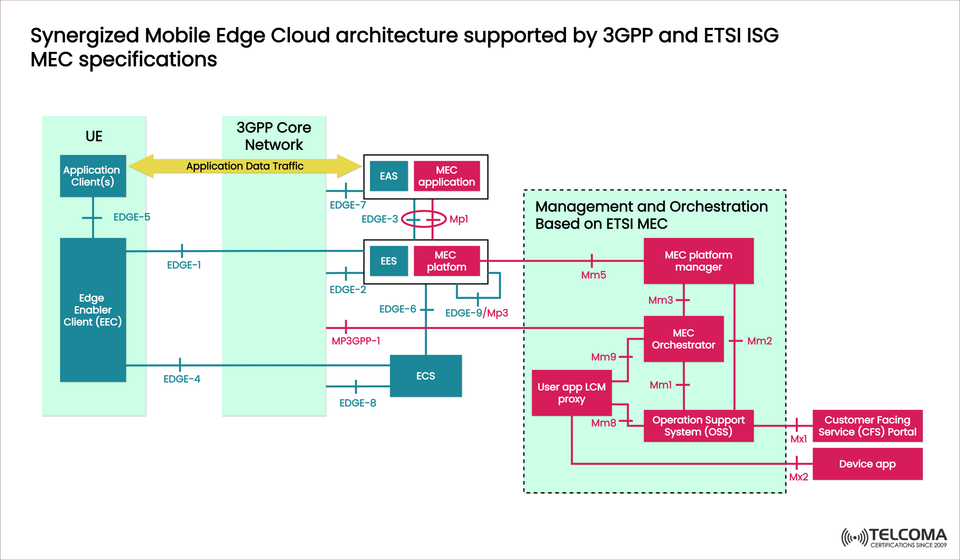

Mobile Edge Cloud Architecture: Merging 3GPP and ETSI MEC for Future Networks As telecom networks move towards 5G and beyond, the need for low-latency processing, smart orchestration, and distributed computing keeps increasing. The concept of Mobile Edge Cloud (MEC) mixes ETSI ISG MEC specs with the 3GPP Core Network, creating a combined Mobile Edge Cloud architecture.
This setup enables mobile operators to provide real-time services, intelligent edge capabilities, and better traffic management. The diagram included clearly shows how the 3GPP core functionalities connect with the ETSI MEC orchestration layers to form an effective architecture for edge service delivery.
Why MEC and 3GPP Integration Matters In conventional cloud computing, data moves from user equipment (UE) to centralized data centers, leading to latency and bandwidth issues. Multi-access Edge Computing (MEC) helps by processing data at the network edge, which is closer to users and IoT devices.
On the other hand, 3GPP lays out core network functions that handle connectivity, mobility management, and policy enforcement. When you pair 3GPP networks with MEC platforms, operators can:
Place computing resources nearer to users.
Enhance responsiveness for real-time services.
Optimize backhaul and network usage.
Support edge-centric applications like AR/VR, self-driving cars, and industrial IoT.
So, ETSI MEC provides the edge intelligence and application layer, while 3GPP brings in solid connectivity and governance, creating a harmonized ecosystem for next-gen telecom solutions.
Overview of the Architecture The diagram outlines how various components work together within the Synergized Mobile Edge Cloud Architecture. It generally includes:
User Equipment (UE) – The device that runs applications.
3GPP Core Network – Oversees connectivity and data traffic.
MEC Platform and Applications – Offer edge services close to users.
Management and Orchestration Layer – Manages lifecycle, orchestration, and operational support.
Let's dig into each part a bit more.
- User Equipment (UE) and Edge Enabler Client (EEC) The User Equipment (UE) is the mobile device or IoT terminal that connects with MEC applications.
Within the UE, the Edge Enabler Client (EEC) acts as a bridge between the user’s app and the MEC platform.
Key Functions of the EEC:
Connects with MEC services using standard EDGE-1, EDGE-4, and EDGE-5 reference points.
Finds nearby MEC applications through EDGE-2 signaling.
Manages app lifecycle interactions via APIs from MEC orchestration.
In short, the EEC allows user devices to interact with edge environments dynamically — choosing the best MEC servers based on distance, latency, or performance.
- Integrating the 3GPP Core Network The 3GPP Core Network forms the backbone of this integrated architecture. It manages application data traffic between UE and MEC applications through the EDGE-7 reference point.
This integration helps keep the data path efficient and allows control signaling for smooth mobility and policy enforcement. The MP3GPP-1 interface makes sure that MEC system components and 3GPP network elements coordinate properly, ensuring service continuity as users transition across network boundaries.
- MEC Applications (EAS) and MEC Platform (EES) ### MEC Applications (EAS): These are specialized services deployed at the edge, including:
Video analytics
Augmented Reality (AR) rendering
Location-based services
Edge content caching
They interact with both the 3GPP network and user devices to deliver quick, context-aware experiences. The Mp1 interface connects the MEC Application (EAS) with the MEC Platform (EES) for service requests, policy control, and event management.
MEC Platform (EES): The EES hosts MEC applications and provides standardized APIs to external apps. It offers:
Service discovery and registration
DNS and traffic routing
Security and resource monitoring
The platform also communicates with the Edge Configuration Server (ECS) to ensure service availability and provisioning.
- Edge Configuration Server (ECS) The ECS plays a key role in the MEC system. It manages:
Application discovery and registration
Service configuration and policy management
Coordination between MEC platforms and orchestrators
It connects with MEC components through EDGE-6, EDGE-8, and EDGE-9/Mp3 interfaces to ensure effective placement and execution of edge services.
- Management and Orchestration via ETSI MEC The right side of the diagram (marked in green) illustrates Management and Orchestration (MANO) — a vital area that guarantees the efficient operation of all MEC resources and services.
a. MEC Platform Manager Oversees MEC platform setup, faults, and performance.
Interface: Mm5 connects it to the MEC platforms.
b. MEC Orchestrator This is the brain of the MEC system, responsible for:
Application lifecycle management
Resource allocation and scaling
Coordination with 3GPP core functions
It communicates with the platform manager via Mm3, links with the Operations Support System (OSS) through Mm1, and connects to the User App LCM Proxy via Mm2.
c. User App LCM Proxy This proxy manages user application lifecycle. It allows external users or clients to deploy, start, stop, and monitor MEC applications using APIs. Interfaces Mm8 and Mm9 connect it to the OSS and Orchestrator.
d. Operation Support System (OSS) The OSS connects the MEC system to the operator’s business processes. It interacts with:
Customer Facing Service (CFS) Portal (Mx1) – for service distribution and customer management.
Device App (Mx2) – for device-level service management.
This orchestration model ensures smooth management across MEC and 3GPP domains.
- Reference Points and Interfaces The architecture outlines several standardized interfaces for seamless operations:
Reference PointFunctionEDGE-1 / EDGE-4 / EDGE-5UE-to-EEC communicationEDGE-2EEC to MEC platform discoveryEDGE-3 (Mp1)MEC App ↔ MEC Platform communicationEDGE-6 / EDGE-8 / EDGE-9MEC platform ↔ ECS controlMm1 / Mm2 / Mm3 / Mm5ETSI MEC orchestration interfacesMx1 / Mx2OSS to external service portals
These interfaces make sure that 3GPP and ETSI systems can work together, granting flexibility in deploying and scaling edge services.
Advantages of Merging MEC and 3GPP Architecture
Ultra-Low Latency: Data processed at the edge cuts down on delays.
Dynamic Service Orchestration: The MEC orchestrator streamlines deployment and scaling.
Network Efficiency: Better traffic routing eases backhaul congestion.
Seamless Mobility: Keeps services consistent even as users shift between cells.
Scalable Ecosystem: Supports collaboration among different vendors and open APIs.
Final Thoughts:
The Synergized Mobile Edge Cloud Architecture — shaped by both 3GPP and ETSI MEC — marks a significant leap towards fully integrated, intelligent, distributed telecom networks.
By aligning 3GPP’s solid connectivity framework with MEC’s edge capabilities, operators can offer real-time experiences, enhanced QoS, and automated networks for various applications. From smart cities to self-driving technologies, this model sets the stage for a genuinely connected future.
Overall, the synergy between 3GPP and ETSI MEC isn’t just an architectural upgrade — it’s a foundational element for the 5G and 6G era, paving the way for the digital edge to fuel tomorrow’s innovations today.