
System Context for Autonomic Networking Operation in 5G Networks
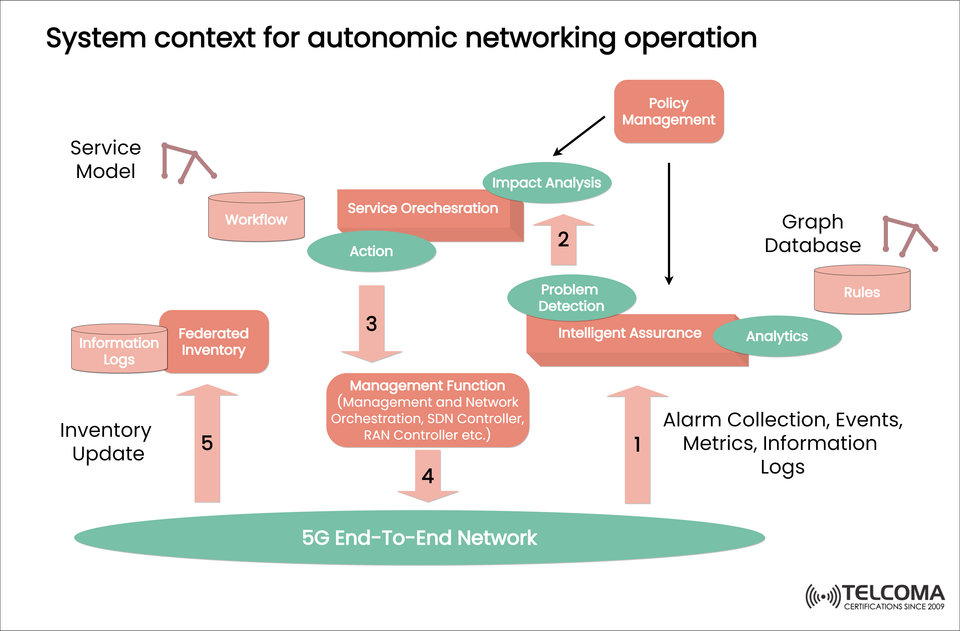

Understanding the System Context for Autonomic Networking Operation in 5G Network
As the complexity involved in 5G Networks continues to rise through interdependencies, there is an increased need for intelligent self-operating systems. Autonomic networking, where networks can self-manage, self-heal, and self-optimize is core to a building block of telecom infrastructure. The image above provides an overall view of the system context required for autonomic networking operations within 5G networks, even taking into account end-to-end provisioned 5G networks.
This article considers each element in achieving autonomic networking operations, creating understanding for professionals in telecommunications, engineers operating networks, and technology enthusiasts.
Key elements of autonomic networking operation
The image shows a closed loop data collection, data analytics, and action, constructing continuous optimization. Below is a description of functionality for the various stages of operation:
- Data Collection and Intelligent Assurance
Input: Alarm collections, event data, metric data, and other information logs.
Function: Once collected, this data is channeled to the Intelligent Assurance system. Tools Used for analytics and analysis of historical and real-time data.
These will include: Analytics to analyze the data of history and real-time.
Rules & Policies held in Graph Database.
2. Detecting Problems and Impact Evaluation
Problem Detector: Evaluates the Intelligent Assurance System inputs to see if there is a possible network issue or problem identified, or if there is currently live network issue.
- Service Orchestration and Action Service Orchestration: translates decisions into actions (at the network level) based on workflows. Action Module: implements corrective or optimization actions. Workflow Implementation: specifies how changes are made based on a Service Model.
- Execution of Management Function Where Management Function Action: 5G Management and Network Orchestration Management Function: - Deutsche Telekom SDN Controller Management Function: - Deutsche Telekom RAN Controller Purpose: to implement changes in a 5G network, acting on the orchestration actions.
- Federated Inventory and Feedback Loop - Following action implementation, pertinent updates of the Federated Inventory will be identified and sent. - Updated helpful logs will provide a feed-back loop into an assurance system that can improve action decisions in the future.
Overview of the workflow.
Step Explanatory Summary Input(s)
1 Collect Network Artefacts Alarms, Metrics, Logs
2 Take Action, Analyze & Detect issues Intelligent Assurance , Impact Analysis
3 Decide and Orchestrate Service Orchestration / Action
4 Execute Changes Do to/ Network Controllers/ SDN/RAN
5 Update Federated Inventory Logs
Why Autonomic Networking is essential for 5G: - 5G Networks will require agile, low latency access and massive connectivity. It is impossible to deploy operational processes that have significant manual operations, at enterprise scale, in practice.
Autonomic Networking enables: - the detection and response to faults and performance degradations, be in milliseconds; - the development of a decision based on established policies, that can be implemented autonomously; - the scalability of complex heterogeneous environments with devices; - The adaption of services to update and change performance requirements, based on real-time data for services such as URLLC and eMBB
Real-World Uses of Autonomic Networking in 5G
As the 5G use cases become more ubiquitous — like autonomous vehicles and remote surgery — the issues around reliability, resiliency, and performance become business-critical. Below are real-world use cases of automic networking in actual implementations:
- Network Slicing
Autonomic networks allocate resources dynamically to multiple virtual networks (called slices), optimizing performance and scalability for different services (e.g., IoT, gaming, enterprise).
Example: An autonomic network ensures low-latency experience for AR/VR, while maintaining higher level throughput for HD video streaming.
Benefit: Improves performance against SLA's, and user experience. - Fault Management
An autonomic system can recognize a fault (i.e., congestion or hardware failure) and dynamically enact healing strategies automatically and continuously.
Example: Automatically finding a new route for traffic in real-time due to a fiber being cut.
Benefit: Minimizes downtime and decreases operational costs. - Energy Efficiency
Networks can power down cells that are unused and reroute traffic as a result of intelligent assurance.
Example: Small cells can be turned off at off-peak times, while macro cells serve the traffic.
Benefit:
Decrease carbon footprint and Opex.
The role of AI and ML in Autonomic Networks
AI and machine learning play an underpinning role in autonomic networking starting from the analytics and decision-making stages.
Key Functions Enabled by AI/ML: Predictive Maintenance: Predicts component failures before they happen. Anomaly Detection: Recognizes variations or departures from the normal behavior. Intent-based networking (IBN): Automates service deployment based on the desired result. Closed-loop automation: Monitors, learns, and adapts network behavior without a human in the loop.
Benefits of Autonomic Networking for Telecommunications.
Benefits. Description.
Operational Efficiency: Not requiring human intervention means efficiency through automation.
Faster Repairs.: Utilizing AI based analytics delivers insights on determining failure mode, and fixes much quicker than a manual process.
Network Resilience: Self-healing capabilities help service providers extend uptime.
Scalability: Handles thousands of connected devices and changing workloads.
Reduced OPEX: Automated operation reduces costs through less human error, and manual operation.
Improved QoS/QoE: Provides better experience, with the ability to optimize behavior proactively.
Challenges and Considerations
There are, however, challenges and things to think about with autonomic networking, including:
Siloed Data: Disparate data sources can result in inaccurate analytics.
Policy Conflicts: Incompatible policies overlap or conflict with one another resulting in contradictory actions.
Security: Automation of responsibilities requires that the decisions made in an automated fashion not be accessed and manipulated.
Standardization: There is little standardized process across industries.
Looking ahead, Autonomic networking is likely to become even more integral moving into the 6G world. We look forward to:
Greater edge-AI integration, ultra-low latency, and improved user experience.
Possibly, complete zero-touch network operation (ZTO).
Increased autonomous duties.
Conclusion
The system context for autonomic networking functionality offers a compelling framework for the management of complex 5G networks. By bringing together intelligent assurance, policy management, and orchestration workflows, telecom operators can enable an automated, real-time response to events within their network.
Adoption of a similar model brings potential improvements to operational efficiency while providing networks with a path forward for the extreme demands of IoT, edge computing, and eventual 6G evolution. For those in the telecom industry, learning and adopting such architecture is not a matter of 'if', but 'when' .