
System Integration for Cloud-Based Mobile Core: Design to Deployment

System Integration for Cloud Native Mobile Core: A Complete Manual for the Telecom Professional
As telecom networks transition to 5G and advanced networks, cloud native architectures are becoming the backbone of modern mobile core deployments. System Integration is the core of this evolution and represents the multi-phase, multi-collaborative complexity associated with ensuring the cloud based mobile core components operate seamlessly and meeting the performance, reliability and scalability thresholds.
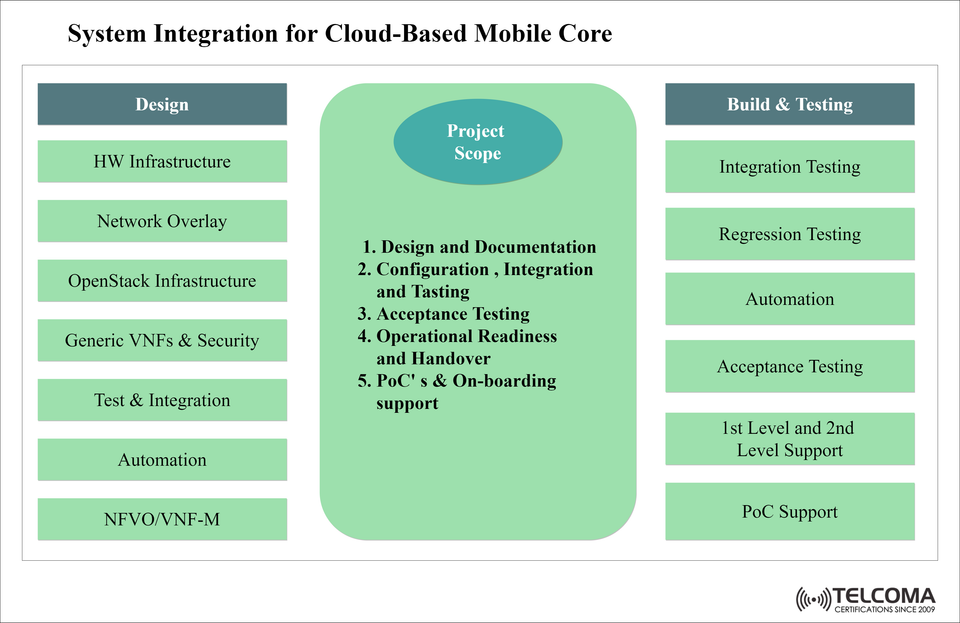
The above image illustrates the comprehensive integration lifecycle process for a cloud based mobile core covering design, testing and operational readiness. This manual will break down each component to provide a clear and technical oriented playbook for network engineers, network architects and decision makers.
🔧 What is Cloud Based Mobile Core Integration?
System Integration for the cloud based mobile core includes design, deployment, validation and support of virtualized core network functions on a cloud platform (OpenStack, Kubernetes or NFV in cloud architecture and other infrastructure).
It is aligned with technologies such as:
vEPC / 5GC
VNF / CNF orchestration
Network slicing
Service based architecture (SBA)
🧩 Core Project Scope
The integration lifecycle consists of four major phases:
Design and Documentation
Creating a technical blueprint including hardware, cloud stack and VNFs.
Configuration, Integration and Testing
Deployment and validation of interconnectivity between cloud infrastructure and VNFs.
Acceptance Testing
Validate performance.
🧱 Design Components
Design Component Description
HW Infrastructure Include compute, storage and networking resources needed for the NFV infrastructure.
Network Overlay Example L2/L3 networks (VXLAN, VLAN) for connecting VNFs.
OpenStack Infrastructure Virtual resources and services in Cloud infrastructure.
Generic VNFs & Security Considering cyber security and deployment of generic VNFs (MME, SGW, PGW, AMF, SMF, etc.).
Test & Integration Conducting end-to-end service verification across VNFs as well as OSS/BSS systems.
Automation Management tools for CI/CD, Lifecycle or orchestrate/management (i.e., Ansible, Helm).
NFVO/VNF-M NFV Orchestrator and VNF Managers enabling the organization to scale services, as well as enabling the healing。
🧪 Build and Testing Activities
Build Activity What
Integration Testing Test that VNFs work together collaboratively in an end-to-end manner.
Regression Testing Confirm that new deployments or patches do not break existing functionality or existing VNFs.
Automation Automation enables you to conduct faster repeat testing using scripts and orchestration platforms.
🚀 Future Thoughts
Considering future integrations AT&T will concentrate on the path to 5G Standalone (SA) and 6G will include:
Containerized Network Functions (CNF using Kubernetes.
AI enabled predictive maintenance used in automating the network.
Zero touch and self healing networks.
Edge cloud initiatives to support ultra-low latency applications.
🔚 Conclusion
System integration of cloud-based core is the start of agile, future state telecom infrastructure. It is as important to track and evaluate throughout each step from design to testing and support when ensuring virtual network functions are integrated right into a cloud based system.
Telecom personnel must not only understand the telecommunications components, but also ensure that they are working toward a business integration strategy that aligns with new technologies and continually evolving integrations. The structured automation will be critical to success during 5G/coupled with cloudnative core integration.
🏗️ Real Word Implementation Examples
- Greenfield 5G Standalone Deployment
A new 5G Standalone operator deploying a fork of OpenStack or k8s can make full use of cloud-native mobile core integration; by deploying virtualization using containerized VNFs such as:
AMF (Access Management Function)
SMF (Session Management Function)
UPF (User Plane Function)
Such initiatives will require a tightly coupled integration cycle as seen in each of the steps as referenced in the diagram; especially with regard to:
OpenStack infra layout
Overlay network (vxlan) design
NFVO/VNF-M configuration
- Transitioning from Legacy EPC to vEPC
Operators transitioning from 4G EPC to vEPC have the option of hybrid core deployment:
Combine legacy and virtual elements (i.e. virtual MME, SGW, PGW)
Have heavy regression and acceptance testing
Take advantage of automation for rollback or rollback-enabled upgrades
- Private 5G Network Incorporation
Enterprise focused use cases (factories, hospitals, campuses) require:
Easy-to-understand design templates
Fast proof of concepts (PoCs)
Integrate with IT tools (CI/CD pipelines, DevOps, etc.)
Provided that the deadlines for projects is often constrained, automating and validating tests are essential.
🔧 Commonly Used Tools and Technologies
Function Tools/Frameworks
Cloud Management OpenStack, Kubernetes, VMware Telco Cloud
Automation Ansible, Terraform, Helm, Jenkins
VNF Lifecycle ETSI compliant NFVO/VNF-M, OSM, ONAP
Testing Robot Framework, TestRail, TOSCA, custom scripts
Monitoring Prometheus, Grafana, ELK Stack, Zabbix
CI/CD GitLab CI, ArgoCD, Spinnaker
📝 Best Practices for Cloud-based Core Integration
Design for Scalability: For example, use modular designs that facilitate simple scaling to scale out for pooled resources.
Automate Everything: Use CDD/CD and Infrastructure-as-code Day 0 through Day N.
Standards and Vendor Neutral: Align to ETSI MANO, O-RAN, and 3GPP specs.
Test Early: Early acceptance testing should be conducted in a lab environment before staging.
Monitor Everything: Build observability across every layer to provide operational visibility.
📈 How Telcos Should Get Ready For The Cloud-Native Future
To remain competitive in the telecom arena, telco providers should be taking the following steps:
Invest in cloud-native skill-building across engineering and operations disciplines.
Build centralized integration teams that include telco and IT/cloud knowledge.
Focus on platform consolidation, including a way to manage both 4G and 5G cores.
Work with vendors that provide the VNF/CNF lifecycle support and PoC engagement.
Create strong feedback loops between design, testing, and operations.
🎯 Conclusion
The cloud-native mobile core should not be seen solely as a technology shift — it’s a must-have for operators who want high levels of agility, scale and a competitive advantage in services that is truly differentiated.
A well-integrated system delivers a reliable functioning 5G network — from hardware, OpenStack design, testing, automation and PoC support.
For those who live and breathe mobile core networks, understanding this integration lifecycle is paramount. For everyone else who is thinking about deploying mobile core networks whether you are a brand new greenfield 5G core, migrating legacy infrastructure to cloud-native, or enabling some cool enterprise use case - this foundational guide provides you with a realistic framework for success.