
Technical Areas of Open RAN: Interfaces, Virtualization, and RIC Intelligence

Technical Areas of Open RAN: Interfaces, Virtualization, and Intelligence
The telecom industry is quickly embracing Open Radio Access Networks (Open RAN) as the future of wireless infrastructure. Open RAN moves away from traditional vendor-locked, closed RAN systems and brings in openness, modularity, and intelligence into the design of networks.
At its heart, Open RAN is built on four key technical areas:
Open Interfaces
Virtualization of network functions
RAN Intelligence through RIC (RAN Intelligent Controller)
Disaggregated hardware and software
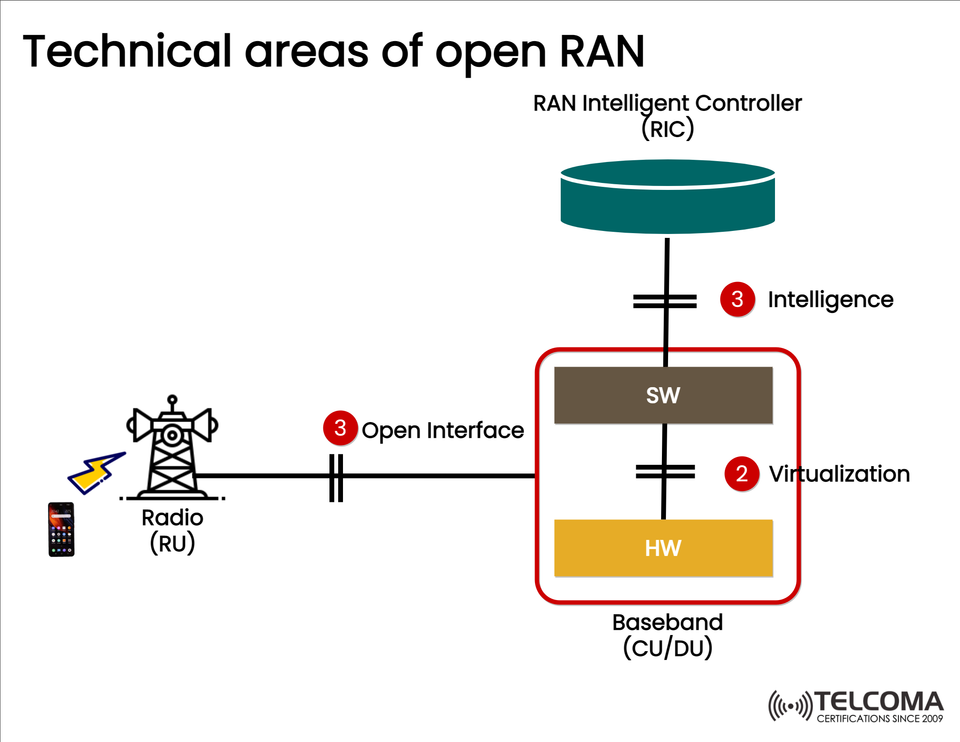
The diagram we've shared illustrates these building blocks of Open RAN, showing how the Radio Unit (RU), Baseband (CU/DU), and the RIC intelligence layer interact through open, software-driven, and virtualized architectures.
In this blog, we’re going to dig into each technical area, explain why they’re important, and outline how these innovations allow for scalability, flexibility, and cost-efficiency in modern 5G networks.
Why Open RAN Matters
Traditional RAN setups rely on vertically integrated solutions, where the Radio Unit, Baseband, and software are all sourced from one vendor. While this approach is stable, it limits flexibility and stifles innovation.
Open RAN, however, breaks the RAN apart into modular components that come with standardized interfaces. This setup lets operators:
Mix and match components from different vendors.
Utilize cloud-native technologies for better scalability.
Add intelligence for real-time optimization.
Cut costs by using commoditized hardware.
Now, let’s dive into the three main technical areas in more detail.
Open Interfaces in Open RAN
What are Open Interfaces?
Open interfaces are standardized communication links that allow for interoperability between components from different vendors in the RAN. Instead of using proprietary connections, Open RAN defines open fronthaul, midhaul, and backhaul interfaces.
Key Interfaces in Open RAN:
Fronthaul: Links the RU (Radio Unit) to the DU (Distributed Unit).
Midhaul: Connects DU to the CU (Centralized Unit).
Backhaul: Connects CU to the 5G Core network.
Why They Matter
They enable multi-vendor ecosystems—operators can choose RUs from one vendor, DUs from another, and CUs from yet another.
They promote innovation by welcoming new players into the ecosystem.
They decrease vendor lock-in and cut costs.
Challenges
Keeping performance consistent across different vendor components can be tricky.
There’s a risk of security vulnerabilities with more open interfaces.
Virtualization in Open RAN
What is Virtualization?
In Open RAN, virtualization means running RAN functions—CU and DU—on general-purpose hardware (COTS servers) instead of using specialized hardware.
The diagram highlights virtualization by showing how the baseband unit (CU/DU) is divided into:
Hardware (HW): Commodity servers, accelerators, and NFVI (Network Function Virtualization Infrastructure).
Software (SW): Virtualized network functions and control logic.
Benefits of Virtualization
Flexibility: Deploy CU/DU functions as needed at the far edge, near edge, or in central offices.
Scalability: Scale resources up or down based on demand.
Efficiency: Make the best use of resources and save on energy.
Cloud-Native Operations: Work with orchestration platforms like Kubernetes to automate processes.
Examples
A vDU (virtual DU) running as a containerized application on edge servers.
A vCU (virtual CU) managing multiple DUs virtually from central offices.
Challenges
Requires high-performance accelerators for real-time processing.
Latency-sensitive functions (like DU) have to be closer to the edge.
Adds complexity to orchestration and lifecycle management.
- Intelligence through RIC (RAN Intelligent Controller)
What is the RIC?
The RAN Intelligent Controller (RIC) serves as the brain of Open RAN. It brings in programmability, automation, and optimization through xApps (near-real-time) and rApps (non-real-time).
Two Types of RIC:
Near-Real-Time RIC (near-RT RIC): Operates within timescales of 10 ms to 1 second, managing resource optimization, mobility management, and interference control.
Non-Real-Time RIC (non-RT RIC): Works on timescales greater than 1 second, focusing on policy control, SLA assurance, and training ML models.
Why RIC Matters
It drives AI/ML optimization of network functions.
Automates coverage, capacity, and load balancing across the network.
Encourages third-party developers to create xApps and rApps, leading to more innovation.
Example Use Cases
Energy Saving: Dynamically turning off RUs during low traffic.
Mobility Optimization: Predicting user movement to improve handovers.
QoS Assurance: Maintaining SLA compliance in real time.
- Disaggregation of Hardware and Software
Besides interfaces, virtualization, and intelligence, another key aspect is hardware-software disaggregation.
Traditional Model
In the past, hardware and software were tightly bundled in vendor-proprietary solutions.
Open RAN Model
Hardware (HW): Standardized, COTS servers and accelerators.
Software (SW): Runs independently of the hardware, functioning as virtualized components.
Benefits
Operators can upgrade software without needing to replace hardware.
Enhances cost-efficiency by relying on generic servers, rather than specialized equipment.
Facilitates faster innovation cycles.
Comparison Table: Technical Areas of Open RAN
Technical Area Role in Open RAN Benefits Challenges Open Interfaces Standardized RU-DU-CU links Multi-vendor, flexibility Security, interoperability Virtualization CU/DU on COTS hardware Flexibility, scalability, cost savings Latency, orchestration complexity RIC Intelligence Optimization via x Apps & r Apps AI-driven automation, innovation App security, complexity HW-SW Disaggregation Independent layers Lower costs, flexibility Integration challenges
Future Outlook: Where Open RAN is Heading
The growth of Open RAN is in sync with the goals of 5G and beyond (6G), which emphasize openness, automation, and intelligence.
AI-driven networks: The RIC will evolve to become more autonomous, enabling self-optimizing networks (SONs).
Edge Cloud Integration: Virtualized DUs and MEC applications will share the same edge infrastructure.
Stronger Ecosystems: With open interfaces, operators will be able to create tailored ecosystems of vendors, developers, and integrators.
Security by Design: As the landscape expands, end-to-end security across virtualization and open interfaces will be crucial.
Conclusion
The technical areas of Open RAN—Open Interfaces, Virtualization, RIC Intelligence, and HW-SW Disaggregation—are key to next-gen mobile networks. Together, they promote flexibility, cost savings, and innovation in ways that traditional RAN simply can’t.
That said, they also bring new challenges related to interoperability, orchestration, and security. For telecom operators, doing well with Open RAN will hinge on finding the right balance between openness, performance, and security.
As Open RAN develops, it won't just complement existing structures but will likely shape the future architecture of 5G and 6G networks, leading to a more open, intelligent, and future-ready telecom infrastructure.