
TETRA Architecture Explained: Gateway, Controller, and ISI Interface

Introduction: Why TETRA Still Matters
In the realm of critical communications, TETRA (Terrestrial Trunked Radio) stands out as a key standard. Created by ETSI, TETRA is widely adopted in sectors like public safety, transport, utilities, and defense. It provides secure, reliable, and mission-critical communications that organizations depend on to avoid downtime or poor coverage.
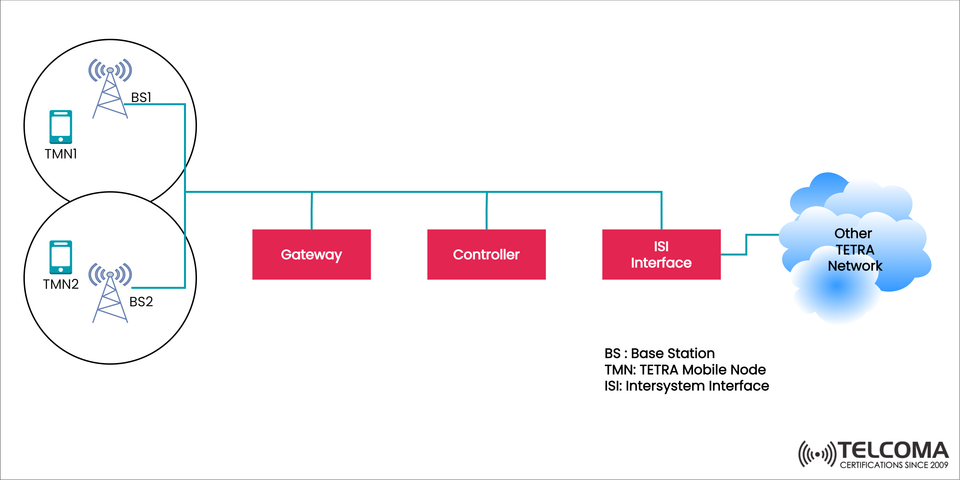
The diagram uploaded shows the TETRA network architecture, highlighting how base stations, mobile nodes, and the control layer—comprising gateways, controllers, and the ISI (Intersystem Interface)—interact. Grasping this architecture is essential to see how TETRA ensures smooth communication and interoperability between networks.
Core Components of TETRA Architecture
The architecture breaks down into two layers: the access layer and the core management layer.
- Base Stations (BS)
In the diagram, BS1 and BS2 represent radio base stations.
These radio access points link TETRA Mobile Nodes (TMN1 and TMN2) to the main network.
Base stations provide:
Coverage over geographical areas.
Communication links for voice and data.
Resource allocation and synchronization with the controller.
- TETRA Mobile Nodes (TMN)
TMN1 and TMN2 stand for user devices, like handheld radios or vehicle-mounted units.
Mobile nodes connect to the closest base station (BS1 or BS2).
Main functions include:
Secure group and individual calls.
Messaging and status updates.
Support for data services alongside voice.
- Gateway
The Gateway links the radio access layer to outside networks.
It handles call routing, session management, and interoperability with public switched telephone networks (PSTN) or IP-based systems.
Plays a crucial role in maintaining smooth external communication.
- Controller
The Controller (typically part of the Switching and Management Infrastructure - S w MI) oversees signaling, authentication, and traffic management.
Its responsibilities include:
Setting up and terminating calls.
Managing subscriber mobility.
Allocating resources for efficient channel usage.
- ISI Interface (Intersystem Interface)
The ISI connects one TETRA network to another.
It allows for cross-border or inter-agency communication, which is crucial in public safety situations (like police coordinating with fire and medical services across jurisdictions).
Helps ensure communication isn't hindered by administrative or geographic limits.
- Other TETRA Network
This reflects external TETRA systems linked via ISI.
Ensures interoperability and coordination during large operations, such as disaster management.
How the Components Work Together
The communication flow in this architecture can be outlined like this:
User Connection:
A mobile user (TMN1 or TMN2) connects to the nearest base station (BS1 or BS2).
Access Management:
The base station checks the user’s access rights and relays communication requests.
Control and Routing:
The controller manages signaling, authenticates the subscriber, and allocates resources.
Calls or data sessions are routed either internally or through the gateway.
External Communication:
If the call is outgoing (like to PSTN or IP networks), the gateway ensures proper routing.
Inter-Network Communication:
If the communication is with another TETRA system, the ISI interface takes care of the interconnection.
This layered structure ensures both local and cross-network communications are secure, effective, and dependable.
Key Features of TETRA Networks
Mission-Critical Reliability: With redundancy and robust design, near-100% uptime is a reality.
Security: Offers end-to-end encryption for voice and data services.
Group Communication: Instantaneous group calls for coordinated efforts.
Scalability: Capable of supporting networks from local city levels to nationwide coverage.
Interoperability: ISI allows communication between different TETRA networks.
Advantages of the TETRA Architecture
Seamless Interoperability: ISI enables effective collaboration between agencies.
Efficient Resource Use: The controller optimizes channel usage.
Scalable Coverage: Base stations can be added or moved to cover new areas.
Reliable Communication in Emergencies: Its robust design helps maintain continuity even during crises.
Flexible Integration: Gateways allow for integration with modern IP-based communication systems.
Real-World Applications of TETRA
Sector Application Example Benefit of TETRA Architecture Public Safety Police, fire, ambulance Secure group calls, cross-agency ISI communication Transport Railways, airports Reliable voice and data for coordination Utilities Power grids, pipelines Instant communication for field crews Defense Military operations Encrypted, mission-critical communication Events Large-scale gatherings Seamless coordination between security teams
Challenges in TETRA Deployment
Cost: The infrastructure and maintenance costs can be high.
Spectrum Availability: Requires dedicated frequencies.
Integration with LTE/5G: While TETRA is excellent for voice, its integration with broadband data is still developing.
Training Needs: Users and administrators require specialized training.
Future of TETRA and Critical Communications
Even though LTE and 5G offer high-speed broadband, TETRA continues to excel in mission-critical voice communication. Going forward, we’re likely to see hybrid systems where:
TETRA manages secure voice and narrowband services.
LTE/5G provides fast data for applications like video streaming and IoT.
ISI will further evolve to enhance cross-technology interoperability.
This ensures that public safety and enterprise users can benefit from the strengths of both.
Conclusion
The TETRA architecture, as depicted in the diagram, underscores the essential roles of base stations, mobile nodes, gateways, controllers, and the ISI interface in facilitating reliable and secure communication. By delivering both local coverage and inter-network interoperability, TETRA remains a cornerstone of mission-critical communications globally.
For telecom professionals, mastering this architecture is key to understanding how secure communication networks function in high-stakes environments. As the industry shifts towards broadband integration, TETRA is set to complement the next-gen networks, ensuring resilience, reliability, and security.