
TFM with Multiple Communication Links in OFDM Systems: Explained for 5G and Beyond

TFM with Multiple Communication Links: Optimizing OFDM for Next-Gen Wireless Networks
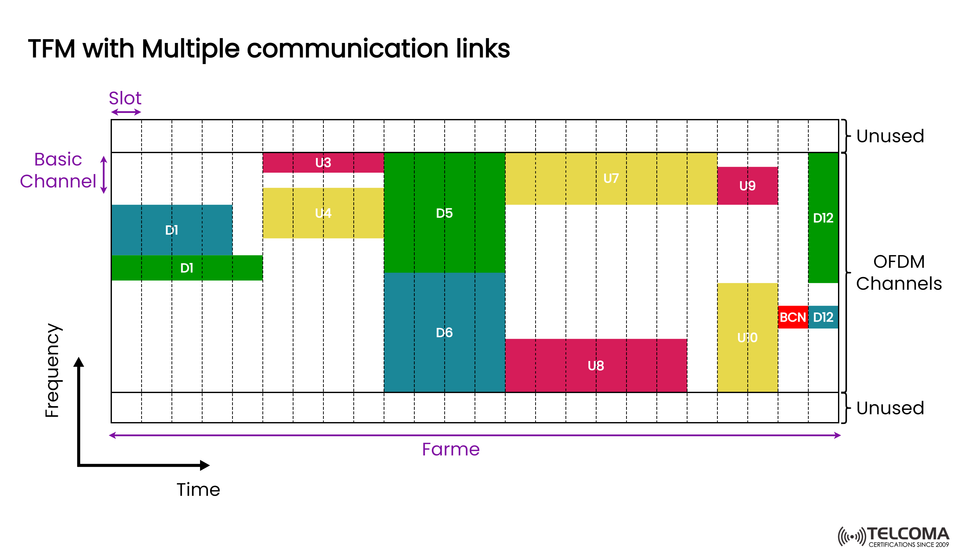
In today’s wireless communication landscape, maximizing efficiency and flexibility is vital for high-performance data transmission. One technique that plays a significant role in achieving these goals is Time-Frequency Mapping (TFM), especially when used with multiple communication links. The diagram labeled “TFM with Multiple Communication Links” illustrates how various users and data streams (represented by U and D) can effectively share the same OFDM (Orthogonal Frequency Division Multiplexing) resources in both time and frequency.
This blog post dives into the technical aspects of TFM, explains the roles of slots, frames, and channels, and discusses how multiple communication links can work together with minimal interference—making it essential for 5G and upcoming 6G wireless technologies.
Key Parameters in the Diagram
Time (Horizontal Axis): Broken down into slots, which create a frame.
Frequency (Vertical Axis): Shows the OFDM subcarriers or channels.
Basic Channel: The minimum frequency resource allocated to a link.
Unused Regions: Spectrum areas that are not in use at certain times.
Colored Blocks (U3, D5, BCN, etc.): Indicate uplink (U) and downlink (D) transmissions, along with beacon or control channels.
This method allows multiple devices to transmit data simultaneously, ensuring the spectrum is used efficiently without interference.
Multiple Communication Links in TFM: Explained
The diagram showcases a situation where several users or devices operate at the same time on different time-frequency blocks. Each block (like U3, D5, U9, D12) corresponds to a specific communication link, either uplink (U) or downlink (D).
These links can represent:
Different users (e.g., smartphones, IoT devices)
Varied types of traffic (e.g., data, control, or broadcast)
Different Quality of Service (QoS) levels (e.g., low-latency, high-throughput, or reliability-focused communication)
Why Multiple Links Matter
In crowded networks like 5G, a single cell might have to serve hundreds or even thousands of devices. If we relied on a traditional single-link mapping, we’d see underutilized spectrum and larger latencies. Multiple communication links make it possible to:
Enable parallel data transmission
Share the spectrum dynamically
Balance loads across both time and frequency
Achieve better interference isolation
Dissecting the Diagram: A Time-Frequency Perspective
Let’s break down what’s shown in the visual:
Frequency Axis: The OFDM Channel Grid
Each horizontal layer represents a subchannel or group of OFDM subcarriers.
Channels are split into a basic channel, several OFDM subchannels, and unused frequency bands.
The empty sections at the top and bottom are guard bands or frequency segments kept clear to avoid interference.
Time Axis: Slots and Frames
The time domain is divided into slots, each with a fixed duration (typically 0.5 or 1 ms in 5G).
A series of slots forms a frame, as labeled “Frame” at the bottom of the diagram.
Each communication event (like U3, D5, etc.) takes up one or more slots depending on how much data and the configuration of the link.
Uplink and Downlink Blocks
U (e.g., U3, U4, U7, U10): Blocks for uplink transmissions where devices send data to the base station.
D (e.g., D1, D5, D6, D12): Downlink blocks for data from the base station to users.
BCN: A beacon or synchronization block used for signaling control and time alignment.
These blocks are color-coded to help distinguish between different user sessions and communication directions.
Benefits of TFM with Multiple Communication Links
Using multiple communication links in a TFM setup offers numerous technical and operational advantages.
Benefit Description Spectral Efficiency Multiple links maximize use of available spectrum over time and frequency. Low Latency Parallel scheduling cuts down on waiting times for accessing resources. Interference Management Careful allocation of links helps minimize overlapping transmissions. Dynamic Resource Allocation TFM allows flexible mapping to meet changing user needs. QoS Differentiation Enables multiple services—like URLLC, eMBB, and mMTC—to coexist within the same frame. Backward Compatibility Works with older OFDM setups, facilitating a smooth transition from LTE to 5G NR.
TFM and 5G NR: A Perfect Match
5G NR (New Radio) is built to support flexible numerology, dynamic TDD, and bandwidth parts—all perfectly aligned with TFM principles.
In 5G:
Each user might have customized slot and subcarrier spacing.
Different services (like IoT vs. enhanced broadband) can run simultaneously using the same spectrum.
Network slicing and beamforming boost TFM efficiency by directing resources to specific devices.
For example, in the diagram:
D5/D6 blocks could show high-throughput eMBB users.
U4 or U10 might represent IoT uplinks sending small data packets periodically.
BCN serves as a synchronization point or control frame for coordination.
This setup guarantees that every service type can access optimal resources without interfering with one another.
Challenges in Implementing Multi-Link TFM
Although TFM with multiple links improves efficiency, it comes with challenges in scheduling and managing interference.
Key Challenges:
Scheduler Complexity: Coordinating in real-time across many devices can be tricky.
Synchronization: Keeping time and frequency aligned for all links is essential.
Power Control: Balancing transmission power is necessary to cut down on inter-link interference.
Hardware Constraints: OFDM hardware must handle tight resource partitioning.
Modern 5G base stations (gNBs) utilize AI-driven schedulers to dynamically adjust TFM maps on the fly, effectively tackling these challenges.
Real-World Applications
TFM with multiple communication links is applied across various next-gen scenarios:
5G Massive MIMO Systems: Efficient mapping over multiple spatial streams.
Vehicle-to-Everything (V2X): Crafting simultaneous uplink/downlink sessions for safety data and entertainment.
Industrial IoT: Supporting low-latency control and high-throughput video streams at the same time.
Public Safety Networks: Allowing multi-channel, mission-critical communication.
Private 5G Networks: Tailored for enterprise-level environments with multiple users.
Conclusion
The approach of TFM with multiple communication links marks a crucial step forward in how wireless networks allocate and utilize resources. By harnessing both time and frequency dimensions, this technique boosts efficiency, reduces latency, and supports a wide variety of services, from enhanced broadband to mission-critical IoT applications.
As we move towards 6G, TFM’s impact will continue to grow, incorporating AI-driven resource mapping, ultra-dense networking, and sub-terahertz frequency management—leading us to an even more interconnected world.