
📅 The 5G Evolution Timeline: From NSA Deployments to Release 17 Enhancements
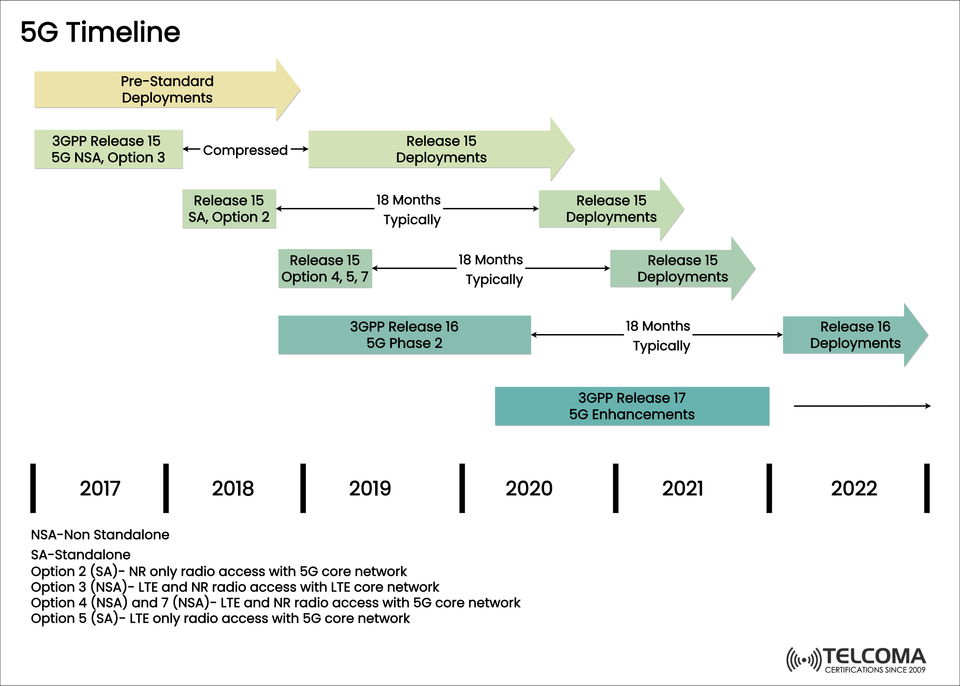

📶 A Macroscopic Understanding of the 5G Timeline: Key 3GPP Releases and Deployments
As 5G network service-quality, capacity, and capability continue to evolve mobile connectivity, it is critical to understand how these networks are evolving through 3GPP releases. This blog post is an explanation of the 5G timeline, starting with the early Non-Standalone (NSA) deployments to the full-fledged Stand-Alone (SA) deployments as shown in the attached image.
This timeline is especially useful for the variety of readers that touch in some way with 5G technology, including telecom engineers, network architects, and technologists who are more interested in a complete view of 5G technological developments.
🧭 Timeline Overview: Key Steps/Milestones (2017-2022)
The evolution of 5G began with pre-standard deployments (where there were no industry standard software releases available); and subsequently moved into a phased timeline of releases, using additional and different features, flexibility, and performance. The above table provides a breakdown of the timeline:
Year Milestones Key Features
2017 Pre-standard deployments Early vendor-specific trials
2018 Release 15 (NSA - Option 3) LTE anchor with NR radio, LTE EPC core
2019 Release 15 (SA - Option 2) Pure NR with 5G Core (5GC)
2019 Options 4, 5, 7 Introduced Mixed-mode deployments (e.g., LTE with 5GC, dual radio with 5GC)
2020 Release 16 (5G Phase 2) URLLC, V2X, enhancements for Industrial IoT
2022 Release 17 (5G enhancements) RedCap devices, slicing normalization, satellite enhancements
Typically releases are published every 18 months, delivering evolutionary upgrades furfilling download-to-3GPP service provider demand.
🧱 Deployment Options Explained
The graphic above depicts different deployment options that may exist for different transition paths between 4G and 5G:
Option Type Description
Option 2 SA NR-only radio access with a 5G core -- "pure" 5G deployment
Option 3 NSA LTE and NR radio access with LTE core -- most prevalent option in terms of early deployment
Option 4 & 7 NSA LTE and NR radio access with a 5G core -- intermediate hybrid modes.
Option 5 SA LTE-only radio with a 5G core --least prevalent (mostly theoretical)
NSA = Non-Standalone
SA = Standalone
🔍 What’s Inside Each 3GPP Release?
📦 Release 15 – Foundational
Established both NSA and SA 5G
Outlined the initial architecture and interfaces
Enabled dual connectivity with LTE
Introduced Options 3, 2, 4, 5, 7.
🚀 Release 16 – Phase 2 Enhancements
Enhanced Mobile Broadband (eMBB).
Ultra-Reliable Low Latency Communication (URLLC).
Industrial IoT, V2X.
Maturity of support for network slicing.
🌐 Release 17 – More Advanced Enhancements
Introduced RedCap (Reduced Capability) devices.
Non-Terrestrial Networks (NTN) Satellite integration.
More spectrum support (mmWave, unlicensed bands).
Enhanced features for slicing and energy efficiency.
💡 Implications to Operators & Vendors
Operators early to market with Option 3 realized fast time to market but are now grappling with transition to SA architectures.
Vendors are obliged to align their solutions to specs related to each release to ensure interoperability and forward compatibility.
The 5G timeline and development—from the foundational work in Release 15 to the features of Release 17—displays an industry commitment to scalable architectures, resilience, and a future-proof approach.
Telecom professionals will benefit by understanding their choices of deployment and release cycle and be able to:
Going Forward – What Comes After Release 17?
While this timeline stops with 3GPP Release 17, the telecom universe is already looking forward to the Release 18, widely known as the "foundation for 5G Advanced." Release 18 will be a significant touchpoint in transitioning toward intelligence, autonomy, and energy efficiency in our mobile world.
3GPP Release 18 – The Essential
Scheduled for release starting in 2024-2025, Release 18 will include:
Greater AI/ML for RAN and Core optimization
New energy savings via new sleep cycles and networks to be managed
XR (Extended Reality) improvements in AR/VR applications
New satellite and NTN (non-terrestrial network) support expandability
Full duplex and enhanced uplink
Further evolution of network slicing and private 5G solutions
The Release 18 advancements will be important not just for consumer services but in relation to requirements for mission critical applications across.
✅ For Equipment Vendors:
Standards Consistency: Verify that equipment supports the latest and future 3GPP specs (especially Options 2, 4, 7).
Open RAN Integration: Ensure the equipment focuses on systems that are modular, agnostic, interoperable and compliant with Open RAN principles to future-proof deployment.
AI Ready - Equipment should allow for the use of AI-native functions that will be necessary in 5G-Advanced for intelligent automation and optimization.
The 5G timeline is not a simple series of software releases; it represents the development trajectory of how future communications networks will evolve in support of a more connected, immersive, and intelligent digital environment.
🌐 Looking Ahead to 6G: The Next Step After 5G-Advanced
5G, with a rollout still in progress on a global scale, may seem a little early to discuss the next version (6G) in various forums in academia, industry, and standards bodies. However, telecommunications R&D has a long-lead time, and many of the fundamental technologies required for 6G are already being researched and developed.
There are a couple of exciting concepts that emerging for 6G:
THz Communications – Which takes communications beyond mmWave to even higher frequencies that will enable extreme data rates and ultra-low latencies.
AI-Native Networks – Artificial intelligence not just for optimization, but rather a native layer of the network where intelligent decisions can be made.
Digital Twin Networks – The capability to mimic the physical system in real-time to enable monitoring, simulation, and automated decision-making.
Integrated Sensing and Communication - The realization that networks can be used to support sensing environmental conditions at the same time as relaying communications.
📈 Industry Perspective: What Does This Mean for Stakeholders
For Mobile Operators:
- Begin to evaluate onboarding/significant integration AI/ML capabilities into operations. AI-native networks will be the next step for mobile broadband.
- Invest early in open standards-based/disaggregated infrastructure to ensure the entire operation will be scalable and agile to changing market dynamics.
- Look into making private 5G and edge compute operational deployments as profit centers.