
The Complete Evolution of Wi-Fi: From 802.11b to Wi-Fi 6E Explained

📶 The Rise and Progress of Wi-Fi: The Evolution from Wi-Fi 1 to Wi-Fi 6E
Since it's inception in the late 1990's, Wi-Fi has travelled a long way. From the original Wi-Fi 1 (802.11b) which had a maximum speed of 11 Mbps, to the formidable speed of Wi-Fi 6E (802.11ax), which offers speeds nearly 1000 times faster at 9608 Mbps. Each generation of Wi-Fi has brought updates in speed, spectral efficiency, and capacity to wireless devices. In this post, we discuss the evolution of the Wi-Fi standards and provide a summary of the information for the well educated telecom engineer, IT person and wireless junkies alike.
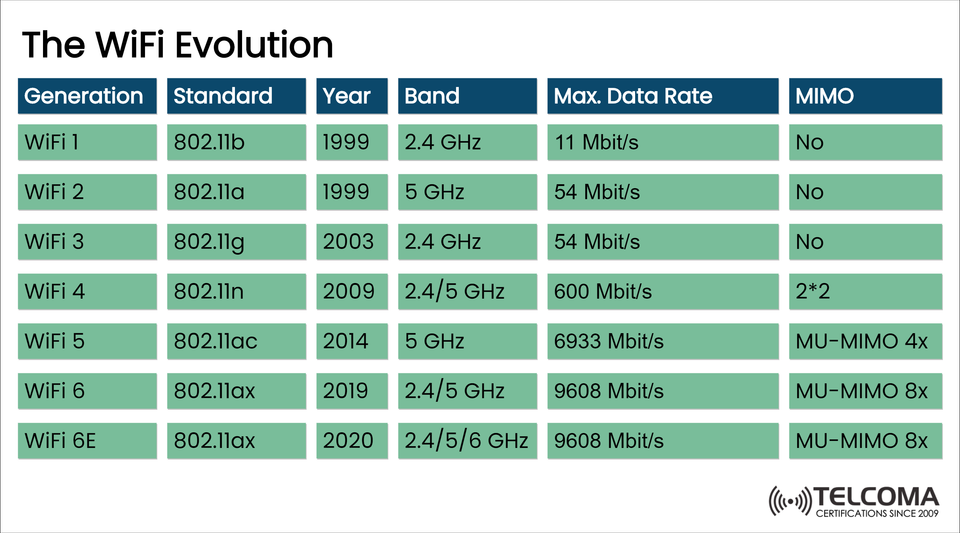
📊 Quick Comparison Table of Wi-Fi Generations:
Generation Standard Year Band Max. Data Rate MIMO
Wi-Fi 1 802.11b 1999 2.4 GHz 11 Mbit/s No
Wi-Fi 2 802.11a 1999 5 GHz 54 Mbit/s No
Wi-Fi 3 802.11g 2003 2.4 GHz 54 Mbit/s No
Wi-Fi 4 802.11n 2009 2.4/5 GHz 600 Mbit/s 2x2 MIMO
Wi-Fi 5 802.11ac 2014 5 GHz 6933 Mbit/s MU- MIMO 4x
Wi-Fi 6 802.11ax 2019 2.4/5 GHz 9608 Mbit/s MU- MIMO 8x
Wi-Fi 6E 802.11ax 2020 2.4/5/6 GHz 9608 Mbit/s MU- MIMO 8x
📌 Notable Milestones in the Evolution of Wi-Fi
🟢 Wi-Fi 1 to Wi-Fi 3: The Beginning
Provided basic wireless connectivity.
Limited to single user connectivity.
Speed capped at 54 Mbps.
Offered service at either 2.4 GHz (802.11b/g) and/or 5 GHz (802.11a).
🟢 Wi-Fi 4: Into MIMO and Dual Band
First to incorporate MIMO (Multiple Input, Multiple Output) for greater throughput.
Supported 2.4 GHz and 5 GHz bands.
This was a game changer for streaming video and transferring large files.
🟢 Wi-Fi 5: Beginning of the Speed Era
Utilized MU-MIMO 4x (Multi-User MIMO).
Greatly increased the throughput (6933 Mbps max).
Created for HD video, gaming, and commercial Wi-Fi performance.
🟢 Wi-Fi 6 and 6E: Capacity with Intelligence
Introduced MU-MIMO 8x, OFDMA, BSS Coloring, and TWT for efficiency.
Wi-Fi 6E had the added 3rd band (6GHz band) to help alleviate congestion.
Best suited for IoT use cases, AR/VR, and ultra-low latency applications.
🧠 Why the Evolution of Wi-Fi is important?
✅ Telecom & ISP Perspective
Facilitates high-density scenarios (stadiums, campus, smart cities).
Enables QoS differentiation for service tiers.
6E has additional revenue opportunities utilizing 6GHz, which is unlicensed.
✅ To Enterprise IT Teams:
Improve client density without degradation.
Enhance power savings for battery-operated devices.
Seamless environment combining with 5G networks in hybrid environments.
📡 Future Thinking: What is Next after Wi-Fi 6E?
Coming soon, the next generation (802.11 be)—Wi-Fi 7 is under development and will include:
320 MHz of channel bandwidth.
4096-QAM utilizing the spectrum further for better efficiency.
Multi-Link Operation (MLO) using multiple-frequency bands simultaneously.
Conclusion
Wi-Fi has come a long way in the past two decades since the introduction of 802.11b to 802.11ax (Wi-Fi 6E). With MU-MIMO, OFDMA, and multi-band operation, Wi-Fi can take over many use cases as a viable option even when comparing it to wired networks. It's essential for telecom industry professionals to stay up to date with the standard as they will help shape a resilient and future-ready network.
Deep Dive: Three major technology advances in Wi-Fi evolution
MIMO and MU-MIMO
The introduction of MIMO (Multiple Input, Multiple Output) in Wi-Fi 4 allowed MIMO-enabled client types to simultaneously send and receive multiple data streams at the same time through the use of multiple antennas.
With MU-MIMO (Multi-User MIMO) introduced in Wi-Fi 5, the access point can communicate with several devices at the same time. Wi-Fi 6 and Wi-Fi 6E included uplink MU-MIMO and once again increased the number of streams in MU-MIMO, up to 8 streams.
Impact:
Greater throughout and lower latencies that are notable for high-density clients in places such as: offices, airports and homes containing many smart devices.
Channel Width and Bands
In the beginning, Wi-Fi only had 20 MHz or 40 MHz channels.
Wi-Fi 5 added the option of channels of 80 MHz and 160 MHz channels for greater throughput.
Wi-Fi 6E provided access to the 6 GHz band. The 6 GHz band provided a clean spectrum to access with no interference.
Benefit to Wi-Fi users:
Better performance, faster data rates, and the availability of cleaner spectrum.
💡 Wi-Fi 6 Improvements Summary
Feature Brief Description
OFDMA Partitions channels into sub-carriers and can reduce spectrum waste.
TWT (Target Wake Time) Allows devices to save power by predetermining communication time.
BSS Coloring This feature allows devices to distinguish between overlapping access points and reduces interference.
Uplink MU-MIMO For the first time, uplink transmission can also be sent in parallel.
🏭 Use Cases by Industry
🏢 Enterprise & Corporate Networks
Video conferences and VoIP with seamlessness.
Enhanced capacity in a BYOD environment.
Mobile workers gain battery drainage improvement.
🏘️ Smart Homes and IoT
Reliable and consistent connectivity for smart thermostats, smart lights, and smart security.
Low latency for video streaming and gaming.
Reduction in energy consumption with battery-powered sensors.
🏥 Healthcare
Dependable wireless coverage, especially for telemedicine and remote monitoring.
Bandwidth prioritization for critical devices.
🚀 Industrial automation
Supports a large number of low power IoT sensors.
Improves real-time data communications via existing manufacturing floor networks.
📈 Wi-Fi Evolution Timeline Overview
Here is a simple timeline of Wi-Fi movement:
1999: Wi-Fi 1 & 2 (802.11b/a) ➜ Basic wireless connectivity
2003: Wi-Fi 3 (802.11g) ➜ Faster data rate on 2.4 GHz
2009: Wi-Fi 4 (802.11n) ➜ Use of MIMO presented
2014: Wi-Fi 5 (802.11ac) ➜ MU-MIMO and greater throughput
2019: Wi-Fi 6 (802.11ax) ➜ OFDMA, BSS Coloring, 8x MU-MIMO
2020: Wi-fi 6E ➜6 GHz band opened, access to massive spectrum expansion