
The Convergence of 5G, Edge Computing, and AI: Applications and Use Cases

The digital landscape is changing rapidly, thanks to the blending of three key technologies: 5G, edge computing, and artificial intelligence (AI). Each of these innovations has its strengths, but they really shine when they work together.
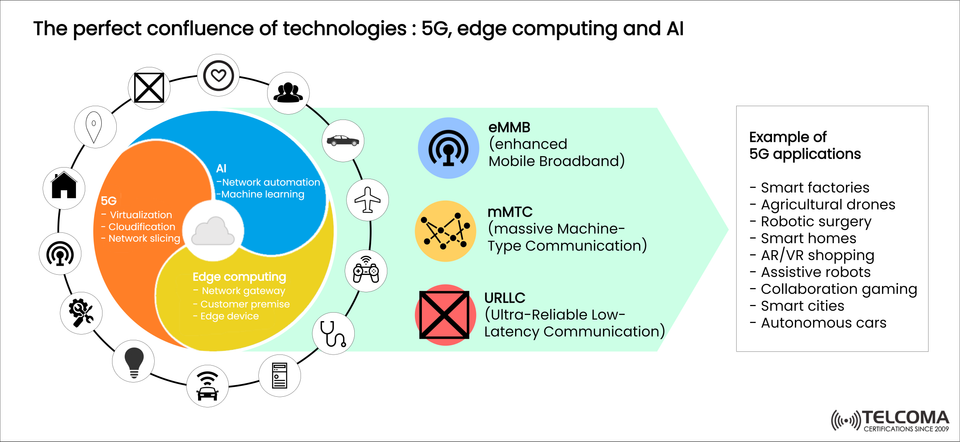
The image uploaded shows how these technologies come together—5G offers fast, low-latency connectivity, edge computing brings processing power closer to users and devices, and AI drives smart automation and decision-making. Together, they lay the groundwork for next-gen applications like smart factories, robotic surgery, self-driving cars, and AR/VR experiences.
In this blog, we’re going to take a closer look at how these technologies intersect, what they can do, and how they’re transforming industries and our day-to-day lives.
Understanding the Three Pillars of Digital Convergence
5G: Connectivity Redefined
5G is about more than just faster internet; it brings in advanced features like:
Virtualization – Which separates hardware from software for more flexible network setups.
Cloudification – Allowing for cloud-native architectures that scale easily.
Network slicing – Creating specialized virtual networks for different needs (think healthcare and gaming).
With categories like eMBB (Enhanced Mobile Broadband), mMTC (Massive Machine-Type Communication), and URLLC (Ultra-Reliable Low-Latency Communication), 5G meets a wide range of demands from high-speed streaming to critical control systems.
- Edge Computing: Bringing Processing Closer
Edge computing tackles one of the biggest issues with centralized cloud models—latency. Instead of sending everything to far-off data centers, edge computing allows for local data processing, right where it's generated.
Key components include:
Network gateways that sift through and handle local traffic.
Customer premise equipment (CPE) which gives enterprises more control.
Edge devices like IoT sensors and gateways that enable immediate responses.
By cutting down on dependence on centralized servers, edge computing makes real-time responsiveness possible, which is crucial for things like autonomous driving and robotic surgery.
- Artificial Intelligence: Intelligence Everywhere
AI adds the intelligence to this connected ecosystem. It’s responsible for:
Network automation for maintenance and traffic management.
Machine learning models that optimize how resources are used.
Cognitive decision-making that helps autonomous systems function better.
When combined with 5G and edge computing, AI ensures that these connected systems are not just fast but also smart and adaptable.
The Synergy: How 5G, Edge, and AI Work Together
The intersection of 5G, edge computing, and AI is where true innovation occurs:
5G delivers the high-bandwidth, low-latency connections needed for quick communication.
Edge computing cuts down on delays by processing data right at the source.
AI drives predictive and automated decision-making, letting systems adjust without needing a human to intervene.
This collaboration allows industries to create applications that simply weren't feasible with older networks.
Applications Enabled by This Convergence
The infographic showcases several examples of 5G applications boosted by edge computing and AI. Let’s take a look at a few:
- Smart Factories
Sensors keep an eye on equipment in real-time.
AI-powered predictive maintenance helps avoid downtime.
Edge processing allows for quick responses on the factory floor.
Result: More productivity, reduced costs, and less downtime.
- Agricultural Drones
Drones with cameras and IoT sensors gather crop data.
Edge computing processes that data right on the spot, cutting down delays.
AI examines soil conditions and recommends better irrigation practices.
Result: Increased crop yields and more sustainable farming.
- Robotic Surgery
Needs ultra-reliable low-latency communication (URLLC) for precise handling.
Edge computing provides real-time feedback to surgeons.
AI aids in diagnostics, planning, and precise movements.
Result: Safer, more accurate surgeries that can be accessed remotely.
- Smart Homes
IoT devices like smart thermostats and cameras rely on instant communication.
AI manages energy use, security, and personal preferences.
Edge devices help reduce lag and boost privacy.
Result: Energy-efficient, safe, and convenient living spaces.
- AR/VR Shopping
eMBB supports high-bandwidth streaming for VR.
Edge computing decreases lag for a seamless experience.
AI personalizes shopping recommendations.
Result: Next-level retail experiences blending the physical and digital.
- Assistive Robots
Utilized in elder care, healthcare, and manufacturing.
Edge computing ensures quick reactions to surroundings.
AI enhances decision-making for better human interaction.
Result: Better collaboration between humans and robots, ensuring safety and efficiency.
- Collaborative Gaming
eMBB allows for cloud-based multiplayer gaming.
Edge computing minimizes lag in fast-paced gameplay.
AI enriches the gaming experience with adaptive environments.
Result: Super responsive and immersive online gaming.
- Smart Cities
mMTC connects countless IoT devices for traffic, waste, and utility management.
Edge computing eases congestion by handling local data.
AI orchestrates urban systems for sustainability.
Result: More efficient, safer, and eco-friendly urban spaces.
- Autonomous Cars
Depend on URLLC for real-time vehicle-to-everything communication.
Edge nodes along roads enable quick decision-making.
AI drives navigation, obstacle detection, and predictive driving.
Result: Safer roads, fewer accidents, and real mobility.
Comparative Overview of Roles
Technology Core Role Contribution to Applications
5G High-speed, low-latency connectivity eMBB, mMTC, URLLC for varied use cases
Edge Computing Localized data processing Real-time responsiveness, reduced reliance on cloud
AI Automation, intelligence, adaptability Smart decisions, predictive analysis, autonomous operations
Why This Convergence Matters for Telecom Professionals
For telecom professionals, the mix of 5G, edge computing, and AI isn’t just a passing trend—it’s a guide for crafting the networks of tomorrow.
Operators can tap into new revenue streams through network slicing for sectors like healthcare and automotive.
Enterprises gain from private 5G networks combined with edge AI for mission-critical tasks.
Developers can create groundbreaking services using low-latency edge setups and AI automation.
Conclusion
The future of digital transformation won’t hinge on any single technology; it’s all about the synergy of 5G, edge computing, and AI. Together, they empower applications that require speed, intelligence, and proximity—from robotic surgeries to self-driving cars, smart cities to immersive gaming.
For telecom professionals, this convergence opens the door to developing intelligent, scalable, and industry-specific solutions. For tech enthusiasts, it highlights how once far-fetched ideas like assistive robots and AR shopping are now on the brink of reality.
In short, the meeting point of 5G, edge computing, and AI is really setting the stage for the next wave of a connected world.