
The Evolution of Fixed Network Generations: From F1G to F5G
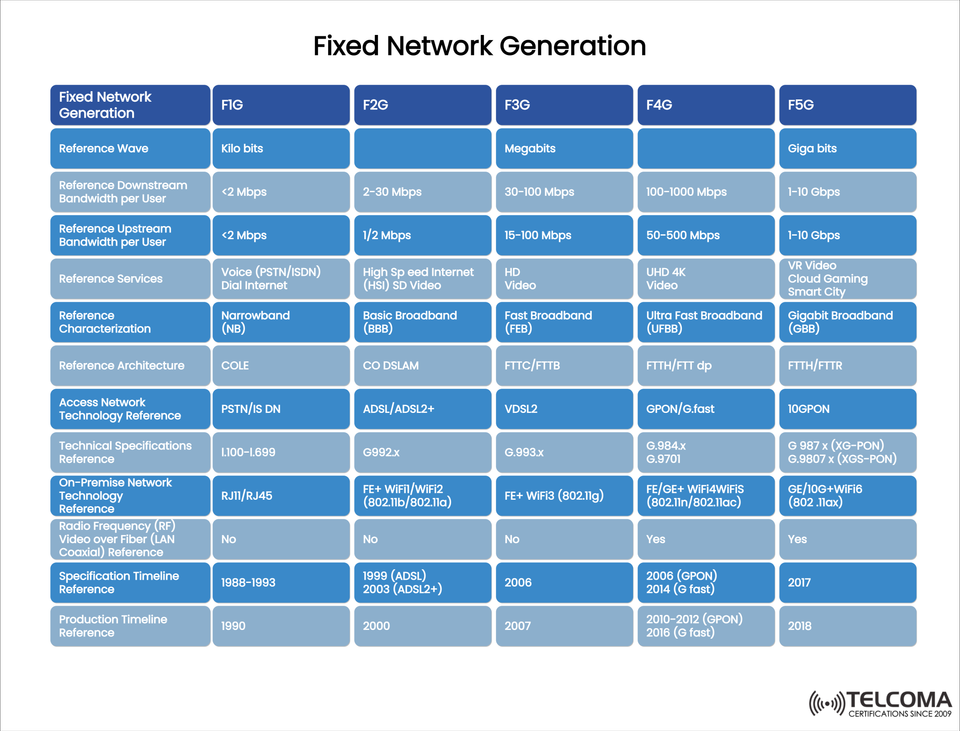

The Evolution of Fixed Network Generations: From F1G to F5G
For decades, fixed networks have been the backbone of global communications. We’ve come a long way from the early days of narrowband telephony to the high-speed gigabit-capable broadband networks we have today. The journey has seen several generations—F1G, F2G, F3G, F4G, and now we’re at F5G (Fifth Generation Fixed Networks).
In this article, we’ll take a closer look at each generation, the technology involved, and how they've impacted connectivity. Whether you're a tech buff wanting to know more about network evolution or a telecom expert after a clear overview, this guide will provide a solid insight into how fixed networks have progressed.
What Are Fixed Network Generations?
Just like mobile generations (think 2G to 5G), fixed network generations represent the step-by-step development of wired communication systems. Each generation comes with its own set of features:
Downstream and upstream bandwidth capabilities
Reference services such as voice, video, gaming, and smart city apps
Architectural changes (like moving from copper to fiber)
Standardization and timelines
While mobile networks are all about delivering wireless service, fixed networks concentrate on reliability, high capacity, and low latency, serving both consumer needs and business-level digital changes.
F1G: The Narrowband Era (1988–1993)
The first fixed generation (F1G) represents the narrowband phase—a time when telecommunications were mostly about voice services with very limited internet access.
Bandwidth: <2 Mbps downstream / <2 Mbps upstream
Services: Voice (PSTN/ISDN), Dial-up Internet
Architecture: COLE (Central Office Line Equipment)
Technology: PSTN/ISDN access, RJ11/RJ45 connectors
Standards: ITU-T I.100–I.699
Timeline: Kicked off around 1988, with commercial use starting by 1990
F1G wasn’t made for advanced multimedia; it was just enough for basic voice calls and the early days of dial-up internet.
F2G: The Rise of Broadband (1999–2003)
The second generation marked a shift from narrowband to basic broadband (BBB). The arrival of ADSL/ADSL2+ offered higher speeds for the first wave of video streaming and enhanced internet access.
Bandwidth: 2–30 Mbps downstream / ~512 Kbps upstream
Services: High-speed internet, SD video
Architecture: CO DSLAM (Central Office DSL Access Multiplexer)
Technology: ADSL/ADSL2+, WiFi (802.11b/802.11a)
Standards: ITU-T G.992.x
Timeline: ADSL launched in 1999; widespread adoption kicked in during the early 2000s
F2G gave us nonstop connectivity, setting the stage for web growth, online gaming, and streaming. But the limited upstream speeds held back user-generated content and the early cloud scene.
F3G: Fast Broadband Era (2006 Onwards)
By the mid-2000s, the demand for HD video streaming, cloud services, and richer online experiences prompted a need for better fixed networks. F3G brought in VDSL2 and FTTC/FTTB architectures, which offered quicker speeds.
Bandwidth: 30–100 Mbps downstream / 15–100 Mbps upstream
Services: HD video, large file transfers
Architecture: FTTC (Fiber to the Cabinet) / FTTB (Fiber to the Building)
Technology: VDSL2, WiFi (802.11g)
Standards: ITU-T G.993.x
Timeline: Commercial rollout started in 2006
F3G was a transitional phase, where copper networks got a fiber boost to shorten loop lengths, providing subscribers with faster speeds without needing full fiber setups.
F4G: Ultra-Fast Broadband (2010–2016)
The fourth generation of fixed networks saw the rise of fiber-to-the-home/premises technologies like GPON and G.fast, which vastly increased bandwidth and cut down latency.
Bandwidth: 100 Mbps–1 Gbps downstream / 50–500 Mbps upstream
Services: UHD/4K video, low-latency gaming
Architecture: FTTH (Fiber to the Home), FTT dp (distribution point)
Technology: GPON, G.fast, WiFi (802.11n/802.11ac)
Standards: ITU-T G.984.x, G.9701
Timeline: * GPON came on the scene in 2006, with rollouts happening between 2010 and 2012 * G.fast emerged around 2014–2016
F4G really made fiber the go-to option, providing ultra-fast broadband for households, businesses, and streaming platforms.
F5G: The Gigabit Era (2017–Present)
The fifth generation of fixed networks (F5G) is all about gigabit broadband (GBB)—enabling advanced applications like VR/AR, cloud gaming, smart homes, and smart cities. Thanks to fiber-to-the-room (FTTR) and 10G-PON, F5G guarantees both speed and stability for our modern digital lifestyles.
Bandwidth: 1–10 Gbps downstream / 1–10 Gbps upstream
Services: VR video, cloud gaming, smart city applications
Architecture: FTTH/FTTR (Fiber to the Room)
Technology: 10G-PON, GE/10G+WiFi6 (802.11ax)
Standards: ITU-T G.987.x (XG-PON), G.9807.x (XGS-PON)
Timeline: Launched in 2017, with large-scale rollouts starting in 2018
F5G is fiber-centric, providing ultra-reliable, low-latency connections. It’s a key player in digital transformation, fueling Industry 4.0, IoT ecosystems, and immersive entertainment.
Comparative Table: Fixed Network Generations
Generation Bandwidth (Down/Up)Services Architecture Key TechnologiesTimelineF1G<2 Mbps / <2 Mbps Voice, Dial-up Internet COLEPSTN/ISDN1990F2G2–30 Mbps / ~512 Kbps HSI, SD Video CO DSLAMADSL/ADSL2+2000F3G30–100 Mbps / 15–100 Mbps HD Video FTTC/FTTBVDSL22007F4G100–1000 Mbps / 50–500 Mbps UHD 4K Video FTTH/FTT d p GPON, G.fast2010–2016F5G1–10 Gbps / 1–10 Gbps VR, Cloud Gaming, Smart Cities FTTH/FTTR10G-PON, WiFi62018–Present
Why Fixed Networks Still Matter in the 5G Era
Even though mobile 5G networks are getting all the attention, fixed networks are equally important:
Stability & Reliability: Wired fiber connections are generally steadier than wireless ones.
Capacity: Gigabit broadband can handle data-heavy applications like 8K streaming, AI tasks, and IoT systems.
Enterprise Use: Businesses rely on fixed networks for secure, high-bandwidth connections.
Complement to Mobile 5G: Fixed networks serve as backhaul infrastructure for mobile operators.
The Road Ahead: Toward F6G and Beyond
While F5G is still growing worldwide, research is already looking into F6G, which will focus on green networking, AI management, and terabit-per-second optical networks. The connection between fixed and mobile developments will keep shaping our hyper-connected future.
Conclusion
The journey from F1G to F5G is an impressive tale of technological growth—upgrading our connectivity from kilobits to gigabits.
F1G: Voice & narrowband Internet
F2G: Basic broadband & always-on Internet
F3G: Fast broadband & HD video
F4G: Ultra-fast broadband & 4K video
F5G: Gigabit broadband for VR, gaming, and smart cities
For telecom professionals, this timeline highlights the shift from copper to fiber infrastructure. For tech fans, it shows how fixed networks quietly support a lot of the digital experiences we often take for granted.
As our digital society dives deeper into AI, IoT, and immersive media, fixed networks will continue to be essential—growing faster, more reliable, and ever-more vital.