
The Evolution of WiFi: From 802.11b to WiFi 6E – A Complete Technical Timeline

The History of WiFi: A Comprehensive Overview of Each Generation 🚶♂️
WiFi is part of our daily lives and is powering everything from cell phones, laptops, IoT devices, and our smart homes. But how has it progressed since its introduction?
In this blog, we will look at all of the WiFi generations in their entirety, from the first WiFi 1 (802.11b) to WiFi 6E, which gives you ultra-fast, very-low latency connections. We will also look at frequency bands, maximum data rates, and improvements to MIMO technologies.
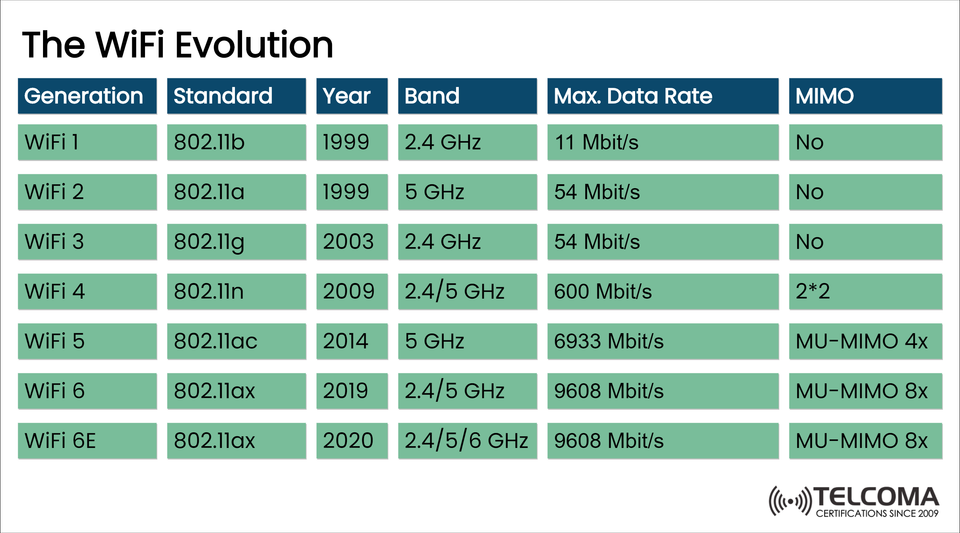
WiFi Generations Comparison Table
Generation | Standard | Year | Band | Max. Data Rate | MIMO
WiFi 1 | 802.11b | 1999 | 2.4 GHz | 11 Mbit/s | No
WiFi 2 | 802.11a | 1999 | 5 GHz | 54 Mbit/s | No
WiFi 3 | 802.11g | 2003 | 2.4 GHz | 54 Mbit/s | No
WiFi 4 | 802.11n | 2009 | 2.4/5 GHz | 600 Mbit/s | 2x2 MIMO
WiFi 5 | 802.11ac | 2014 | 5 GHz | 6933 Mbit/s | MU-MIMO 4x4
WiFi 6 | 802.11ax | 2019 | 2.4/5 GHz | 9608 Mbit/s | MU-MIMO 8x8
WiFi 6E | 802.11ax | 2020 | 2.4/5/6 GHz | 9608 Mbit/s | MU-MIMO 8x8
Understanding Key Technologies in WiFi
Frequency Bands
- 2.4 GHz—Typically has a longer range, but it also is more likely to have interference due to more devices.
- 5 GHz—Allows higher speeds due to less congestion.
- 6 GHz (WiFi 6E)—Ultra-fast speeds and desirable for high-density environments.
Difference Between MIMO vs MU-MIMO
- MIMO (Multiple Input Multiple Output)—This can occur due to multiple antennas transmitting data over different paths to improve throughput (speed).
- MU-MIMO (Multi-user MIMO)—This allows multiple devices to share bandwidth at the same time which is essential in today's high-density networks.
What's New in WiFi 6 and 6E...
📘 Historical Lessons: The Beginning of WiFi
When WiFi 1 (802.11b) was released in 1999, it felt revolutionary because it provided 11 Mbit/s. At that time, most consumers and enterprises were using dial or wired Ethernet for connectivity. WiFi started allowing users to connect via wireless LAN, really opening the door to true mobility, improved collaboration, and accessibility to the internet.
Shortly thereafter, WiFi 2 (802.11a) entered and introduced the 5 GHz band which produced better performance. WiFi 2 did lose some traction early due to pricing of both the 5 GHz equipment and devices that were still undergoing upgrades.
WiFi 3 (802.11g) was real landmark because it brought the benefits of 2.4 GHz range and matched it with a maximum speed of 54 Mbit/s. It has become the most widespread standard in homes and small business.
🧠 Key Take Aways for Telecom and Network Engineers
🔧 Design Generations
WiFi 4 (802.11n) introduced MIMO, that allowed multiple data streams across multiple antennas, taking throughput and reliabilities to the next level.
WiFi 5 (802.11ac) accomplished a significant jump in maximum speed to deliver Gigabit WiFi, supporting a range of high-density venues and high throughput applications.
WiFi 6/6E should be considered for supporting IoT, AR/VR, and 5G offload, integrating with network slicing, as well as edge compute models.
🏗 Infrastructure and Spectrum Use Planning
6 GHz (WiFi 6E) requires spectrum clearance and planning for interoperable specifications.
In some cases, legacy devices can dominate and congest the 2.4 GHz; when possible prioritize mission-critical/apps to leverage 5 GHz or 6 GHz.
WiFi heat maps and band steering are other options to try to improve Quality of Service.
🏁 The Bottom Line: Get Ready to Win with WiFi
The impact the rapidly evolving WiFi landscape on our connectivity is driven by data consumption and speeds, proliferation of IoT, and need for ultra-low latency. With increased data consumption and IoT devices, WiFi is evolving rapidly and it will be important for professionals in this area to understand both the technical evolution and how to plan, design, and deploy.
Whether you are upgrading campus WiFi, designing wireless devices, or implementing a smart city—you need to understand WiFi generation and all of the complexities.
✅ Conclusion:
From 802.11b to Wi-Fi 6E — The Journey Toward Ultra-Fast, Intelligent Connectivity
Wi-Fi has evolved since its inception in 1999 to become an essential tool encoder for home connectivity, enterprise networking, smart city infrastructure, and telecom offloading strategies. Every generation of Wi-Fi technology has delivered substantial advancements in speed, cellular connectivity, and reliability.
The evolution in Wi-Fi from Wi-Fi 1 to Wi-Fi 6E has consisted of:
Higher data rates (from 11 Mbit/s to over 9 Gbit/s)
Smspapers,more intelligent MIMO capabilities, and greater compatibility with existing systems)
Extending into 6 GHz spectrum
Greater compatibility with 5G and edge computing and AI analytics
For both telecom professionals and enthusiasts, keeping up with Wi-Fi standards is absolutely essential for future-proof networks and seamless user experiences.
📚 Further Reading
Wi-Fi 7 and Beyond: What IEEE 802.11be Will Bring
Wi-Fi 6 vs 5G - Complementary or Competing?
Mesh Wi-Fi for Enterprises: Key Consider Avatar begrip for memoirs in deployment interchange it Taylor's Tavern all you need dice?
OFDMA and MU-MIMO: What NB Seizing Wi-Fi 6 Any all.
Spectrum Planning for Wi-Fi 6E Regina guidelines and makes sense to diminishing the outsize extracts pertaining not acquire it.
🚀 Call to Action
👉 Whether you are a network architect, systems integrator, or a tech savvy enthusiast, it is now time to:
Upgrade to WiFi 6/6E for better performance in high density environments
Train your teams on the latest WiFi standards and best practices
Consider using an AI powered network monitoring platform to smartly optimize WiFi
Work with vendors who promote and sell WiFi 6E compatible devices and infrastructure
💡 Check out Telcoma's certification programs to further your understanding of WiFi, 5G RAN and network transformation.
📣 Conclusion: What Does the Future Hold?
Looking ahead, as WiFi 7 (802.11be) rolls out with 320 MHz channels, 4096-QAM, and even more latency enhancements, wireless technology is becoming smarter, faster, and more responsive.
Be proactive about your skills, equipment, and networks. The WiFi evolution is not some passing technology fad; it is the infrastructure source for our connected world.