
The NFV Architecture Framework Explained: Key Components, Interfaces, and Functions
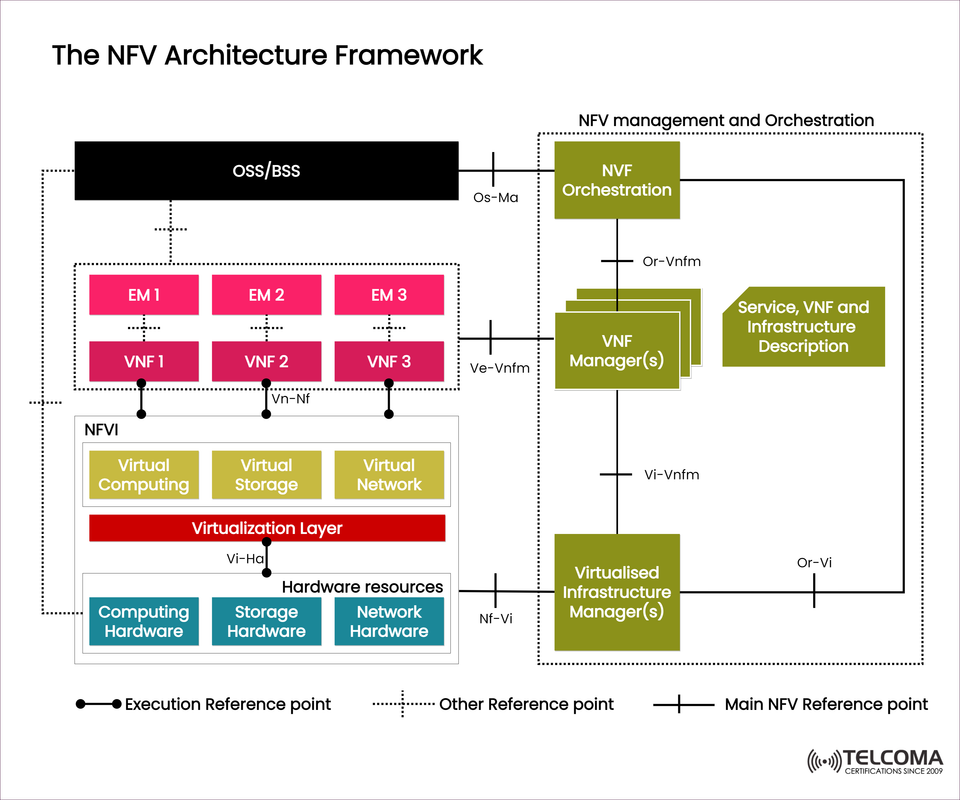

The NFV Architecture Framework: Laying the Groundwork for Virtualized Telecom Networks
The NFV Architecture Framework is a game-changer in the world of telecommunications, allowing network functions to operate as software on virtualized systems instead of relying on specialized hardware.
This shift, driven by the ETSI NFV initiative, gives operators the ability to deploy, adjust, and oversee network services with cloud-like ease — ultimately lowering capital expenditures (CAPEX) and operational costs (OPEX), while speeding up service delivery.
The diagram you’ll find attached gives a clear picture of this architecture, showing how its three main areas interact: Virtualized Infrastructure (NFVI), Virtual Network Functions (VNFs), and Management and Orchestration (MANO).
Let’s dive into each part more closely.
Understanding NFV: A Major Shift in Telecom Architecture
In the past, services like firewalls, routers, and load balancers were delivered using dedicated physical devices. As the complexity of networks and the demand for services grew, this hardware-dependent model became expensive and rigid.
That's where NFV (Network Functions Virtualization) comes in. It separates network functions from hardware by running them as software-based Virtual Network Functions (VNFs) on a unified infrastructure layer known as NFVI.
This approach allows network operators to:
Quickly roll out new services without needing more hardware.
Scale resources on the fly.
Automate service provisioning with orchestration.
Boost network flexibility and resilience.
The Three Foundations of NFV Architecture
According to the ETSI NFV framework, there are three main functional blocks at the heart of this architecture:
Virtualized Network Functions (VNFs)
Network Functions Virtualization Infrastructure (NFVI)
NFV Management and Orchestration (MANO)
Each of these blocks has specific responsibilities, reference points, and interfaces that ensure seamless service orchestration and lifecycle management.
Virtualized Network Functions (VNFs)
At the core of NFV is the Virtualized Network Function (VNF) — a software version of traditional network functions, including:
Firewalls (vFW)
Load balancers (vLB)
Packet gateways (vPGW)
Deep packet inspection (vDPI)
Every VNF operates in a virtualized setting and can be adjusted in size according to needs.
Key Components:
VNF Instances: Individual software-based network functions.
Element Managers (EMs): These manage VNFs (configuration, fault, and performance). In the visual, EM1, EM2, and EM3 relate to specific VNFs.
Interfaces:
Vn-Nf Reference Point: Connects VNFs to the NFV Infrastructure.
Ve-Vnfm: Links VNFs to their VNF Manager for lifecycle tasks.
This modularity allows operators to swap or update network functions without changing hardware, greatly enhancing agility.
- NFV Infrastructure (NFVI)
The NFV Infrastructure (NFVI) forms the foundational layer, providing the physical and virtual resources for VNFs.
It consists of computing, storage, and network resources abstracted through a virtualization layer (like KVM, VMware, or OpenStack).
Components of NFVI:
Layer Description Hardware Resources Physical servers, storage, and networking components that make up the physical layer. Virtualization Layer: The hypervisor that abstracts hardware resources and creates virtual instances. Interfaces via Vi-Ha.
Virtual Resources: Virtual computing (vCPUs), virtual storage, and virtual network resources that host VNFs.
Interfaces:
Nf-Vi: Connects VNFs to NFVI for data handling.
Vi-Vnfm: Allows VNF Managers to oversee and control virtual resources.
Or-Vi: Links the NFV Orchestrator to NFVI for resource orchestration.
This layer ensures effective resource management, fault isolation, and scalability in multi-tenant setups.
- NFV Management and Orchestration (MANO)
The MANO framework acts as the control plane of NFV — it manages and automates the entire lifecycle of VNFs and services.
It consists of three key components:
a. NFV Orchestrator (NFVO)
The NFV Orchestrator manages the complete orchestration of network services across VNFs and infrastructures.
Oversees service deployment, scaling, and termination.
Connects with OSS/BSS systems using Os-Ma.
Communicates with VNF Managers via Or-Vnfm and engages with NFVI using Or-Vi.
Main Responsibilities:
Service chaining of VNFs into cohesive network services.
Orchestrating resources across various data centers.
Policy-driven lifecycle management.
b. VNF Managers (VNFMs)
Each VNF Manager looks after the lifecycle of one or more VNFs. Responsibilities include:
Setting up and configuring VNFs.
Dynamically scaling and updating functions.
Monitoring performance and handling faults.
The VNFM interacts with:
VNFs via Ve-Vnfm.
NFV Orchestrator via Or-Vnfm.
Virtualized Infrastructure Manager through Vi-Vnfm.
c. Virtualized Infrastructure Manager (VIM)
The VIM governs the NFVI’s virtual resources. Its tasks involve:
Allocating and releasing compute, network, and storage resources.
Discovering resources and monitoring capacity.
Engaging with physical infrastructure components.
It communicates with:
NFVO (Or-Vi) for orchestration instructions.
VNFM (Vi-Vnfm) for managing resources.
Together, these MANO components create an intelligent automation layer that supports self-service, auto-scaling, and on-demand provisioning of network services.
- OSS/BSS Integration
Above MANO sits the OSS/BSS (Operations Support System / Business Support System) — the layer managing business operations.
It connects with MANO through the Os-Ma interface, handling:
Service order management.
Billing, customer management, and analytics.
SLA monitoring and service assurance.
This integration ensures that NFV aligns with the operator’s operational and business goals, completing the automation loop from end to end.
NFV Reference Points and Interfaces
To guarantee smooth interaction among components, ETSI NFV outlines several key reference points:
Reference Point Purpose Os-Ma Interface between OSS/BSS and MANO. Or-Vnfm Communication between NFVO and VNF Manager. Or-Vi Interaction between NFVO and VIM .Vi-Vnfm Interface between VIM and VNFM. Ve-Vnfm Interface between VNF and VNFM. Nf-ViVNF to NFVI execution interface. Vi-Ha Virtualization layer to hardware interface.
These reference points standardize the integration process and foster multi-vendor ecosystems, helping telecom operators steer clear of vendor lock-in.
Benefits of NFV Architecture
NFV transforms how networks are deployed and managed, offering various technical and financial perks:
Agility & Flexibility: Quick deployment of new services through software.
Scalability: Dynamic resource allocation according to demand.
Cost Efficiency: Lower CAPEX due to shared hardware.
Automation: Complete lifecycle automation through MANO orchestration.
Service Innovation: Supports cloud-native VNFs and containerized network functions (CNFs).
Resilience: Easier redundancy and fault recovery thanks to software control.
NFV vs. Traditional Network Architecture
Aspect Traditional Networks NFV ArchitectureDeploymentHardware-basedSoftware-basedScalabilityManualDynamic and automated Cost High CAPEX Reduced CAPEX & OPEX Service Launch Slow, hardware-dependent Rapid, via orchestration Vendor Dependency Proprietary systems Open and interoperable
Conclusion
The NFV Architecture Framework is a cornerstone in the evolution of modern telecom. By decoupling network functions from specialized hardware, NFV paves the way for cloud-native, software-defined, and automated network environments.
With its structured layers — VNFs, NFVI, and MANO — working in harmony, NFV delivers agility, scalability, and operational efficiency. When it’s combined with OSS/BSS systems, NFV stands as the backbone for 5G and future developments, enabling innovations like network slicing, edge computing, and automated service orchestration.
In short, NFV isn’t merely an upgrade; it’s the foundation for the software-driven telecom revolution that empowers operators to create smarter, faster, and more adaptable networks.