
The Relationship Between 5G IoT and Deep Learning | Data Mining & AI in Telecom

Introduction: The Connection Between 5G, IoT, and Deep Learning
As industries dive into digital transformation, three game-changing technologies are leading the way: 5G, Internet of Things (IoT), and Deep Learning (DL).
5G IoT promises super-fast and low-latency connectivity.
IoT devices produce huge amounts of real-time data.
Deep learning algorithms sift through this data, facilitating automation and informed decision-making.
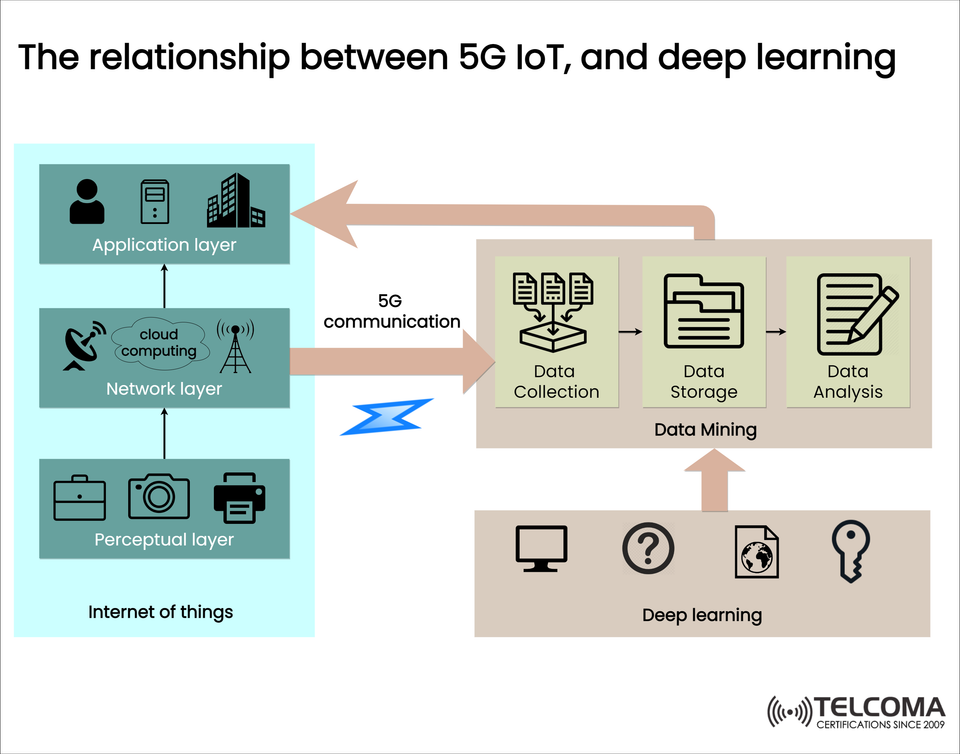
The diagram uploaded gives a great overview of this ecosystem, showing everything from IoT perception to data collection, storage, mining, and AI analysis, all made possible by 5G networks.
Understanding 5G IoT Layers
The architecture of 5G IoT can be broken down into three key layers:
Perceptual Layer (Sensing)
Devices: Sensors, cameras, RFID tags, wearables.
Role: Gather raw environmental data like temperature, movement, images, etc.
Challenge: The data is often unstructured and voluminous.
Network Layer (Connectivity)
Enablers: 5G base stations, cloud computing, edge servers.
Role: Transmit IoT data at ultra-high speeds without much delay.
Feature: Supports dynamic spectrum sharing, which helps use frequency bands more efficiently.
Application Layer (End-User Services)
Use Cases: Smart homes, self-driving cars, industrial robotics, telemedicine.
Role: Turns raw IoT data into actionable insights for users.
Together, these layers create the IoT data pipeline, which 5G enhances by offering massive connectivity, ultra-reliability, and real-time responses.
How 5G Enhances Data Mining
Data mining is all about turning raw IoT data into valuable insights. 5G makes this possible by:
High-Bandwidth Data Collection
Millions of IoT devices can send data at the same time.
For instance, smart grids can gather real-time electricity usage.
Real-Time Data Storage and Retrieval
Thanks to cloud and edge storage solutions supported by 5G, data is instantly available.
Edge computing cuts down on delay for applications that need it fast.
Faster Data Analysis
5G serves as the backbone for AI platforms analyzing continuous data streams.
It supports predictive analytics and spotting irregularities.
Where Deep Learning Fits with 5G IoT
Deep learning (DL), a branch of AI, injects intelligence into the IoT data pipeline. Here's how it integrates:
Data Collection → Training Data: IoT devices provide rich datasets that help train deep learning models.
Data Storage → Big Data Integration: DL thrives on large data lakes made possible by 5G’s rapid connectivity.
Data Analysis → Pattern Recognition: DL algorithms find patterns, anomalies, and correlations.
Benefits of Deep Learning in 5G IoT
Real-Time Decision Making: Autonomous vehicles can make quick decisions.
Predictive Maintenance: Factories can foresee machine failures before they happen.
Smart Healthcare: AI can analyze patient data for tailored treatments.
Enhanced Security: DL-driven anomaly detection boosts cybersecurity.
Real-World Applications of 5G IoT and Deep Learning
- Smart Cities
IoT: Cameras, air-quality sensors, traffic lights.
5G: Provides seamless, low-latency connectivity.
Deep Learning: Optimizes traffic management, lowers energy use, and improves public safety.
- Healthcare
IoT: Wearable devices tracking vital signs.
5G: Guarantees real-time data flow to hospitals.
Deep Learning: Identifies health anomalies and suggests early interventions.
- Industry 4.0
IoT: Robots, automated machinery, and smart supply chains.
5G: Enables URLLC (Ultra-Reliable Low Latency Communication).
Deep Learning: Enhances quality control and predictive maintenance.
- Autonomous Vehicles
IoT: Sensors, LiDAR, GPS systems.
5G: Facilitates vehicle-to-everything (V2X) communication.
Deep Learning: Analyzes real-time road and traffic data to ensure safe navigation.
Challenges in Merging 5G, IoT, and Deep Learning
Even with its potential, this combination faces several hurdles:
Data Privacy & Security: Sensitive IoT data needs encryption and anonymization.
High Computational Demands: Deep learning requires robust GPUs and TPUs.
Infrastructure Costs: Rolling out 5G and edge servers calls for substantial investment.
Interoperability Issues: Smooth communication among various IoT devices can be tricky.
Looking Ahead: The Intelligent 5G IoT Ecosystem
The combo of 5G, IoT, and deep learning is setting the stage for the next era of innovation. In the future:
Edge AI: More AI processing will occur nearer to IoT devices, cutting down on delays.
Federated Learning: Distributed DL models will keep data on devices to protect privacy.
5G Network Slicing: Unique virtual slices will be allocated for specific IoT sectors like healthcare or automotive.
Autonomous Systems: Smart factories, cities, and vehicles will operate with minimal human oversight.
Conclusion
The bond between 5G IoT and deep learning is crucial for digital transformation. While IoT generates the data and 5G ensures speedy transmission, deep learning provides actionable insights.
For telecom experts, this intersection opens doors in network planning, AI-driven services, and enterprise IoT solutions. For tech enthusiasts, it illustrates how intelligent, autonomous systems are becoming a reality.
Together, 5G, IoT, and deep learning will drive the next generation of smart applications, making industries faster, safer, and more efficient.
SEO Keyword Strategy
To really boost our visibility, we’re going to use a mix of primary keywords, LSI (Latent Semantic Indexing) keywords, and long-tail keywords.
Primary Keywords (Main Focus)
5G IoT
Deep learning and IoT
5G AI integration
IoT and artificial intelligence
Data mining in 5G networks
LSI Keywords (Related Phrases for SEO Context)
Internet of Things (IoT) applications
Edge computing and 5G
Real-time data analytics
AI in telecom
Low latency communication
Smart cities and 5G IoT
Industry 4.0 automation
Predictive maintenance with AI
Long-Tail Keywords (High Intent & Niche-Specific)
How 5G enables deep learning in IoT applications
Benefits of 5G IoT and deep learning for smart cities
Role of AI and IoT in Industry 4.0 with 5G
Real-time healthcare monitoring using 5G IoT and AI
Deep learning algorithms for IoT data mining in 5G
Suggested SEO-Optimized Blog Enhancements
Table for Clarity
LayerFunction5G Role Deep Learning Contribution Perceptual Layer Sensors, cameras, wearables capture raw data Enables massive IoT connectivity Supplies diverse datasets for model training Network Layer Transmits IoT data via 5G RAN & core Ensures ultra-low latency & high bandwidth Provides real-time data streams to DL systems Application Layer Delivers smart services (healthcare, cities)Provides seamless connectivity Generates actionable insights for end-users.
Here are some quick takeaways for those who want the essentials:
5G IoT is all about enabling devices to communicate instantly.
Deep learning helps make sense of IoT data, turning it into something you can actually use.
Data mining takes the raw data from IoT and turns it into real business value.
Smart cities, healthcare, and Industry 4.0 are set to gain the most from these advancements.
Of course, there are challenges too, like security issues, making sure everything works together, and the costs of building out the infrastructure.