
The Role of RIC (RAN Intelligent Controller) in Enabling Vertical Industries with Open RAN

How RIC (RAN Intelligent Controllers) Unlock Intelligence for Vertical Industries in Open RAN
As the telecommunications industry transitions to Open RAN (O-RAN), perhaps one of the most important components that allow intelligent, dynamic, service-specific operations is the RAN Intelligent Controller (RIC). With intelligence divided into Non-Real-Time (non-RT RIC) and Near-Real-Time (near-RT RIC), Open RAN provides a robust platform to support vertical industries – manufacturing, education, healthcare, logistics, smart cities etc.
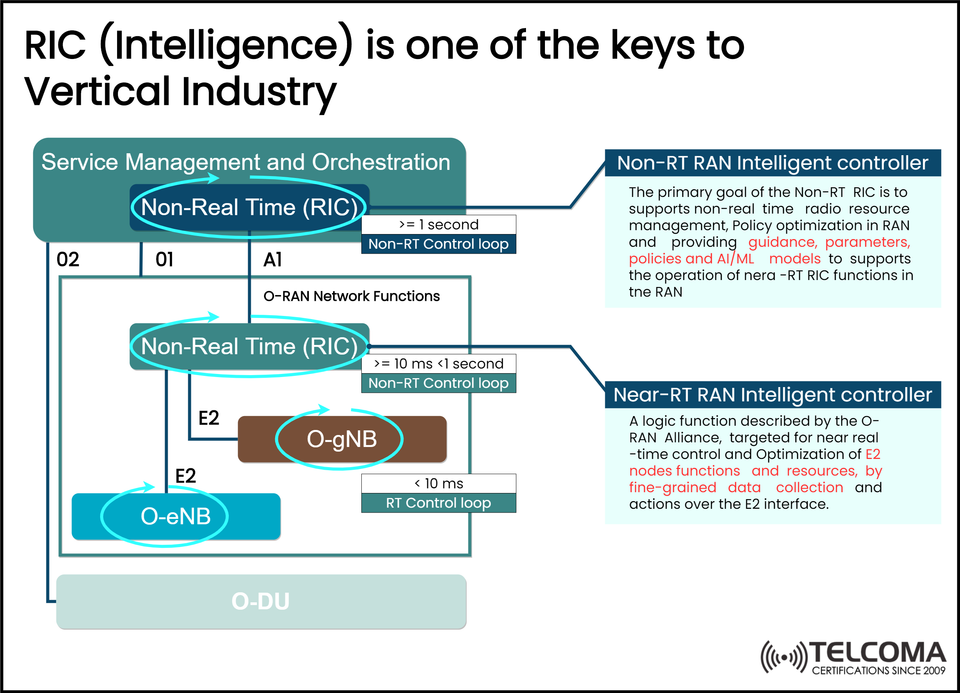
In this article, we will deconstruct the architecture shown in the above image, discuss the key interfaces (A1, E2), control loops, and discuss how RIC provides fine-grained control and automation.
🧠 What Is RIC in Open RAN?
RIC (RAN Intelligent Controllers) is a logical function in the O-RAN architecture that adds intelligence and programmability into the radio access network. RIC is broken into two functional parts:
Non-RT RIC: Responsible for non-real-time optimization (>1s latency)
Near-RT RIC: Responsible for near-real-time control (10ms – 1s latency)
These layers communicate with standard interfaces such as A1 (communication between non-RT RIC and near-RT RIC), and E2 (communication between near-RT RIC and E2 nodes (gNB's, eNB's etc.)).
📶 Major Interfaces in RIC Architecture
Interface Connects Function
A1 Non-RT RIC ↔ Near-RT RIC Policy, guidance, and AI models
E2 Near-RT RIC ↔ O-eNB / O-gNB / O-DU Control and monitoring of RAN nodes
O1/O2 Service Management & Orchestration ↔ Network Functions Configuration, Performance and Fault information
⏱️ RIC Control Loop Timing
RIC enables three types of control loops, based on timing and responsiveness requirements:
Non-RT Control Loop (greater than or equal to 1 second)
Straw by non-RT RIC for long-term planning, training AI models, and providing policy guidance.
Near-RT Control Loop (greater than or equal to 10ms and less than 1 second)
Served by near-RT RIC for fast optimization of networks - such as frequency-hopping and interference mitigation.
Real-Time Loop (less than 10ms)
Resides at the O-DU and RAN nodes, due to the strict latency limits.
🧭 Non-Real-Time RIC: Strategic Optimizer
The non-RT RIC sits in the SMO architecture, responsible primarily for the following functions:
- AI/ML model training and inference
- Policy development and lifecycle management
- Providing guidance on radio resources management
- Multi-vendor coordination
Policies, parameters and analytics are communicated to the near-RT RIC over the A1 interface to influence RAN behavior in time-sensitive scenarios.
⚙️ Near-Real-Time RIC: Tactical Executors
The Near-RT RIC interfaces with the actual E2 nodes (e.g. O-eNB, O-gNB, O-DU) through the E2 interface and executes instantaneous and near-instantaneous decisions around monitoring system performance and reducing faults in the near real-time domain.
🏭 The Importance of RIC for Vertical Industries
Vertical industries have unique requirements for their respective networks:
Reliable: performance is consistent, and latency is low
Customizable: service policies and traffic shaping are not just provided, they are tailored to the industry's policies and procedures
Secure: traffic handling is isolated by policies
Adaptive: ability to respond not only in real-time but also able to operate in ways that are predictive. The RIC can produce all of the above by adding intelligence at multiple layers of control. Some examples of the benefits of RIC would be:
Manufacturing: The near-RT RIC would help ensure that robots coordinated with ultra-reliable low-latency communication (URLLC).
Healthcare: The non-RT RIC could help with utilizing AI in the policy planning process when prioritizing telehealth traffic.
Smart City: Resources from connected infrastructure and sensors can be allocated in real-time.
🌐 Benefits of RIC-Based Architecture
✅ AI-optimized (utilizing trained models and data feedback loops)
✅ Disaggregated intelligence (non-RT RIC and near-RT RIC)
✅ Vendor interoperability (standard O-RAN interfaces)
✅ Closed-loop automation (low-latency / high-efficiency control)
✅ Vertical-specific services (programmable network functions).
🧩 Summary Table:
RIC Types and Capabilities
RIC Type Timing Functions Interfaces
Non-RT RIC >1 sec AI model training, policy, orchestration A1
Near-RT RIC 10ms–1sec handover, interference mgmt. QoS E2
Real-Time Functions <10ms PHY layer tasks, scheduling Internal to O-DU
🧱 Deploying RIC in the Evolution of O-RAN
🔑 Basic Steps for Network Operators:
Integrate into a Service Management and Orchestration (SMO):
Be sure that your SMO components comply with O-RAN-defined interfaces.
Take advantage of O-1 and O-2 interfaces for configuring, and fault and performance data.
Deploy Non-RT RIC functions as part of your centralized cloud function:
This is as a way to train up all AI/ML models, and push policies into your near-RT RIC.
Ensure your A-1 interface is standardized to allow vendor drop-in.
Deploy a Near-RT RIC as close as possible to the edge of the RAN:
This allows near-RT RIC to have the lowest priority/latency-sensitive control, hence using an edge cloud or MEC just makes sense as the environment.
Deploy an xApp (modular RAN function) for mobility, QoS, and interference control.
Deploy E2 nodes ( either O-eNB, O-gNB or O-DU) to Near-RT RIC:
E2 interface enables the use near-RT RIC functions to have real-time insight (or action) into the RAN.
There are no special restrictions technically on which E2 node is connected to a near-RT RIC but be sure to collect as much performance data available and continuously monitor performance.
Design your control loops (non-RT, near-RT, and RT) in accordance to your latency needs:
To maximize the effectiveness of your RIC architecture, use the right RIC layer for the right use case to provide a balance of responsiveness vs processing complexity.
✅ Conclusion
The RAN Intelligent Controller is critical to realizing Open RAN's promise for programmable, scalable, and intelligent wireless networks. The layered approach of non-RT and near-RT RIC arms telecom operators with the necessary tools to provide precise control and automation, enabling the optimization of their networks while accommodating the demands of vertical industries.
RIC will be fundamental in supporting future evolution of networks-as-a-service with flexibility and service-awareness as we progress towards 5G and beyond applications across all vertical industries.