
TOO Precocious Handover in LTE and 5G: Causes, Signaling, and Optimization Strategies

TOO Precocious Handover in LTE and 5G Networks: A Comprehensive Guide
Mobility management is central to wireless networks today. As users move between cells, handover mechanisms are crucial for keeping connections alive without dropped calls or interrupted data sessions. However, when these handovers happen too early, we encounter a problem known as TOO Precocious Handover.
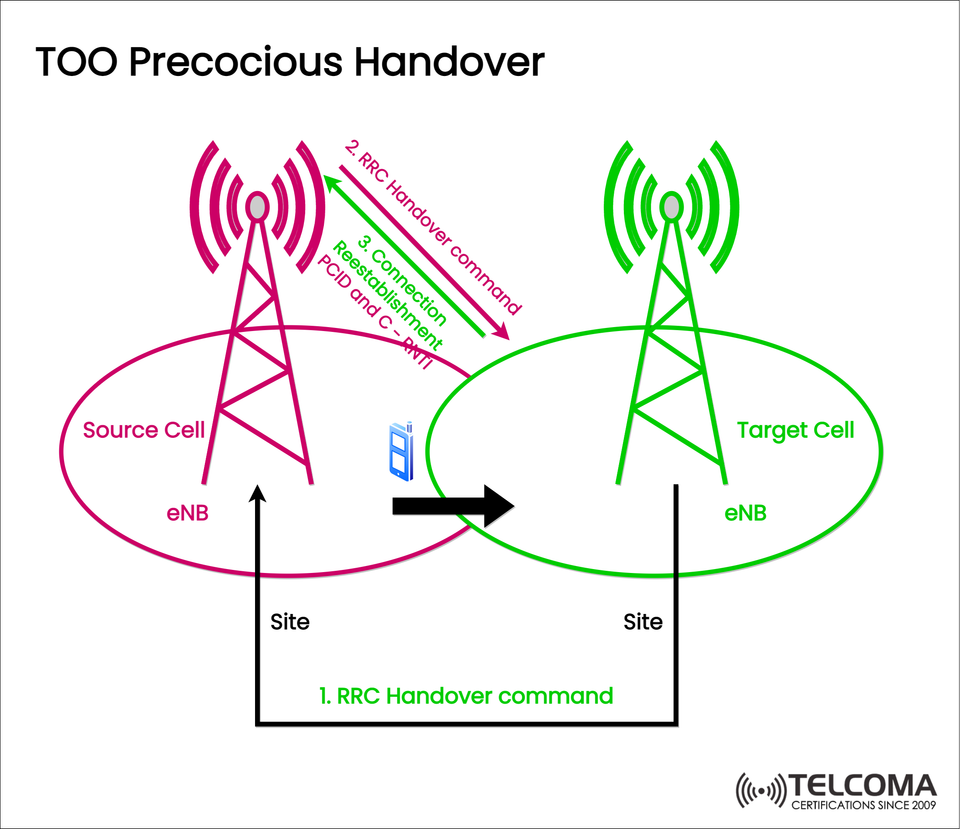
The diagram we uploaded clearly shows what happens in this situation:
The source cell sends an RRC Handover Command to the UE.
The handover takes place prematurely, before the target cell is ready.
The UE can't stabilize and must start a connection reestablishment with the target cell, using PCID and C-RNTI.
In this article, we’re going to dive into TOO Precocious Handover—we'll explain what it is, how signaling works, what causes it, its impacts, and ways to optimize it in LTE and 5G networks.
- What is TOO Precocious Handover?
TOO Precocious Handover describes a handover failure scenario where the UE (User Equipment) switches to the target cell too soon. At that moment, the target cell’s signal isn’t strong enough for reliable communication, which means the UE has to reestablish its connection.
Instead of a smooth transition, users may face delays, interruptions, or even dropped calls.
Key Characteristics:
Handover initiated before the optimal threshold.
Target cell doesn’t have enough coverage for the UE.
UE tries to perform RRC Connection Reestablishment.
Standard Handover Process in LTE/5G
To understand where TOO Precocious Handover happens, let’s quickly review the normal handover process:
Measurement Reports * The UE sends periodic updates on RSRP, RSRQ, and SINR to the serving cell.
Handover Decision * The source cell decides the right moment to trigger the handover based on certain thresholds and mobility settings.
RRC Handover Command * The source cell tells the UE to switch over to the target cell.
Handover Execution * The UE synchronizes with the target cell, creating a new RRC connection.
Handover Completion * The target cell confirms to the network that the process is finished.
In the case of TOO Precocious Handover, the issue arises during step 2 (decision-making), where the handover is called too early.
TOO Precocious Handover Signaling Flow
The signaling steps shown in the image can be broken down like this:
RRC Handover Command (Source → UE) * The source eNB/gNB issues the handover command too soon.
Premature Handover Execution * The UE moves toward the target, only to find that the signal quality isn’t good enough yet.
Connection Reestablishment (Target Cell) * The UE carries out RRC Reestablishment using PCID (Physical Cell ID) and C-RNTI (Cell Radio Network Temporary Identifier).
This reestablishment causes delays and can destabilize the session.
Causes of TOO Precocious Handover
Several technical reasons can lead to early handover triggers:
Aggressive Mobility Parameters * Low handover thresholds or short Time-to-Trigger (TTT).
Fast UE Speed * When users move quickly, their measurements can fluctuate, leading to early handovers.
Ping-Pong Effect * The UE gets handed back and forth between two cells because of misconfigured hysteresis settings.
Load Balancing Bias * Some networks prioritize load sharing and push UEs too early into cells with lighter loads.
Radio Environment Variability * Temporary measurement fluctuations result in incorrect handover decisions.
- Impacts of TOO Precocious Handover
Higher Call Drop Rate * VoLTE or VoNR calls can get severely affected by unstable transitions.
Service Interruptions * Activities like streaming, gaming, or video calls might get interrupted or freeze.
Signaling Overhead * Frequent reestablishments consume network resources unnecessarily.
Poor User Experience * Users often feel a drop in reliability and slower connectivity.
- Optimization Strategies
To reduce instances of TOO Precocious Handover, telecom engineers can implement various strategies:
a. Fine-tuning Mobility Parameters
Adjust Time-to-Trigger (TTT) to prevent premature handovers.
Utilize hysteresis to mitigate ping-pong handovers.
b. Adaptive Mobility Profiles
Customize parameters based on whether the UE is stationary or in a vehicle.
c. Load-aware Handover Management
Strike a balance between load distribution and signal strength-based handovers.
d. Radio Environment Prediction
Apply AI/ML algorithms to anticipate UE mobility patterns and delay unnecessary handovers.
e. Interference Mitigation
Optimize frequency usage and implement Inter-Cell Interference Coordination (ICIC) or Coordinated Multi-Point (CoMP) approaches.
- TOO Precocious Handover in LTE vs 5G
Aspect LTE Networks5G NR Networks Triggering RSRP/RSRQ-based thresholds Beam-level & advanced HO algorithms Voice Services Likely VoLTE drops VoNR is sensitive to early HO Data Services Packet loss, delay Lower latency but still interruptions Optimization Parameter tuning AI-driven mobility, network slicing Mobility Speed Challenging above 120 km/h Supports higher speeds but still prone to early HO
In 5G, beam-level mobility helps cut down on premature handovers, but dense deployments with small cells can increase the chances of running into this problem.
- Use Cases Where TOO Precocious Handover Happens
Urban Microcells * Densely packed cells can lead to early handover decisions due to quick signal fluctuations.
Highway Mobility * Fast-moving vehicles can trigger handovers earlier than ideal.
Load Balancing Scenarios * Networks that enforce early handovers for traffic management can lead to TOO Precocious failures.
Indoor/Outdoor Transitions * Moving from indoors to outdoors can create sudden shifts in RSRP, causing premature handovers.
- Best Practices for Telecom Engineers
Routinely check Handover Failure KPIs (HO Failure Rate, Call Drop Rate).
Implement self-optimizing networks (SON) for adaptive handover adjustments.
Conduct drive tests and analyze UE trace logs to spot early handover instances.
Use AI-based predictive models in 5G networks for smarter handovers.
Conclusion
TOO Precocious Handover poses a significant mobility management challenge in both LTE and 5G networks. Unlike the TOO Arrear Handover, where the transition happens too late, this issue occurs too early, leaving the UE struggling to stabilize on the target cell.
By carefully fine-tuning mobility parameters, managing interference effectively, and utilizing AI-driven predictive handover algorithms, operators can significantly cut down on early handover failures.