
Top 10 Emerging Technical Trends Shaping the Future of Telecom and Technology
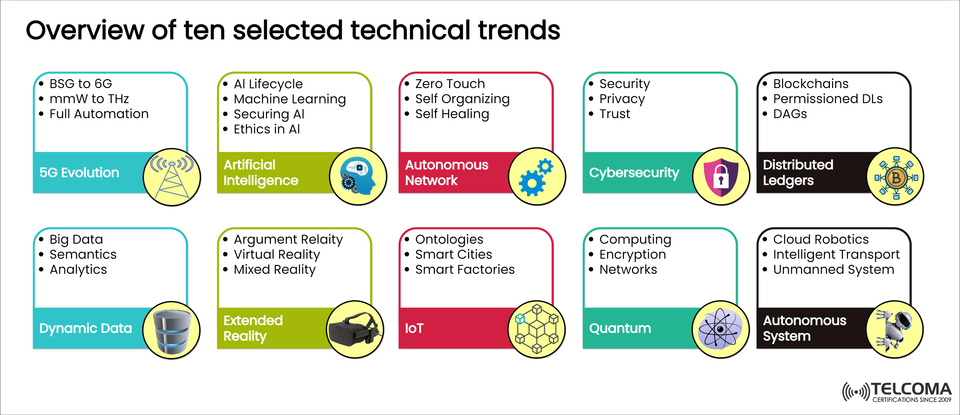

A Look at Ten Key Tech Trends Shaping the Future
The tech scene is changing rapidly. With advancements from 5G to Quantum Computing and Artificial Intelligence, these new trends are altering the way networks function, how devices talk to each other, and how data is handled.
This overview dives into ten key tech trends, each significantly influencing the next wave of telecommunications, digital transformation, and smart automation.
- 5G Evolution: The Path to 6G
The journey with 5G is just getting started — it’s evolving toward 6G, which promises faster speeds, incredibly low latency, and complete automation.
Key Areas of Focus:
Transitioning from 5G to 6G: Going past traditional cellular networks to dense, high-frequency 6G systems.
From mmWave to THz Spectrum: Using millimeter-wave and terahertz frequencies for high data throughput.
Total Automation: Allowing for autonomous management of networks, predictive maintenance, and self-optimizing processes.
Why It’s Important:
The technologies behind 5G and future 6G are crucial for building smart cities, self-driving vehicles, and Industry 4.0, creating a highly connected digital ecosystem.
- Artificial Intelligence: The Brain Behind Next-Gen Networks
AI is powering automation, boosting efficiency, and sparking innovation in the telecom space.
Core Ideas:
Managing the AI Lifecycle: Keeping tabs on, optimizing, and rolling out AI models.
Machine Learning: Algorithms that enhance predictions, optimizations, and user experiences.
Securing AI: Putting safeguards in place against data bias and other attacks.
AI Ethics: Making sure AI-driven decisions are transparent, fair, and accountable.
Impact of AI:
From predictive maintenance to understanding customer behavior, AI helps telecom companies cut costs, boost network reliability, and enhance user experiences.
- Autonomous Networks: Self-Driven Intelligence
Telecom networks are becoming self-configuring, self-optimizing, and self-healing, largely due to the rise of autonomous designs.
Key Features:
Zero Touch Operations: Reducing the need for human input in managing networks.
Self-Organizing Networks (SON): Automating configuration and optimization processes.
Self-Healing Systems: Automatically spotting and fixing network issues.
Industry Perspective:
Managing the intricacies of 5G and edge computing calls for autonomous networks, which ensure reliability and adaptability on a large scale.
- Cybersecurity: Protecting Our Connected World
As connectivity expands, so do the risks. Cybersecurity is now a critical part of every telecom layer.
Essential Elements of Cybersecurity:
Security: Safeguarding systems from breaches and cyberattacks.
Privacy: Protecting user and enterprise information.
Trust: Developing transparent and verifiable systems that users can count on.
Relevance to Telecom:
With millions of IoT devices and 5G endpoints out there, network security and data encryption have become not just important, but essential for business.
- Distributed Ledgers: Instilling Trust through Transparency
Blockchain and Distributed Ledger Technologies (DLTs) are changing how trust is built in digital systems.
Key Technologies:
Blockchains: Immutable and decentralized databases for secure transactions.
Permissioned DLTs: Systems with controlled access for enterprise applications.
DAGs (Directed Acyclic Graphs): Advanced ledger structures that enhance scalability and speed.
Telecom Applications:
Managing identities and preventing fraud
Creating transparent billing and roaming agreements
Ensuring secure data exchange for IoT
Why It’s Critical:
Distributed ledgers are bringing decentralized trust to telecom, paving the way for secure, traceable, and auditable data transactions.
- Dynamic Data: The Lifeblood of Digital Transformation
Data is often seen as the new oil — but it’s the dynamic, contextual data that drives good decision-making.
Core Ideas:
Big Data: Handling huge amounts of structured and unstructured data.
Semantics: Grasping the meaning behind data for better understanding.
Analytics: Gleaning insights for timely decision-making.
Real-World Use:
Telecom operators are using dynamic data for optimizing networks, improving user experiences, and predictive analytics.
- Extended Reality (XR): Blending Physical and Digital Realms
Extended Reality (XR) covers AR (Augmented Reality), VR (Virtual Reality), and MR (Mixed Reality) — and it’s transforming how users interact and experience things remotely.
Elements:
Augmented Reality (AR): Adding digital info to real-world settings.
Virtual Reality (VR): Crafting fully immersive digital experiences.
Mixed Reality (MR): Merging AR and VR for interactive experiences.
Telecom Use Cases:
Remote maintenance via AR overlays.
Virtual training spaces for field technicians.
Engaging customer experiences in gaming and entertainment.
As 5G boosts bandwidth and reduces latency, XR applications are set to thrive, opening up fresh avenues for engagement and creativity.
- Internet of Things (IoT): The Backbone of Connectivity
IoT continues to be the core of our connected world, tying together billions of devices and systems.
Key Focus Areas:
Ontologies: Structuring IoT data for better interoperability.
Smart Cities: Managing urban infrastructure in real-time.
Smart Factories: Powering Industry 4.0 with automated manufacturing and logistics.
Outcomes:
IoT fuels intelligent automation, enhances efficiency, and promotes sustainability — connecting everything from smart meters to self-driving cars under the broader 5G umbrella.
- Quantum Technologies: Changing the Game for Computing and Security
Quantum computing isn’t just theory anymore — it’s reshaping encryption, computation, and network security.
Core Applications:
Quantum Computing: Tackling complex problems way faster than classical computers.
Quantum Encryption: Offering unbreakable communication through quantum key distribution (QKD).
Quantum Networks: Creating interconnected systems that are tough to hack.
Why Telecom Should Care:
Quantum technologies promise to redefine data processing, cryptography, and signal optimization, ushering in a new era of telecom innovation.
- Autonomous Systems: The Emergence of Intelligent Machines
Autonomous systems are smart, adaptable, and able to operate independently in complex settings.
Key Features:
Cloud Robotics: Robots using cloud computing for better intelligence and collaboration.
Intelligent Transport: Self-driving vehicles that communicate via 5G networks.
Unmanned Systems: Drones and automated tech for logistics, surveillance, and delivery.
Role of Telecom:
5G delivers the ultra-reliable, low-latency communication (URLLC) required for autonomous systems to function safely and effectively.
Summary Table: Ten Key Tech Trends
TrendKey Focus AreasPrimary Impact5G Evolution6G, mmWave, AutomationUltra-low latency and global connectivityArtificial IntelligenceML, AI Ethics, AutomationIntelligent network operationsAutonomous NetworksZero Touch, Self-HealingAutomated and resilient infrastructureCybersecuritySecurity, Privacy, TrustData and network protectionDistributed LedgersBlockchain, DAGsDecentralized transparencyDynamic DataBig Data, SemanticsReal-time insightsExtended RealityAR, VR, MRImmersive digital experiencesIoTSmart Cities, FactoriesConnected, data-driven environmentsQuantumComputing, EncryptionNext-gen computation and securityAutonomous SystemsRobotics, DronesIntelligent automation and mobility
Wrapping Up
These ten tech trends are shaping the future of technology and telecommunications. As 5G matures and AI dives deeper into network operations, breakthroughs like quantum encryption, autonomous systems, and XR experiences will push the limits of innovation.
For those in telecom, getting on board with these trends isn’t just a choice — it’s a necessity. The organizations that adapt now are positioned to lead the way into a smarter, more connected, and automated future.