
Top 6 Use Cases of 6G: How Next-Gen Networks Will Transform Connectivity

Exploring 6G Use Cases: Shaping the Future of Connectivity
Even as 5G continues its rollout around the globe, researchers and telecom innovators are already dreaming up 6G—the next leap in wireless communication. While 5G mainly boosted speed, capacity, and latency, 6G aims to blend the physical, digital, and biological realms, leading to futuristic applications that once seemed like something out of a sci-fi novel.
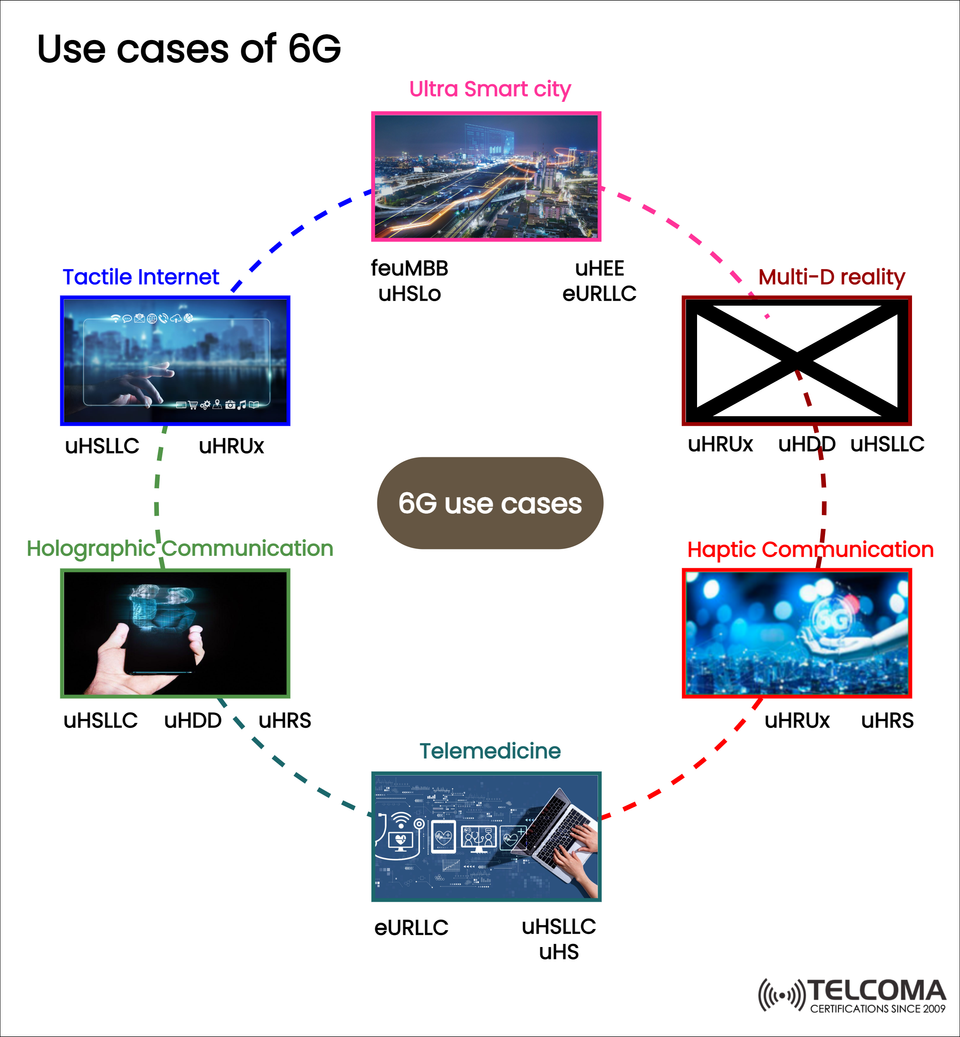
The image shared outlines six key use cases of 6G, each driven by specific performance requirements like eURLLC (enhanced Ultra-Reliable Low Latency Communication), uHRUx (ultra-High Reliability Uplink/Downlink), and uHSLLC (ultra-High-Speed Low Latency Communication).
Let’s unpack these six game-changing 6G use cases and see how they could redefine our future.
- Ultra-Smart Cities
Smart cities powered by 5G are starting to pop up, but 6G is set to elevate them—transforming smart into truly intelligent.
Features of Ultra-Smart Cities with 6G:
FeuMBB (Future enhanced Ultra Mobile Broadband): Enables real-time analytics and high-definition surveillance in urban environments.
uHSLo (Ultra High-Speed Low Latency): Allows instant communication among millions of IoT devices.
uHEE (Ultra High Energy Efficiency): Promotes sustainable, energy-friendly city infrastructures.
eURLLC (Enhanced URLLC): Supports vital services like smart grids, disaster management, and emergency response.
With 6G, cities will act like living entities, adapting in real time to the needs of their inhabitants.
- Multi-Dimensional (Multi-D) Reality
Multi-Dimensional Reality goes beyond the current VR and AR tech. It envisions immersive digital landscapes that mesh seamlessly with our physical surroundings.
Enablers for Multi-D Reality:
uHRUx (Ultra High Reliability Uplink/Downlink): Ensures steady connections within immersive settings.
uHDD (Ultra High Data Density): Handles massive data transfer for holographic and 3D experiences.
uHSLLC: Provides ultra-low latency for real-time responses.
Use Cases:
Virtual tourism in fully immersive worlds.
Remote teamwork with lifelike avatars.
Training simulations across healthcare, defense, and aviation sectors.
Multi-D reality will blur the lines between physical and digital worlds, all thanks to the power of 6G.
- Haptic Communication
While current communication typically relies on visual and auditory cues, 6G brings touch into the digital realm through haptic communication.
Technical Enablers:
uHRUx: Ensures reliable, two-way data flow.
uHRS (Ultra High Reliability Sensing): Supports applications requiring delicate tactile feedback.
Use Cases:
Remote surgeries where doctors can feel the procedure in real time.
Online shopping where customers can “touch” materials virtually.
Gaming experiences that integrate physical sensations into digital worlds.
Haptic communication will transform how we interact with each other and with machines, making remote experiences feel almost like physical ones.
- Telemedicine
6G is set to change healthcare dramatically by enabling telemedicine far beyond what we know now with just video calls.
Requirements for Telemedicine in 6G:
eURLLC: Guarantees ultra-reliable, low-latency communication for remote medical procedures.
uHSLLC: Allows real-time sharing of high-res imaging and patient data.
uHS (Ultra-High Speed): Facilitates smooth communication for advanced medical applications.
Potential Applications:
Remote robotic surgeries with zero delay.
Continuous monitoring of patients through wearables and implants.
AI-driven diagnostics supported by real-time imaging and data analysis.
With 6G, healthcare can become genuinely global, connecting urban hospitals with rural patients seamlessly.
- Holographic Communication
Thanks to 6G, holographic calls are moving from the realm of fiction into our daily lives.
Technical Enablers:
uHSLLC: Ensures ultra-low latency for smooth hologram rendering.
uHDD: Provides high-density data needed for streaming 3D holograms.
uHRS: Guarantees reliability for critical communications.
Example Scenarios:
Business meetings with participants appearing as holograms.
Education with teachers presented as 3D holograms.
Entertainment experiences featuring live holographic performances.
Holographic communication will change the way we socialize, making physical presence optional.
- Tactile Internet
The tactile internet ramps up interactivity by allowing real-time touch-sensitive control. It demands ultra-low latency (sub-millisecond), making it one of the most challenging applications for 6G.
Key Enablers:
uHSLLC: Offers ultra-fast and reliable responses.
uHRUx: Ensures real-time control remains uninterrupted.
Applications:
Remote operation of industrial robots with instant feedback.
Autonomous vehicles communicating with each other and their environment in real time.
Precision agriculture with remote-controlled farming tools.
The tactile internet will create a new level of connection between people and machines, enabling lightning-fast remote control on a global scale.
Comparing 6G Use Cases and Their Requirements
Use Case Key Requirements Ultra-Smart Cities feuMBB, uHSLo, uHEE, eURLLC Multi-D Reality uHRUx, uHDD, uHSLLC Haptic Communication uHRUx, uHRS Telemedicine eURLLC, uHSLLC, uHS Holographic Comm. uHSLLC, uHDD, uHRS Tactile Internet uHS LLC, uHRUx
This chart highlights how each use case relies on a distinct mix of ultra-reliable, high-speed, low-latency communication standards.
From Vision to Reality: How 6G Will Make It Happen
To bring these use cases to life, 6G needs a number of technology enablers, which include:
AI-driven intelligence for networks that adapt on their own.
THz communication for lightning-fast data transfer.
Quantum security for unbeatable encryption.
Ultra-massive MIMO and smart surfaces for better coverage.
Digital twins to simulate and optimize operations in real-time.
Without these key technologies, the exciting 6G use cases would remain just ideas.
Wrap Up
Moving from 5G to 6G isn’t just about boosting speeds—it's about transformative use cases that will reshape industries and how we connect with each other.
Ultra-smart cities will evolve into adaptable, responsive systems.
Multi-D reality and holographic communication will make immersive experiences part of our everyday lives.
Telemedicine and haptic communication will extend our senses across distances, enabling critical applications.
Tactile internet will facilitate instant human-machine collaboration on a global scale.
✅ Final Thought: By combining ultra-reliable, high-speed, and low-latency communications, 6G will unify the physical and digital realms, opening doors to applications that could transform society as we know it.