
Top 8 Technology Enablers of 6G: Building the Future of Wireless Connectivity
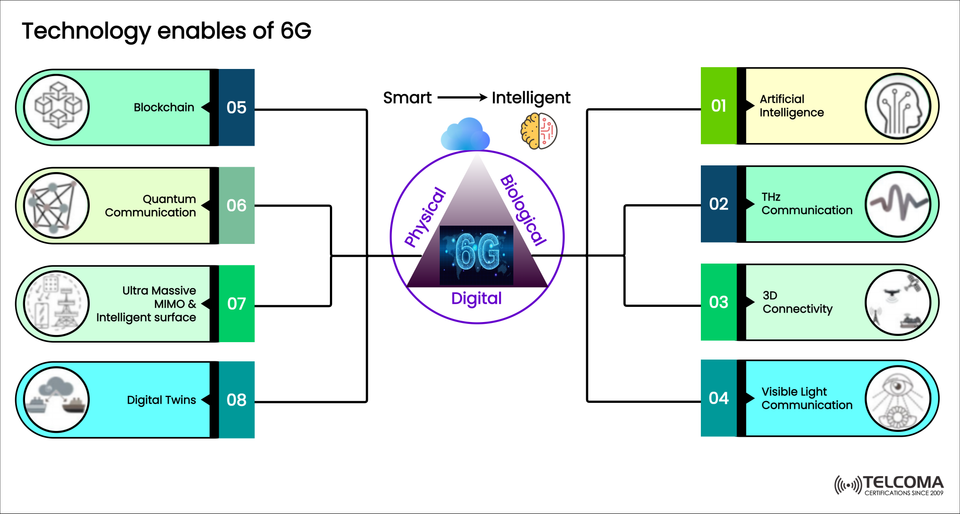

Technology Enablers of 6G: The Road to Intelligent Connectivity
The shift from 5G to 6G isn't just about getting faster speeds. It's really about changing how we think about connectivity—moving beyond smart systems to truly intelligent networks. While 5G is all about boosting mobile broadband, ultra-low latency, and handling lots of devices, 6G aims to blend the physical, digital, and biological worlds together.
This change will be driven by several key technology enablers that lay the groundwork for smart wireless ecosystems, paving the way for new applications like holographic communication, the tactile internet, brain-computer interactions, and advanced digital twins.
The diagram uploaded showcases 8 major technology enablers of 6G. Let’s take a closer look at each of them.
- Artificial Intelligence (AI) in 6G
AI will be woven into every layer of the 6G network stack. Unlike its role in 5G, where it's mainly used for optimization, in 6G, AI becomes native intelligence—a core feature.
Role of AI in 6G:
Self-optimizing networks (SON): AI helps optimize spectrum, power, and routing in real-time.
Predictive resource allocation: It anticipates what users and devices will need before congestion hits.
Enhanced security: AI can spot anomalies and threats with machine learning.
Cognitive networks: The network learns, adapts, and evolves based on usage.
Basically, AI is like the brain driving 6G, making networks proactive, adaptive, and context-aware.
- Terahertz (THz) Communication
One of the most intriguing features of 6G is THz communication (operating in the 0.1–10 THz frequency range). This spectrum offers ultra-high data rates—up to terabits per second.
Benefits of THz Communication:
Massive bandwidth that supports holographic and 3D communications.
Ultra-low latency ideal for tactile internet applications.
Short-range, ultra-high-speed links perfect for urban areas.
THz will be essential for achieving 6G’s extreme performance goals, opening doors to applications like holographic conferencing and immersive XR experiences.
- 3D Connectivity
While 5G mostly connects devices on the ground, 6G expands connectivity vertically—to land, air, and even space.
Features of 3D Connectivity:
Satellite-terrestrial integration: Offers seamless global coverage.
Drone communication platforms: Extends coverage to hard-to-reach areas.
Aerial and space-based base stations: Guarantees service availability everywhere.
With 3D connectivity, 6G turns into a global, borderless network, ready to serve users anywhere on the planet (and beyond).
- Visible Light Communication (VLC)
Visible Light Communication, or Li-Fi, takes advantage of LED light waves to transmit data wirelessly.
Advantages of VLC in 6G:
High-capacity indoor networks (think offices, hospitals, or airplanes).
Unlicensed spectrum: Helps ease congestion in traditional RF bands.
Secure communication: Since light can't pass through walls, it cuts down on interference and eavesdropping.
VLC will work alongside radio-based 6G, especially for indoor high-speed connectivity.
- Blockchain Integration
With 6G expected to support billions of devices, security and trust become critical. Blockchain offers a decentralized solution to handle this complexity.
Blockchain in 6G:
Decentralized security: Protects data integrity without a central authority.
Trust in IoT: Facilitates secure device authentication and transactions.
Transparent spectrum management: Keeps track of fair allocation and use records.
Blockchain makes sure that 6G networks are not just fast but also secure, reliable, and trustworthy.
- Quantum Communication
Quantum communication is set to transform security in 6G networks through unbreakable encryption techniques.
Benefits of Quantum Communication:
Quantum key distribution (QKD): Allows for communication that's theoretically unhackable.
Secure cross-border data exchange: Protects sensitive information for governments and financial institutions.
Defense against quantum computing attacks: Keeps security robust for the future.
Quantum communication will form the security foundation of 6G, making data transmission nearly tamper-proof.
- Ultra Massive MIMO & Intelligent Surfaces
While 5G brought us massive MIMO, 6G takes it up a notch with Ultra Massive MIMO and Reconfigurable Intelligent Surfaces (RIS).
Capabilities:
Higher spectral efficiency: Thousands of antennas can support terabit speeds.
Dynamic signal control: RIS can adjust the reflection and focusing of signals smartly.
Coverage in tricky areas: Enhances signals in crowded urban or indoor spaces.
Together, Ultra Massive MIMO and RIS turn the wireless environment into a programmable space, boosting coverage and efficiency.
- Digital Twins in 6G
Digital twins create virtual replicas of physical objects, networks, or environments, allowing for real-time monitoring and optimization.
Use Cases in 6G:
Network management: Models and predicts network performance.
Industry 4.0: Simulates factories, logistics, and supply chains.
Smart cities: Develops digital versions of cities for planning and crisis management.
Digital twins in 6G facilitate proactive, real-time decision-making, closing the gap between the physical and digital worlds.
Technology Enablers of 6G at a Glance
Here’s a quick table summarizing the 8 technology enablers of 6G:
Technology Enabler Key Contribution1Artificial Intelligence Built-in intelligence for autonomous networks2THz Communication Ultra-fast, low-latency communication3D Connectivity Effortless global land-air-space integration4Visible Light Communication Secure and high-capacity indoor links5BlockchainDecentralized security and trust management6Quantum Communication Impenetrable encryption for secure networks7Ultra Massive MIMO & RIS Programmable, high-efficiency wireless environments8Digital Twins Real-time virtual replicas for optimization
Smart → Intelligent: The Evolution of 6G
At the heart of 6G is the shift from “smart” to “intelligent” connectivity.
Smart networks (5G): Respond to situations based on set rules.
Intelligent networks (6G): Proactively learn, adapt, and evolve using AI, quantum tech, and advanced sensing.
This transition means that 6G will not just link devices but also interconnect the physical, digital, and biological worlds.
Conclusion
The journey to 6G revolves around game-changing technologies coming together into one unified ecosystem. From AI-driven intelligence to THz communication, blockchain security, quantum encryption, and digital twins, each enabler plays a crucial role in redefining how we connect.
6G won’t just offer faster speeds; it’s set to blur the lines between the physical, digital, and biological realms, fueling innovations like holographic communication, immersive XR, and brain-computer interfaces.
For telecom professionals and tech enthusiasts, getting a handle on these 8 enablers is key to gearing up for the next wave of digital transformation.