
Top Applications of 5G: eMBB, mMTC, and URLLC Use Cases Explained
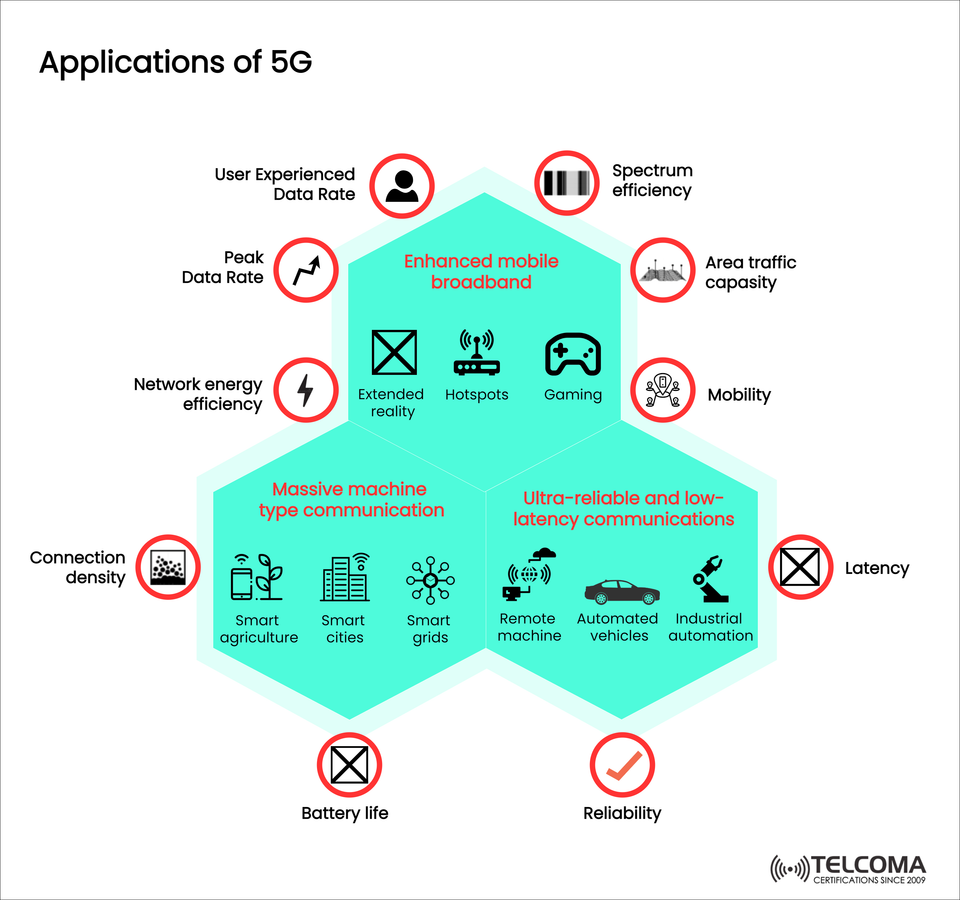

5G technology is a major milestone in the world of wireless communication. Unlike 4G, which mainly boosted mobile internet speeds, 5G offers three different applications tailored to meet various needs:
Enhanced Mobile Broadband (eMBB) for faster internet, gaming, and immersive experiences.
Massive Machine-Type Communication (mMTC) designed for IoT-driven environments, like smart cities and agriculture.
Ultra-Reliable and Low-Latency Communication (URLLC) aimed at critical operations such as self-driving cars and industrial automation.
These applications leverage 5G’s key performance features, including super-low latency, high data rates, better energy efficiency, and the ability to connect a vast number of devices.
- Enhanced Mobile Broadband (eMBB)
Enhanced mobile broadband is the most recognized 5G application, focusing on providing faster speeds and more engaging experiences for users.
Key eMBB Use Cases:
Extended Reality (XR): Technologies like augmented reality (AR), virtual reality (VR), and mixed reality (MR) thrive on high bandwidth and low latency. With 5G, we can create realistic simulations and immersive experiences in fields like education, healthcare, and entertainment.
Crowded Areas: 5G ensures a smooth connection in busy places like stadiums, airports, and city centers, where 4G often struggles to keep up.
Cloud Gaming: Thanks to 5G, gaming is shifting to the cloud, allowing players to enjoy console-level games on mobile without any delays.
Benefits of eMBB:
User-experienced data rates of 100 Mbps and up.
Peak data rates reaching 20 Gbps, making for incredibly fast downloads.
Better spectrum use and traffic capacity, which supports large gatherings without issues.
- Massive Machine-Type Communication (mMTC)
5G paves the way for massive IoT ecosystems, allowing millions of devices to connect in a small area—vital for the future of smart cities and industries.
Key mMTC Use Cases:
Smart Agriculture: With 5G-powered IoT sensors, farmers can monitor things like soil moisture and crop health, leading to precision farming and increased productivity.
Smart Cities: From smart traffic signals to connected public safety systems, 5G helps cities become more efficient, eco-friendly, and user-centered.
Smart Grids: 5G enables real-time monitoring of power grids for efficient energy distribution and fewer outages.
Benefits of mMTC:
Connection density can go up to 1 million devices per km².
Lower energy consumption, which extends the battery life of IoT devices.
Facilitates predictive analytics and automation on a large scale.
With mMTC, 5G truly becomes the backbone of the IoT, driving us towards fully connected environments.
- Ultra-Reliable and Low-Latency Communication (URLLC)
URLLC might be the most groundbreaking feature of 5G, offering latency as low as 1 ms along with high reliability. This is crucial for mission-critical applications where even a slight delay can have serious consequences.
Key URLLC Use Cases:
Remote Machinery: Industrial robots and remote equipment can operate more safely and accurately, fostering Industry 4.0.
Self-Driving Vehicles: Autonomous cars require dependable connectivity for vehicle-to-vehicle (V2V) and vehicle-to-infrastructure (V2I) communication.
Industrial Automation: Smart factories benefit from real-time machine control, predictive maintenance, and effortless AI integration.
Benefits of URLLC:
Ultra-low latency (as low as 1 ms).
High reliability, which is crucial for mission-critical tasks.
Supports healthcare innovations, such as robotic surgeries and online patient monitoring.
URLLC holds the potential to change industries where safety, accuracy, and reliability are non-negotiable.
- Key Performance Enablers Driving 5G Applications
The success of 5G applications relates to its performance targets, which outshine those of 4G/LTE in several areas:
Peak Data Rate: Up to 20 Gbps, speeding up downloads.
User-Experienced Data Rate: Average of 100 Mbps for everyday smoothness.
Latency: Reduced to 1 ms, making real-time applications possible.
Connection Density: Up to 1 million devices/km², supporting large-scale IoT.
Mobility Support: Connectivity for speeds up to 500 km/h, perfect for fast trains.
Network Energy Efficiency: 100 times better than 4G.
Spectrum Efficiency: Three times improved usage of available frequencies.
Area Traffic Capacity: 100-fold enhancement for crowded settings.
These metrics make sure that 5G isn’t just faster; it’s smarter, denser, and more trustworthy than older technologies.
Comparative Table: 5G Applications at a Glance
5G Application | Use Cases | Performance Features
Enhanced Mobile Broadband (eMBB) | XR, Hotspots, Cloud Gaming | High data rate, spectrum efficiency
Massive Machine-Type Communication (mMTC) | Smart cities, smart agriculture, smart grids | High connection density, long battery life
Ultra-Reliable Low-Latency Communication (URLLC) | Remote machines, autonomous vehicles, industrial automation | Low latency, high reliability
Why Applications of 5G Matter
The real strength of 5G lies in its ability to meet diverse and demanding requirements all at once. Unlike 4G, which was mainly for consumer broadband, 5G caters to:
Consumers looking for better experiences in gaming, video, and extended realities.
Industries needing smart automation, IoT integrations, and advanced analytics.
Society as a whole, aiming for smarter infrastructure, sustainable agriculture, and efficient energy systems.
This adaptability positions 5G as the foundation for digital advancement in economies worldwide.
Challenges in Realizing 5G Applications
Despite its promise, getting 5G applications widely adopted comes with its hurdles:
High infrastructure costs for rolling out mmWave and dense small-cell networks.
Spectrum management and regulations, which differ from country to country.
Integration issues with existing 4G and Wi-Fi networks.
Security and privacy concerns in IoT-rich environments.
Tackling these challenges will be essential to fully realize the benefits of 5G applications around the globe.
Conclusion
The applications of 5G—enhanced mobile broadband, massive machine-type communication, and ultra-reliable low-latency communication—are set to change the way we connect, work, and live. With top-notch performance in speed, reliability, latency, and scalability, 5G isn’t just an upgrade; it’s the basis for a future digital society and Industry 4.0.
For those in telecommunications, grasping these applications is crucial for building and refining next-gen networks. For tech enthusiasts, they offer a sneak peek into a world full of smart cities, self-driving cars, immersive experiences, and intelligent automation.
As we see more 5G rollouts, these applications will reshape industries, boost economies, and transform our societies, pushing us closer to a fully connected future.