
Transparent and Regenerative Non-Terrestrial Platforms in 5G Explained

The development of 5G networks is really expanding beyond just traditional ground coverage, reaching up into the skies and further through non-terrestrial networks (NTNs). With the increasing need for global connectivity, NTNs, which utilize satellites and high-altitude platforms, are becoming essential for closing the digital gap.
The 3GPP (3rd Generation Partnership Project) has laid out two main NTN architectures aimed at integrating into 5G:
Transparent Non-Terrestrial Platform
Regenerative On-Board Non-Terrestrial Platform
Each of these architectures plays a distinct role in facilitating smooth communication between User Equipment (UE), the 5G Core Network (5GC), and data networks. This blog will dive into these architectures, point out their differences, and explore how they're applied in real-world 5G setups.
What are Non-Terrestrial Networks (NTNs)?
Non-Terrestrial Networks are communication systems that depend on platforms beyond the usual ground-based setup. They include:
Geostationary Earth Orbit (GEO) satellites
Medium Earth Orbit (MEO) satellites
Low Earth Orbit (LEO) satellites
High-Altitude Platforms (HAPs)
NTNs help provide connectivity in:
Remote and rural regions
Over oceans and in the air
During disaster recovery efforts
For defense and emergency communications
By working in tandem with 5G, NTNs make sure coverage is global, reliable, and continuous.
Transparent Non-Terrestrial Platform
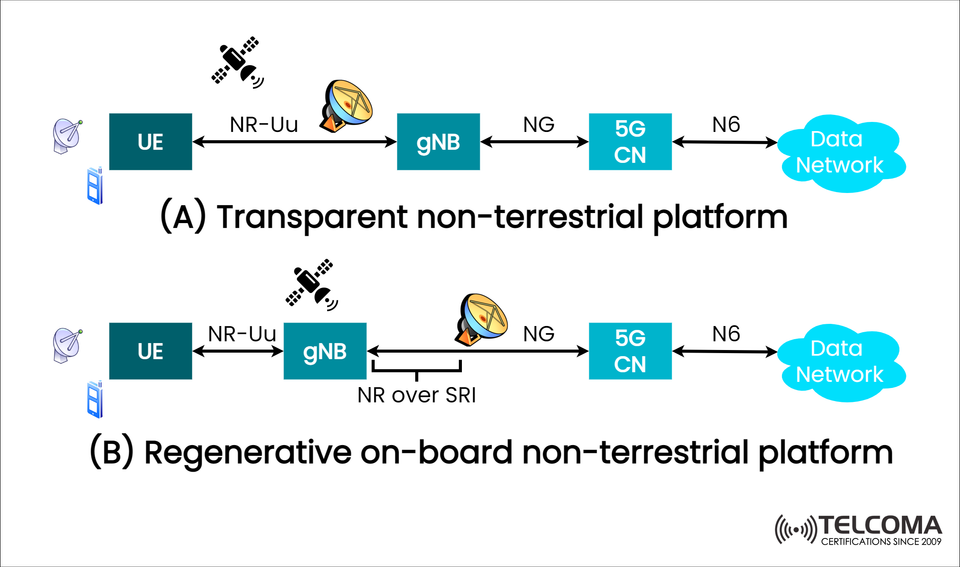
In the transparent NTN architecture (as shown in section A of the image):
The satellite serves as a “bent pipe” or relay station.
It simply passes along the radio signals (NR-Uu interface) between the UE and the gNB (next-generation Node B) on the ground.
The gNB connects to the 5G Core (5GC) via the NG interface.
Finally, the 5GC links up with the data network over N6.
Characteristics of Transparent NTN:
The satellite does not process data—just boosts and forwards signals.
It has less complexity in satellite hardware.
There’s a higher reliance on ground-based gNB infrastructure.
There’s limited flexibility for managing resources dynamically.
Regenerative On-Board Non-Terrestrial Platform
In the regenerative NTN architecture (as shown in section B of the image):
The satellite itself has a gNB onboard.
The UE communicates directly with the on-board gNB through the NR-Uu interface.
The satellite manages NR over SRI (Satellite Radio Interface) to connect with the 5G Core (5GC) through the NG interface.
The 5GC then connects to the data network via N6.
Characteristics of Regenerative NTN:
The satellite processes both data and signals locally, which cuts down on round-trip delays.
There’s less reliance on ground stations.
Advanced features like resource allocation and mobility management are possible on board.
This comes with higher satellite complexity and costs.
Key Differences Between Transparent and Regenerative Platforms
Feature Transparent Platform Regenerative Platform Architecture Satellite acts as a relay Satellite hosts on-board gNB Signal Processing Done on the ground Done in space Complexity Low (simple bent-pipe relay)High (requires processing unit)Latency Higher due to ground relay Lower thanks to on-board processing Flexibility Limited High (advanced resource management possible) Cost Lower Higher Best Use Case Areas with ground infrastructure Remote/oceanic regions with minimal ground support
Benefits of Non-Terrestrial Platforms in 5G
Each architecture brings unique advantages that enhance 5G systems:
🌍 Extended Coverage: They help maintain connectivity in underserved and remote locations.
🚀 Mobility Support: This is critical for ships, planes, and connected vehicles.
🔒 Resilience: They provide backup options if terrestrial networks go down.
📶 Scalability: They accommodate large-scale IoT deployments across the globe.
⚡ Flexibility: Regenerative platforms allow for on-the-fly resource allocation in changing environments.
Real-World Applications of NTN in 5G
Maritime Connectivity
Transparent platforms help with crew communication and navigation.
Regenerative platforms enable real-time data analytics on ships.
Aviation
In-flight connectivity services depend on NTN for broadband access.
Regenerative satellites help reduce latency for cockpit communications.
Emergency Services
Transparent NTNs can quickly restore connectivity during disasters.
Regenerative NTNs ensure ongoing communication when terrestrial sites are compromised.
IoT Expansion
Transparent NTN assists in gathering sensor data from extensive rural areas.
Regenerative NTN supports real-time control loops for industrial automation.
Challenges in NTN Deployment
While NTNs hold great potential, several challenges need to be tackled:
Latency: Particularly significant with GEO satellites, but regenerative platforms help reduce it.
Cost of Deployment: Launching and maintaining satellites can be pricey.
Interference Management: Coordination with terrestrial networks is necessary to prevent signal overlap.
Standardization: The ongoing work by 3GPP aims to ensure interoperability among vendors and platforms.
The Future of NTN in 5G and Beyond (Heading Toward 6G)
As 5G NTN architectures continue to evolve, we're looking ahead to the next major step—6G—which will depend even more on integrating non-terrestrial technologies.
🌐 Smooth Terrestrial-Non-Terrestrial Integration: In the world of 6G, users won’t even have to think about whether their signal is coming from a ground station or a satellite.
📡 AI-Driven NTN Management: Smart algorithms will take charge of resource allocation, interference management, and demand forecasting.
🛰️ LEO Satellite Mega-Constellations: Companies like SpaceX (with Starlink) and OneWeb are launching thousands of LEO satellites to create the foundation for NTN services.
🌍 Universal Service Coverage: With NTN, we’re getting closer to the goal of “connectivity everywhere, anytime,” which will support industries such as autonomous shipping, global UAV operations, and remote healthcare.
Conclusion
Bringing non-terrestrial networks into 5G systems is a game-changing step towards achieving global connectivity.
Transparent NTN platforms offer a more cost-effective, straightforward solution when terrestrial infrastructure exists.
Regenerative NTN platforms come with advanced processing abilities and lower latency, making them perfect for remote and high-mobility scenarios.
Both architectures complement each other and are likely to coexist as we move into the evolving 5G and 6G ecosystem. For telecom professionals, grasping these deployment models is crucial for planning networks that are ready for the future, ensuring ubiquitous, reliable, and resilient communication.