
UE–gNB Simulation in 5G Networks: Validating End-to-End Connectivity with LoadCore

Why UE–gNB Simulation Matters in 5G
Moving to 5G Core (5GC) and its Service-Based Architecture (SBA) opens a world of possibilities, like super-fast internet, the growth of IoT, and better services for businesses. But with all this complexity, we face the challenge of making sure everything works as it should.
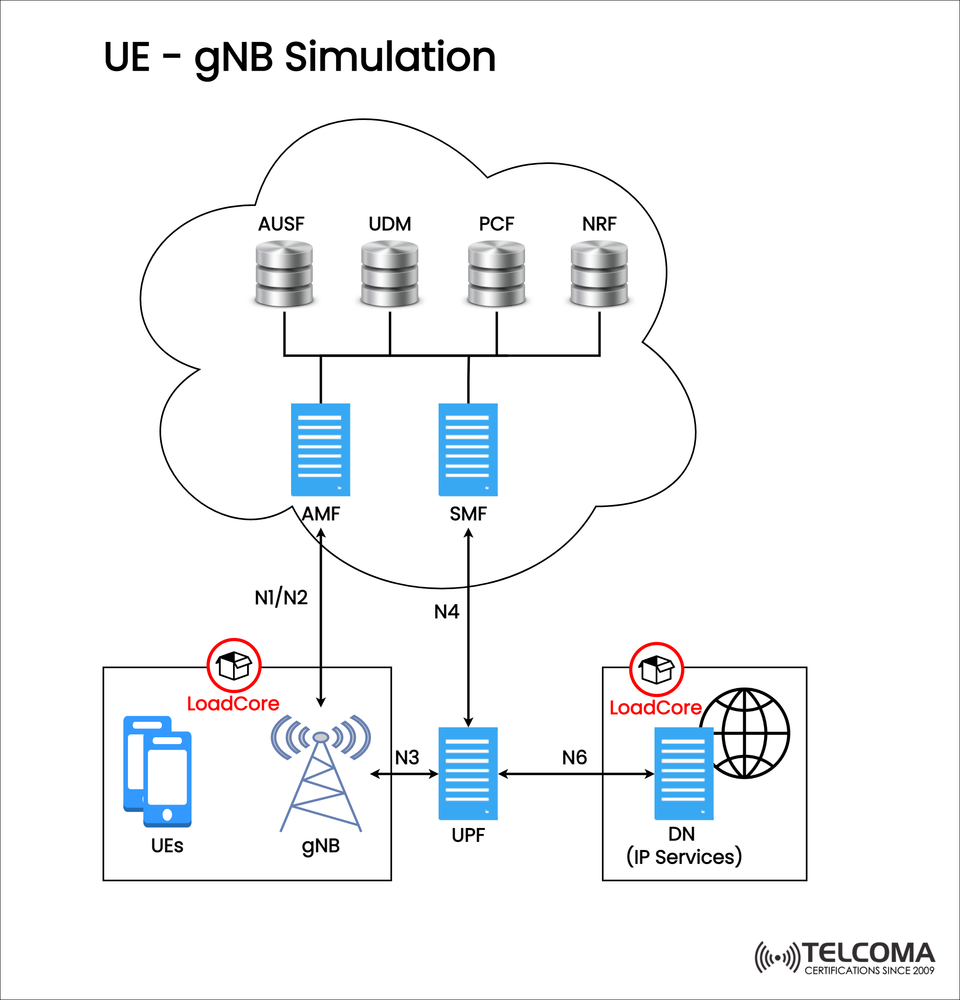
That’s where UE–gNB simulation comes into play. By simulating User Equipment (UE) and gNodeB (gNB), network operators and vendors can see how actual traffic interacts with key 5G Core elements like the AMF, SMF, UPF, and DN (Data Network). The diagram we uploaded illustrates this full flow, with LoadCore simulating users and services to assess performance in both control and user planes.
For those in telecom, UE–gNB simulation represents a crucial link between theory and practice, ensuring that 5G networks can reliably handle real-world scenarios.
What is UE–gNB Simulation?
Simply put, UE–gNB simulation is about emulating user devices (UEs) and the 5G base station (gNB) to test the end-to-end data and signaling flows across the network.
Rather than deploying thousands of actual devices, operators leverage simulation tools like LoadCore to create realistic traffic patterns and measure how well everything performs. This helps confirm:
Registration and Authentication: How UEs connect through the gNB to AMF/AUSF/UDM.
Session Management: How effectively the SMF establishes and manages sessions.
User Plane Performance: How well the UPF handles data traffic heading to the DN (IP services).
Policy and QoS Enforcement: The role the PCF plays in enforcing policies.
Components Involved in UE–gNB Simulation
a) User Equipment (UE)
Simulated devices like smartphones, IoT sensors, or enterprise endpoints.
They generate both signaling (control plane) and data (user plane) traffic.
b) gNodeB (gNB)
The 5G base station that connects UEs to the core network.
It handles the N1/N2 interface toward AMF and the N3 interface toward UPF.
c) Access and Mobility Management Function (AMF)
Takes care of registration, mobility, and connection control.
It’s the first point of contact for signaling traffic coming from UEs.
d) Session Management Function (SMF)
Manages the establishment and lifecycle of sessions.
Coordinates with UPF over the N4 to control the data path.
e) User Plane Function (UPF)
Directs user data traffic between the gNB and the Data Network.
Responsible for enforcing QoS, routing packets, and lawful intercepting.
f) Data Network (DN)
Provides outside services (like the internet, enterprise apps, and cloud services).
Connected via the N6 interface to UPF.
g) LoadCore
A simulation tool that replicates UEs, gNB, and traffic patterns.
It validates core functions and ensures adherence to 3GPP standards.
5G Interfaces Highlighted in the Simulation
The diagram focuses on these interfaces:
InterfaceConnectionPurposeN1/N2UE ↔ gNB ↔ AMF Control signaling and registrationN3gNB ↔ UPF User-plane data transportN4SMF ↔ UPF Session and policy controlN6UPF ↔ DN External service connectivity
By simulating these connections, operators can assess both control plane (signaling) and user plane (data traffic) performance.
Why UE–gNB Simulation is Critical in 5G Networks
a) End-to-End Validation
Guarantees smooth integration across access, core, and data networks.
Helps spot bottlenecks before going live.
b) Testing on a Massive Scale
Simulates thousands to millions of devices without needing physical hardware.
This is huge for IoT, mMTC, and large-scale enterprise scenarios.
c) Validating Network Slices
Tests slice-specific QoS policies.
Ensures URLLC, eMBB, and mMTC slices work as intended.
d) Focusing on Security and Authentication
Stress-tests AUSF/UDM’s authentication capabilities under load.
Uncovers vulnerabilities within signaling flows.
e) Ensuring Multi-Vendor Interoperability
Assesses compliance among different vendors' AMFs, SMFs, UPFs, and gNBs.
Benefits of Using LoadCore in UE–gNB Simulation
The diagram clearly shows LoadCore interacting with both UEs and DN. Its perks include:
UE Emulation: Creates large-scale, realistic traffic patterns.
gNB Simulation: Validates the N2/N3 interfaces.
End-to-End Testing: Covers AMF, SMF, UPF, and DN in one framework.
QoS Enforcement: Validates how PCF and SMF manage QoS flows.
Scalability Testing: Pushes networks to their limits.
Testing for Resilience: Simulates failures and recovery situations.
Practical Use Cases of UE–gNB Simulation
a) IoT Device Testing
Tests high-density connections for IoT and smart city applications.
b) URLLC (Ultra-Reliable Low-Latency Communication)
Evaluates low-latency performance between UEs and DN.
Vital for critical services like healthcare and autonomous driving.
c) Enterprise Network Validation
Tests private 5G setups with controlled UE simulation.
Validates SLA compliance for critical industries.
d) Mobility Scenarios
Simulates handovers between gNBs.
Validates how well the AMF keeps sessions continuous.
e) Edge Computing Validation
Simulates UE traffic directed to UPF at the edge.
Ensures low latency for AR/VR and other real-time applications.
Challenges in UE–gNB Simulation
While simulation is powerful, it’s not without its hurdles:
Complexity: Accurately simulating diverse UE traffic can take a lot of resources.
Signaling Load: High volumes might overwhelm poorly optimized networks.
Cost: Simulation tools and licenses can get pricey.
Interoperability: Testing in multi-vendor environments needs careful validation.
The Role of UE–gNB Simulation in the Transition from 5G to 6G
As networks aim toward 6G, simulation will keep being central:
AI-Driven Testing: Automating traffic generation and analysis.
Quantum-Safe Authentication: Stress-testing AUSF/UDM against potential quantum threats.
Digital Twins: Using UE simulation to create network digital twins.
Edge-Native Validation: Testing highly distributed architectures at the edge.
Conclusion
The diagram on UE–gNB Simulation underscores the need for validating end-to-end 5G connectivity. By simulating UEs and gNBs with tools like LoadCore, telecom operators can evaluate how traffic flows through AMF, SMF, UPF, and DN before going live.
From authentication and session management to QoS enforcement and network slicing, UE–gNB simulation lays the groundwork for building robust, scalable, and secure 5G networks. For telecom professionals, it not only ensures compliance with 3GPP standards but also prepares them for the real demands they’ll face.
As we gear up for 6G, UE–gNB simulation's role will only grow stronger—helping operators validate increasingly complex, high-performing, and intelligent networks.