
Understanding 5G CU-DU-RU Architecture: O-RAN Split, Interfaces, and Testing Explained

Understanding 5G CU–DU–RU Architecture:
The Role of O-RAN and OAI Labs in Scalable, Virtualized Networks As 5G networks move towards open, flexible, and cloud-native designs, breaking down the Radio Access Network (RAN) into Central Units (CUs), Distributed Units (DUs), and Radio Units (RRUs) has become essential for modern telecom advancements.
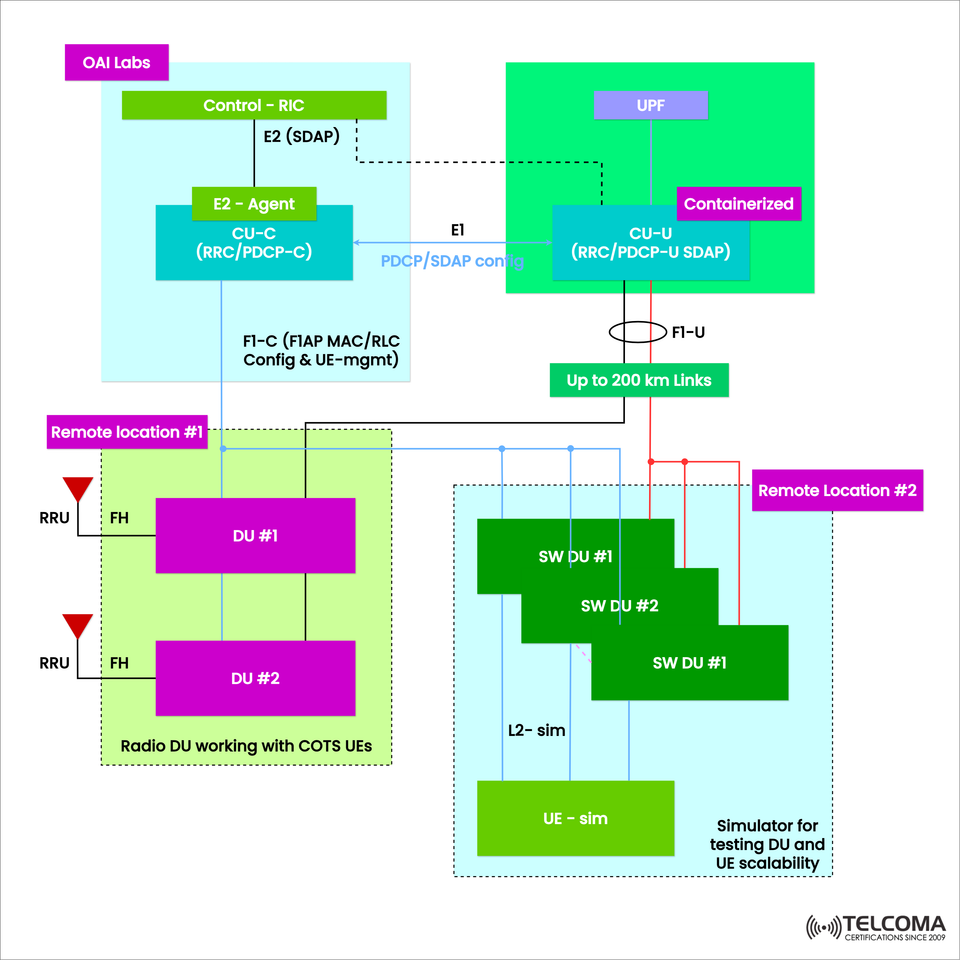
The diagram uploaded illustrates how this functional split works within a 5G O-RAN environment, featuring control and user plane separation, virtualized functions, and test simulation setups that allow for scalability assessments using OAI (Open Air Interface) Labs.
Let’s dive into each part of this architecture, look at the connections between them, and see how this setup promotes performance, flexibility, and open innovation within 5G networks.
Overview of the CU–DU–RU Split in 5G
In traditional LTE systems, the Baseband Unit (BBU) managed all of the RAN processing functions. With 5G, there’s a split architecture that distributes these processing tasks among three key components:
RU (Radio Unit): Responsible for sending and receiving RF signals.
DU (Distributed Unit): Handles real-time baseband processing, including MAC and PHY tasks.
CU (Centralized Unit): Takes care of non-real-time operations like RLC, PDCP, SDAP, and RRC.
This division brings in benefits like flexibility, cost-effectiveness, and scalability through virtualization and cloud deployment.
O-RAN Functional Overview
The image shows how the CU, DU, and RRU interact through standardized O-RAN interfaces. This setup is spread out across various remote sites and a central lab environment (OAI Labs) for testing, managing, and controlling.
Key Functional Elements:
CU-C (Central Unit - Control Plane): Manages control functions like RRC and PDCP-C, communicating with the RIC and DU over the F1-C.
CU-U (Central Unit - User Plane): Responsible for user data transport through PDCP-U and SDAP layers.
DU (Distributed Unit): Executes real-time Layer 1 and Layer 2 functions like MAC, RLC, and scheduling.
RRU (Radio Unit): Provides RF functionality and connects with DUs via the Fronthaul (FH) interface.
OAI Labs: Serves as a testbed for developing and validating 5G RAN components, like CUs and DUs.
UPF (User Plane Function): Key network part that forwards user data.
RIC (RAN Intelligent Controller): Aids in policy control and AI-driven RAN optimization.
Understanding O-RAN Interfaces
The architecture in the diagram highlights various standardized interfaces that are crucial for O-RAN and 3GPP functional splits:
E2 (SDAP): Connects RIC ↔ E2 Agent to enable control and analytics over nearly real-time RAN functions.
E1: Connects CU-C ↔ CU-U to separate control and user planes within the CU.
F1-C: Connects CU-C ↔ DU to manage RRC, MAC/RLC setup, and UE management.
F1-U: Connects CU-U ↔ DU for transferring user plane data packets.
FH (Fronthaul): Links DU ↔ RRU, connecting DUs with remote radio heads to assure low-latency transmission.
These connections allow for multi-vendor interoperability and flexible layering across spread-out network components.
Control and User Plane Separation (CUPS)
In 5G networks, Control and User Plane Separation (CUPS) is key for achieving scalability and enhancing cloud-native performance.
The CU-C (Control Unit – Control Plane) oversees signaling, mobility, and session control through the RRC and PDCP-C.
The CU-U (Control Unit – User Plane) manages data flow between user equipment (UE) and the core network via SDAP and PDCP-U layers.
In the diagram, both units share the E1 interface, allowing them to scale and position independently based on network needs; for instance:
CU-C can sit in a central cloud for policy control and coordination.
CU-U can be placed near the edge to reduce data latency.
- Distributed Units (DU): Processing at the Edge The Distributed Units (DU), labeled as DU#1 and DU#2, are located at remote sites. They connect to:
RRUs via Fronthaul (FH) links.
CUs through F1-C and F1-U interfaces.
These DUs manage time-sensitive activities like:
Scheduling
HARQ (Hybrid Automatic Repeat Request)
Uplink and downlink resource management
Radio DU with COTS UEs In the first remote location, the DUs link up with COTS (Commercial Off-The-Shelf) UEs, which means they work with standard user devices. This setup checks for real-world interoperability and performance validation.
Testing Scenarios and Use Cases
The OAI-based setup can facilitate various testing and validation scenarios relevant to 5G research and operator operations:
a. CU–DU Functional Validation
Check that configuration exchanges (PDCP, SDAP, RRC setup) are correct through F1-C and F1-U.
b. DU–RRU Integration Testing
Measure latency and synchronization performance via Fronthaul links.
c. End-to-End Throughput Testing
Simulate user plane data flow through CU-U → DU → RRU → UE-sim.
d. Multi-Site Network Validation
The “up to 200 km links” in the diagram indicate geographically distributed testing — crucial for confirming network performance in both rural and urban areas.
e. DU Scalability
With SW DUs and UE simulations, OAI Labs can mimic multiple DUs and UEs to evaluate how well the network can scale.
Containerization in CU and Core Components
Containerization is vital for modern 5G testing. The CU-U and UPF (User Plane Function) in the diagram are containerized, allowing for:
Quick deployment and scaling using tools like Kubernetes.
Resource isolation and flexibility across various test environments.
Smooth integration with CI/CD pipelines to enable ongoing validation.
This cloud-native strategy facilitates dynamic scaling and zero-touch deployment, which are foundational to 5G standalone (SA) architectures.
Benefits of the OAI-Based CU–DU–RU Test Architecture
Feature Benefit
O-RAN Compliant Interfaces: Ensures compatibility between different vendors.
Distributed Testing: Measures real-world latency and link performance.
Simulation Flexibility: Enables extensive virtual testing without needing physical hardware.
Containerized CU/UPF: Supports cloud-native efforts and automation.
RIC Integration: Boosts RAN optimization using AI/ML methods.
This architecture is crucial for modern 5G research and development, supporting both academic studies and operator-level validation.
Conclusion
The 5G CU–DU–RU disaggregated architecture signifies a significant shift in RAN design — transitioning from monolithic structures to open, modular, and cloud-native frameworks.
By utilizing OAI Labs, O-RAN interfaces, and virtual testing environments, telecom engineers can create, assess, and enhance 5G networks more efficiently than ever.
The combination of control/user plane separation, containerized CUs, DU simulation, and intelligent RIC orchestration is paving the way for flexible, interoperable, and high-performance 5G networks — setting the stage for innovations like Open RAN, 6G, and beyond.