
Understanding 5G MEC Core Network Interfaces: N4, N6, N9, and OAM Explained

Defining Interfaces Between Core Network Elements in 5G MEC: N4, N6, N9 and OAM
As 5G networks evolve, and with the essential integration of Multi-access Edge Computing (MEC), scenarios of how core network elements are interconnecting has now become imperative. This post is going to identify the interfaces across the 5G core components are connected and used in the context of MEC.
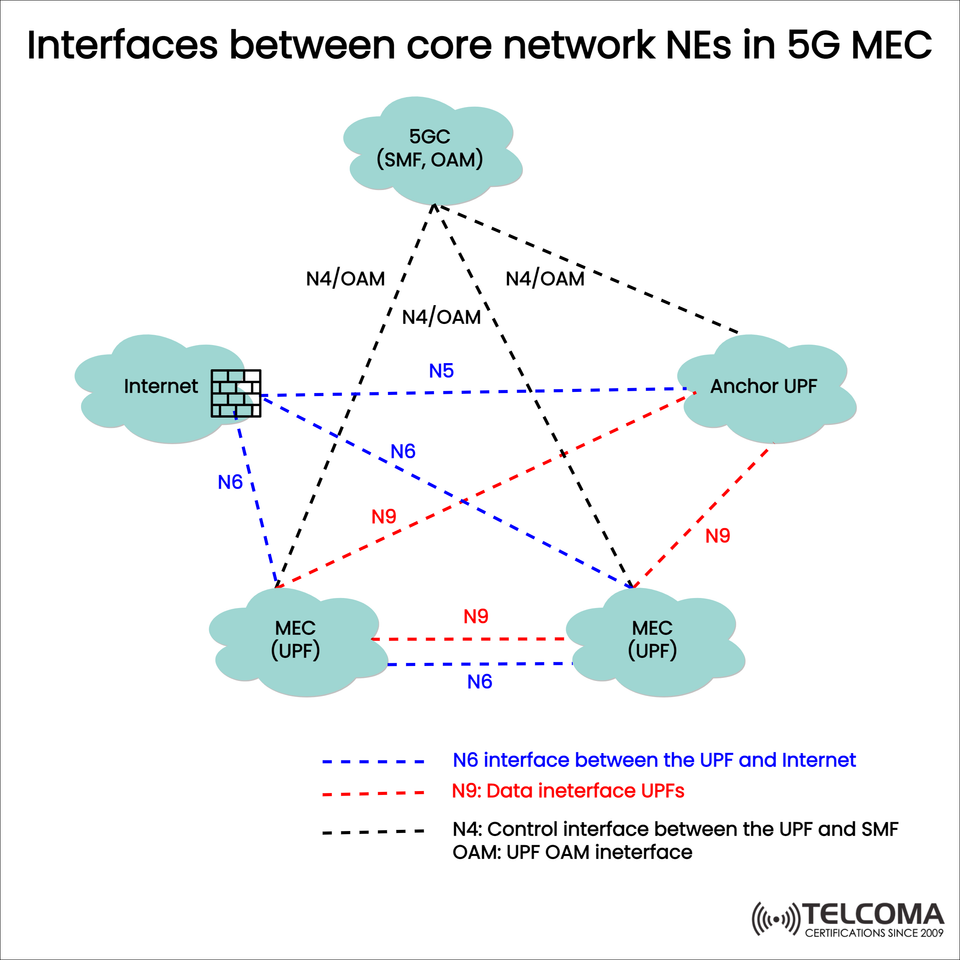
The diagram above illustrates how 5G core (5GC), UPF's function (User Plane Function), the MEC nodes and the internet, are signalling respectively with the following logical interfaces: N4, N6, N9 and OAM.
🔍 Core Interfaces in 5G MEC (Summary)
Interface Function Type
N4 Control interface between SMF and UPF Control Plane
OAM Operations, Administration and Maintenance of UPF Management
N6 Interface between UPF and external data networks (e.g. Internet) User/Data Plane
N9 Inter-UPF interface connecting distributed UPF and anchor UPF User/Data Plane
📌 A more complete summary of interface function in the 5G MEC architecture
🔵 N6 Interface – (UPF to Internet)
Blue dashed lines in the illustration
Connects MEC UPF and Anchor UPF to external data networks such as the Internet.
Delivers data from UE to external applications.
🔴 N9 Interface – (UPF to UPF)
The red dashed lines
Provides data transfer/exchanges from UPF to UPF, particularly for the MEC UPF to the Anchor UPF.
🗺️ Interface Interconnection Map (as seen in chart)
The 5GC controls all the UPFs – (SMF & OAM) control all the UPFs via N4/OAM
The MEC UPFs talk to each other via N9
All UPFs (including but not limited to the MEC UPF and the Anchor UPF) have N6 interfaces towards the internet.
Inter-UPF data routing is done via N9 and Policy and Control is done via N4.
🌐 Importance of Each Interface in the MEC Context
Interface Why it Matters for MEC
N6 MEC Applications can interface to the external world
N9 Provides flexibility in data path for local breakout and/or service chaining
N4 Ensures that session is correctly established via mobility between edge UPFs and central/upstream UPFs
OAM Provides dynamic configuration at UPFs and real time analytics
🧠 Real World Use Cases
Smart City Video Surveillance: Data is processed locally via MEC UPF using N6
AR/VR Gaming at the Edge: Low-latency routing is possible between MEC and Anchor UPF via N9
Connected Vehicles: Control over session is managed on N4 and routing is intelligent over N9
🔧 Internal Linking Ideas for WordPress
To improve your site structure and SEO, link this post to:
Understanding 5G User Plane Function (UPF)?
Introduction to Multi-access Edge Computing (MEC)
Understanding 5G Core Interfaces: N1 to N16 Explained
give readers some insight into the interfaces that connect core network nodes within 5G MEC (multiple access edge computing) will help operators implement efficient, scalable, and low-latency mobile networks.
Each interface performs a specific function:
N6 is the internet connection;
N9 is responsible for routing traffic between UPFs;
N4 is for control signaling;
OAM handles the UPFs lifecycle management.
These interfaces provide a mechanism to manage optimized flow of traffic and localized service delivered to Edge regardless of mobility between edge and core network.
Tags (search engine optimized):
5G core interface , N4 N6 N9, MEC UPF architecture, 5G data plane control plane, SMF & UPF interface, core network protocols - telecom .
❗️ Call to Action (CTA)
Suggestions to readers on how to go deeper or take action:
🧠 For Learners:
Do you want to learn about 5G Core and MEC architecture?
If so, check out the 5G training series and upgrade your telecom skills!
🧩 For Network engineers and architects:
Are you looking to design or troubleshoot your 5G MEC interfaces?
Download our free 5G core interface design guide (PDF) and ensure you optimize your deployments.
🔁 Content Repurposing Ideas
Repurpose this blog post into multiple types of content for multi-platform outreach:
Format Use case Platform
Slide deck Training sessions, webinars, LinkedIn slides, webinars
Animated Explainer To visualize the interface flows. YouTube, eLearning
Infographic To summarize the interface architecture and high-level information. Instagram, Pinterest
Cheat sheet (PDF) For quick reference. 5G core engineer or related engineering jobs.
🖥️WordPress Formatting Suggestions
When you are getting the content ready in your Gutenberg (Block Editor), consider:
H2 & H3 tags for each of the interface sections (N4, N6, N9, OAM)
Using the Table Block for the interface summation and comparisons
Image Block with appropriate SEO alt text
Optionally, the Table of Contents block for longer posts
🧾 JSON-LD Schema (For SEO Plugins like Yoast/RankMath)
Here's a schema you can place in the page header, to enhance SEO discoverability:
json
Copy
Edit
{
"@context": "https://schema.org",
"@type": "TechArticle",
"headline": "Understanding 5G MEC Core Network Interfaces: N4, N6, N9 and OAM",
"description": "Learn about the N4, N6, N9, and OAM interfaces and discover how these interfaces allow seamless communication between multiple 5G Core Network nodes, MEC UPFs and the internet.",
"image": "URL_TO_IMAGE",
"author": {
"@type": "Organization",
"name": "Telcoma"
},
"publisher": {
"@type": "Organization",
"name": "Telcoma",
"logo": {
"@type": "ImageObject",
"url": "https://telcomaglobal.com/logo.png"
}
},
"datePublished": "2025-07-12",
"keywords": "5G MEC interfaces, N4 N6 N9 OAM explained, UPF SMF control, 5G data plane, telecom network functions"
}
✅ Summary Checklist for Publishing
Task Status
SEO Title & Meta ✅
Image Alt Text ✅
Table of Interfaces ✅
CTA Block ✅
Internal Linking ✅
WordPress Tips ✅
Schema Markup ✅
🧩 Proposed Placement in Series
You could put this blog as Part 4 in a valuable educational series:
Part 1: Carrier Network Architecture from the MEC Viewpoint
Part 2: 4G to 5G Deployment Options (NSA & SA)
Part 3: vRAN Architecture Clarified
Part 4: Interfaces Between Core Network Elements in 5G MEC ✅
✅ Next-Step Recommendations:
Do you want me to:
Implement the complete whitepaper (PDF) with all four blog posts?
Draft the HTML for a landing/resource page?
Collaborate with you on a LinkedIn carousel or SlideShare presentation?
Format this into a training manual or other internal knowledge pick?