
Understanding 5G mmWave Bands: Spectrum, Shared Frequencies, and Use Cases

Understanding 5G mmWave Bands: Spectrum, Shared Frequencies, and Use Cases
5G networks are really changing the game in mobile communications, and at the heart of this is the mm Wave (millimeter wave) spectrum. While lower (sub-1 GHz) and mid-band (1–6 GHz) frequencies focus more on coverage, 5G mm Wave is all about speed and capacity. This spectrum operates in the 24 GHz to 300 GHz range, offering multi-gigabit data rates, ultra-low latency, and the ability to connect a lot of devices at once—essential for things like smart cities, self-driving cars, and densely populated urban areas.
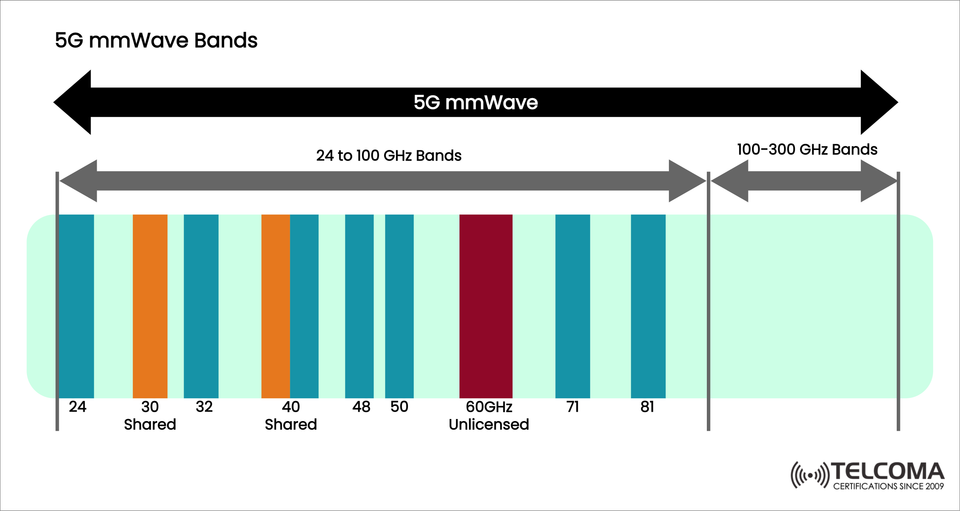
The image you see included demonstrates important allocations within the 5G mm Wave spectrum, covering shared, licensed, and unlicensed bands. Let’s dive into what these terms mean, why they’re significant, and how they’re shaping the future of telecom.
What is mm Wave in 5G?
Definition: Millimeter wave (mm Wave) refers to the high-frequency spectrum found between 24 GHz and 300 GHz.
Wavelength: It spans from 1 mm to 10 mm, which is where the name comes from.
Strengths: It offers high data rates, low latency, and the capability to manage a high density of traffic.
Challenges: Its range is shorter and it doesn't penetrate buildings well, so it needs small-cell deployments to work effectively.
5G mm Wave Spectrum Bands
The chart below showcases some important frequency blocks in the 5G mm Wave spectrum. Here’s a closer look:
- 24 GHz Band
This is at the lower end of the mm Wave spectrum.
It strikes a balance between range and fast data transfer.
It's been widely used in early 5G mmWave launches.
- 30 GHz (Shared Band)
This band is a shared spectrum, meaning it accommodates multiple services at once.
It's handy for flexible setups in urban settings.
- 32 GHz Band
Mainly assigned to telecom operators.
It supports enhanced mobile broadband (eMBB) and fixed wireless access (FWA).
- 40 GHz (Shared Band)
Another shared spectrum option.
This promotes innovation and allows different industries to work together.
48 GHz and 50 GHz Bands
These bands offer higher capacity for crowded places like stadiums, airports, and busy business areas.
- 60 GHz (Unlicensed Band)
Unique feature: It operates on an unlicensed spectrum, which lets companies and ISPs set up without the need for standard licensing fees.
It’s perfect for private 5G networks, WiGig (802.11ad/ay), and IoT applications.
Great for short-range ultra-fast connections, like wireless VR/AR.
- 71 GHz and 81 GHz Bands
Part of the E-band spectrum (70/80 GHz).
Commonly used for backhaul connections, providing high-capacity links between small cells.
It’s essential for supporting the 5G infrastructure.
- 100–300 GHz Bands
Considered future-facing spectrum.
Expected to play a significant role in the rise of 6G, providing terabit-per-second data rates.
There’s potential here for applications like holographic communication, ultra-precise sensing, and space communications.
Shared vs. Unlicensed mm Wave Bands
Shared Bands (30 GHz & 40 GHz):
Designed to promote spectrum reuse and coexistence.
They allow for dynamic allocation between telecoms and enterprises.
Increase flexibility in how 5G is rolled out in cities.
Unlicensed Band (60 GHz):
Open to innovation without the usual regulatory hassles.
It lowers the entry barriers for startups and businesses.
Supports niche applications like industrial automation and campus networks.
Advantages of 5G mm Wave
Ultra-Fast Data Rates: Multi-gigabit speeds that are great for 8K streaming, VR/AR, and gaming.
High Capacity: Can support lots of users in places like stadiums, metro stations, and city centers.
Low Latency: Perfect for things like self-driving cars, remote surgeries, and critical IoT systems.
Network Offloading: Helps ease congestion on mid- and low-band 5G networks.
Challenges of 5G mm Wave
Short Range: Typically limited to a few hundred meters in urban areas.
Poor Penetration: Doesn’t do well going through walls, glass, or trees.
Cost of Deployment: Needs dense small-cell networks and advanced beamforming technology.
Weather Sensitivity: Heavy rain and atmospheric conditions can impact performance in higher bands.
Real-World Use Cases of mm Wave
Smart Cities: Offering high-capacity connections for IoT sensors, surveillance systems, and traffic management.
Enterprise Networks: Using private 5G in factories, ports, and campuses with unlicensed 60 GHz.
Fixed Wireless Access (FWA): A high-speed internet alternative for urban and suburban homes.
Transportation Hubs: Providing seamless connectivity for airports, train stations, and major highways.
Immersive Entertainment: Enhancing VR/AR experiences in sporting venues and gaming arenas.
5G Backhaul: Using the 70/80 GHz E-band for reliable transport between small-cell setups.
5G mm Wave vs. Sub-6 GHz Spectrum
Feature Sub-6 GHz mm Wave (24–300 GHz)
Coverage Range Wide, covering kilometers Short, usually just a few hundred meters
Penetration Strong, easily passes through walls Weak, struggles with indoor environments
Capacity Moderate Extremely high
Latency Low (ms-level)Ultra-low (<1 ms possible)
Use Cases Broad coverage for rural and suburban areas Dense urban, enterprise, and IoT applications
The Road Ahead: mm Wave and 6G
While 5G mm Wave is already making waves with its impressive performance, its ultimate potential is still on the horizon:
We’re looking at expanding into 100–300 GHz bands.
AI-driven dynamic spectrum allocation could be the future.
There’s potential for integrating with non-terrestrial networks (NTN), including satellites.
It’ll lay the groundwork for 6G applications, such as holographic telepresence and tactile internet.
Conclusion
The 5G mm Wave spectrum, from 24 GHz to 300 GHz, serves as the backbone of ultra-fast, high-capacity mobile communications. With shared and unlicensed bands driving innovation, and higher bands paving the way for 6G, mm Wave isn’t just about speed; it’s opening doors to entirely new possibilities for telecom and beyond.
For telecom professionals, grasping these bands is essential for network planning, spectrum strategy, and infrastructure investments. And for tech enthusiasts, it shows how 5G mm Wave is pushing mobile networks into a phase of unprecedented performance.
As networks evolve, mm Wave will keep being a central player in shaping smart cities, immersive tech, and our connected future.