
Understanding 5G NR Flexible Slot Duration and Numerology Explained

Understanding 5G NR Flexible Normal Slot Transmission Duration
In 5G New Radio (NR), the idea of flexible slot duration stands out as one of the major improvements over LTE. This flexibility enables 5G to cater to a variety of use cases — from ultra-reliable low-latency communications (URLLC) to enhanced mobile broadband (eMBB) and massive IoT.
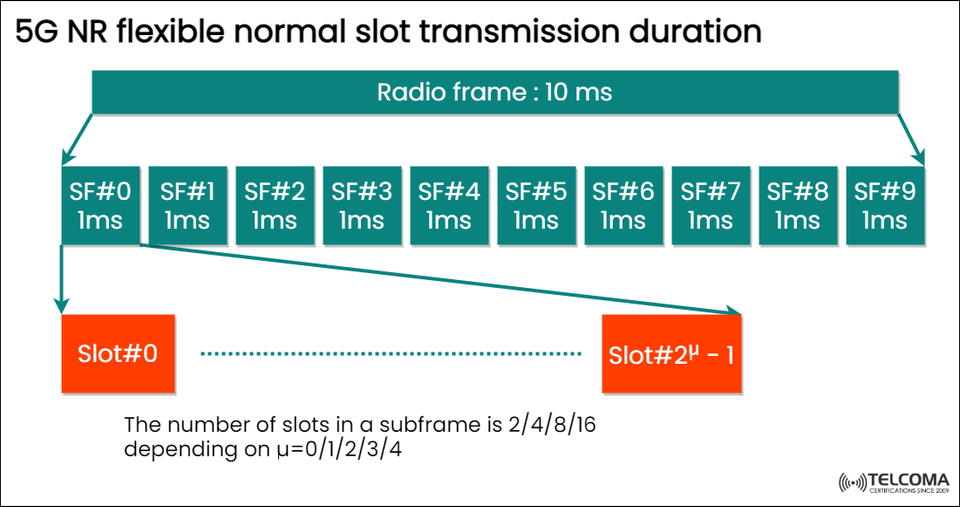
The diagram you uploaded, titled “5G NR Flexible Normal Slot Transmission Duration,” illustrates how a radio frame lasting 10 milliseconds (ms) can be divided into subframes and slots based on the chosen numerology (μ).
This article explains how 5G NR manages time structuring, what numerology means, and why it’s crucial for meeting the diverse performance goals of 5G networks.
5G NR Frame and Slot Structure Overview
In 5G NR, the radio frame is the main time unit used for transmission and scheduling.
Radio Frame Duration: 10 ms (fixed)
Number of Subframes per Frame: 10 (each 1 ms)
Number of Slots per Subframe: Depends on numerology (μ)
Slot Duration: Varies with subcarrier spacing
Each radio frame (10 ms) consists of 10 subframes, each lasting 1 ms. Within every subframe, there are slots, and their number is determined by the numerology index (μ).
What Is 5G NR Numerology (μ)?
Numerology in 5G NR outlines the relationship between subcarrier spacing (SCS) and slot duration. It allows 5G to function efficiently across different deployment scenarios — whether it's dense cities or low-frequency rural areas.
Numerology Index (μ) and Subcarrier Spacing
Numerology (μ)Subcarrier Spacing (kHz)Slots per Subframe (1 ms)Slot Duration (ms)Typical Use Case01511.0LTE-equivalent coverage, low frequency bands13020.5eMBB mid-band deployments26040.25URLLC and high-frequency mid-band312080.125mmWave, ultra-low latency applications4240160.0625Future mmWave, extremely low latency
As the numerology index μ increases, the subcarrier spacing doubles while the slot duration halves.
This scalable framework enables 5G NR to adjust dynamically to:
Higher bandwidths
Reduced latency
Different frequency ranges (FR1 and FR2)
Slot and Subframe Relationship in 5G NR
Every subframe (1 ms) is made up of multiple slots, and each slot contains 14 OFDM symbols (at normal cyclic prefix).
The calculation for the number of slots per subframe is:
Nslots=2μN_{slots} = 2^{μ}Nslots=2μ
This means:
For μ = 0 → 1 slot (1 ms)
For μ = 1 → 2 slots (0.5 ms)
For μ = 2 → 4 slots (0.25 ms)
For μ = 3 → 8 slots (0.125 ms)
For μ = 4 → 16 slots (0.0625 ms)
Example:
If the system is running on μ = 2 (subcarrier spacing 60 kHz):
Each subframe (1 ms) will have 4 slots.
Each slot = 0.25 ms long.
Thus, a 10 ms radio frame will contain 40 slots.
This flexibility is what defines 5G NR as “flexible.”
The Concept of Slot-Based Scheduling
A significant advantage of 5G NR is slot-based or mini-slot scheduling, which allows for quicker and more precise data transmissions.
Slot Scheduling Options:
Full Slot: The entire slot is used for transmission (14 OFDM symbols). It’s suitable for large data payloads or control info.
Mini-Slot: Transmission can kick off at any OFDM symbol in the slot. It can use 2, 4, or 7 symbols — perfect for URLLC, where latency is critical.
By providing flexible slot boundaries, 5G NR accommodates asynchronous data bursts, which is crucial for real-time applications such as:
Autonomous vehicles
Remote surgery
Industrial automation
Flexible Transmission Duration and Its Benefits
The flexible slot architecture allows 5G NR to adjust transmission times based on service needs and deployment contexts.
Key Benefits:
Reduced Latency: Shorter slot durations (when μ increases) speed up transmission times, enhancing responsiveness.
Higher Throughput: More subcarrier spacing enables greater data transmission rates.
Frequency Flexibility: Allows 5G operations across both FR1 (Sub-6 GHz) and FR2 (mmWave) bands.
Dynamic Service Adaptation: The network can assign different numerologies to various users or services at the same time via bandwidth parts (BWPs).
Enhanced Reliability: Mini-slot scheduling guarantees that critical data is sent with minimal delay, even during times of high demand.
5G NR Frame Hierarchy
To understand how slot duration fits into the NR timing structure, let’s summarize the hierarchical layout of time units in 5G NR:
Time UnitDurationContainsNotesFrame10 ms10 Subframes Fixed for all numerologiesSubframe1 ms2^μ Slots Varies with numerologySlot1/2^μ ms14 OFDM Symbols Flexible duration OFDM Symbol Variable-Basic transmission unit
This structure highlights how 5G NR’s time-domain flexibility supports both wide coverage and low-latency communications.
Practical Example: Slot Duration Adaptation
Let’s consider a couple of scenarios:
Scenario 1: Wide-Area 5G Coverage (μ = 0)
Subcarrier Spacing: 15 kHz
Slot Duration: 1 ms
Slots per Subframe: 1
Use Case: Rural or suburban coverage
Scenario 2: mmWave URLLC Deployment (μ = 3)
Subcarrier Spacing: 120 kHz
Slot Duration: 0.125 ms
Slots per Subframe: 8
Use Case: Factory automation, AR/VR, autonomous systems
This adaptability lets the same 5G standard work efficiently in very different conditions — from long-range low-frequency coverage to short-range high-frequency operations.
Slot Duration in Frequency Ranges FR1 and FR2
5G runs across two main frequency ranges:
Frequency Range Bandwidth Numerology (μ)Typical Slot DurationFR1 (Sub-6 GHz)≤100 MHzμ = 0–21 ms to 0.25 msFR2 (mmWave)≤400 MHzμ = 3–40.125 ms to 0.0625 ms
FR1 utilizes lower numerologies (μ ≤ 2) for coverage and stability.
FR2 applies higher numerologies (μ ≥ 3) for speed and lower latency.
How Flexible Slot Duration Enhances Network Efficiency
Multi-Service Coexistence: Supports eMBB, URLLC, and mMTC on a single carrier.
Energy Efficiency: Optimized slot durations help lower power use for IoT and mobile devices.
Resource Optimization: NR schedulers can dynamically assign slots based on demand, boosting spectral efficiency.
Interference Management: Shorter slots reduce inter-symbol interference at higher frequencies.
Conclusion
The flexible slot duration mechanism in 5G NR is fundamental to its adaptability and performance. By defining time structures through numerology (μ), 5G NR strikes a balance between coverage, capacity, and latency — something LTE struggled to achieve.
This flexibility enables operators to tailor network performance based on service type, accommodating a broad range of applications from streaming to critical IoT tasks.
As the 5G landscape evolves, slot-based and mini-slot scheduling will become increasingly important in ensuring networks can meet the demands of next-gen services and edge computing.