
Understanding 5G NR Subcarriers and Numerology: The Foundation of 5G Waveform Design
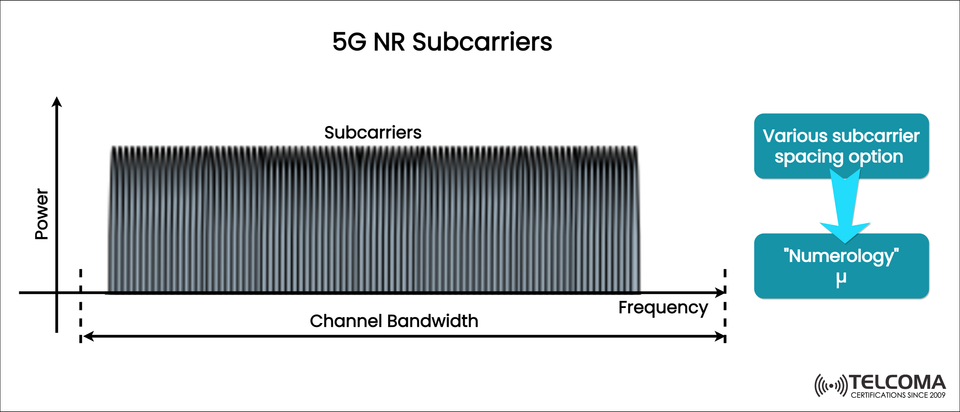

Explaining 5G NR Subcarriers: Numerology and Subcarrier Spacing Explained
The principle that allows 5G New Radio (NR) to be flexible and scalable — designed to support communications ranging from low-power IoT sensors to ultra-fast mobile broadband and low-latency industrial applications — is the idea of having multiple subcarrier spacing options, which is referred to as numerology (μ).
The accompanying image, “5G NR Subcarriers,” displays how subcarriers are allocated out across channel bandwidth and how numerology specifies this spacing, which affects the system’s spectral efficiency, latency, and overall performance.
What Are 5G NR Subcarriers?
In 5G NR, the communication from the base station (gNB) to the user equipment (UE) is based on Orthogonal Frequency Division Multiplexing (OFDM), which is a modulation scheme that divides your configured spectrum into numerous closely spaced subcarriers that can communicate at the same time.
5G NR subcarriers:
Carry a small portion of the aggregate data rate.
Are orthogonal (i.e., non-overlapping) to each other, providing separation.
Provide high spectral efficiency, as well as strong multipath fading mitigation.
OFDM and Its Role in 5G NR
Orthogonal Frequency Division Multiplexing (OFDM) Technology is not new, having already been used in LTE. However, 5G New Radio (NR) enhances OFDM to meet the challenges of a wide variety of deployment scenarios and frequency ranges.
The Benefits of OFDM in 5G NR
High Spectral Efficiency (Δf): There are minimal guard bands between subcarriers.
Multipath Resilience: Manages the effects of inter-symbol interference.
Flexible Configuration: Subcarrier spacing (Δf) can be adjusted.
Ability to Handle Wide Bandwidths: Functions well with FR1 (sub 6 GHz) and FR2 (mmWave) system.
5G can vary the subcarrier spacing to enable low-latency high throughput communications as well as long range low power links for IoT.
What Is Numerology in 5G NR?
The term “numerology” (μ) refers to a set of characteristics that indicate subcarrier spacing, symbol duration and cyclic prefix.
Each numerology corresponds to a different subcarrier spacing (Δf), which is calculated as follows:
Δ𝑓=15 kHz ×2𝜇
Δf=15 kHz×2μ
Where μ = 0, 1, 2, 3 or 4 based on the frequency of operation and use case.
Table: 5G NR Numerologies
Numerology (μ) Subcarrier Spacing (Δf) Slot Duration (ms) Typical Use Case
0 15 kHz 1.0 Compatible with LTE, low frequency bands
1 30 kHz 0.5 Sub 6 GHz, eMBB (Enhanced Mobile Broadband)
2 60 kHz 0.25 mmWave, low latency
3 120 kHz 0.125 mmWave, ultra low latency (URLLC)
4 240 kHz 0.0625 Very High Freq mmWave,
The illustration illustrates "varied subcarrier spacing options," which directly refers to numerology (μ) — as shown, the flexibility of numerologies enables 5G to be efficiently used across different frequency bands and service types.
How Subcarrier Spacing Impacts 5G Performance
Subcarrier spacing (Δf) adds flexibility, creating trade-offs relative to coverage, latency, and eventual capacity.
- Lower Subcarrier Spacing (e.g, 15 kHz)Used within low-frequency bands (<3 GHz).Results in better coverage and greater toleration to Doppler shifts. A driver for IoT, rural, and wide area applications.
- Higher Subcarrier Spacing (e.g., 120kHz, 240 kHz)Used with the mmWave bands (>24 GHz).Achieves shorter symbol duration, thus lower latency. Designed for high-capacity, short-range, ultra-reliable communication.
Such flexibility enables 5G NR to adapt to any condition, whether densely populated urban cities or remote rural locations, while maintaining the same underlying waveform structure.
5G NR Channel Bandwidth and Subcarriers
The illustration provides channel bandwidth, as shown on the x-axis, which contains all active subcarriers that are used for the communication. Each 5G NR carrier will be divided into Resource Blocks (RBs), where a Resource Block contains 12 subcarriers.
Relationship Between Bandwidth and Subcarriers
Total subcarriers = Bandwidth / Subcarrier spacing.
As Δf increases, the total number of subcarriers decreases while maintaining the same bandwidth.
For example:
In a 100 MHz channel;
At 15 kHz → ~6600 subcarriers.
At a 60 kHz subcarrier spacing → ~1800 subcarriers.
Flexible Frame Structure in 5G NR
The frame structure of 5G NR has been implemented to support multiple numerologies at the same time.
One frame = 10 ms and is composed of 10 subframes (1 ms).
The number of slots per subframe varies by numerology (μ).
μ=0 → 1 slot per subframe
μ=1 → 2 slots per subframe
μ=2 → 4 slots per subframe, and so on...
This scalable mechanism lets the low-latency service use the higher numerology (meaning more slots in the frame), while the coverage-oriented service uses the lower numerology.
Advantages of Supporting Multiple Numerologies
The multi-numerology architecture in 5G NR provides unprecedented flexibility. 5G can support various requirements in the same environment at the same time.
Main Advantages:
Dynamic Adaption:
Each service or device can operate at its optimal numerology.
Coexistence:
One 5G Cell can support IoT devices (μ=0) and URLLC users (μ=3) at the same time.
Spectrum Efficiency:
The subcarrier spacing and symbol time can be adjusted according to channel conditions and frequency band.
Latency Reduction:
Higher numbers of numerologies can allow less time for a slot, thus supporting real time applications.
Network Backward Compatibility:
15 kHz numerology can support/ease back to LTE network.
Challenges with Multi-Numerology Operation
Even with all the benefits from supporting multiple numerologies the management of multiple numerologies presents some challenges:
Inter-numerology interference (INI):
With different subcarrier spacings (depending on the numerology), there may be overlaps at the edges of bands.
Guard Band:
Small guard bands will be required between numerologies.
Real-World Applications of 5G NR Subcarriers
Various real-world deployment situations always utilize adaptive numerology selection through a radio network scheduler.
Examples:
Enhanced Mobile Broadband (eMBB):
Bandwidth of 100 MHz, 30 kHz spacing → High throughput for streaming and VR.
Ultra-Reliable Low-Latency Communication (URLLC):
Spacing of 60 or 120 kHz → Very low latency—for autonomous systems.
Massive IoT (mMTC):
15 kHz spacing → Larger coverage and extended battery life for IoT sensors.
This is one example of how 5G NR subcarriers can be dynamically taken advantage of to meet the performance needs of an application.
Conclusion
The idea of 5G NR subcarriers and numerology (μ) underlines the flexibility and scalability of the 5G technology. 5G NR is able to serve a wide spectrum of use cases from massive IoT networks to ultra-reliable, low-latency communications by offering multiple subcarrier spacing.
As the image illustrates, different subcarrier spacing options allow a 5G system to provide dynamic adaptation to spectrum availability, propagation condition and service need, which is a critical difference from earlier generations.