
Understanding 5G Physical Channels and Physical Signals: A Complete Technical Overview

Getting to Know 5G Physical Channels and Signals
In 5G New Radio (NR), physical channels and physical signals are crucial for communication between the gNodeB (base station) and User Equipment (UE). They dictate how data and control information are transmitted, ensuring the network runs smoothly and efficiently.
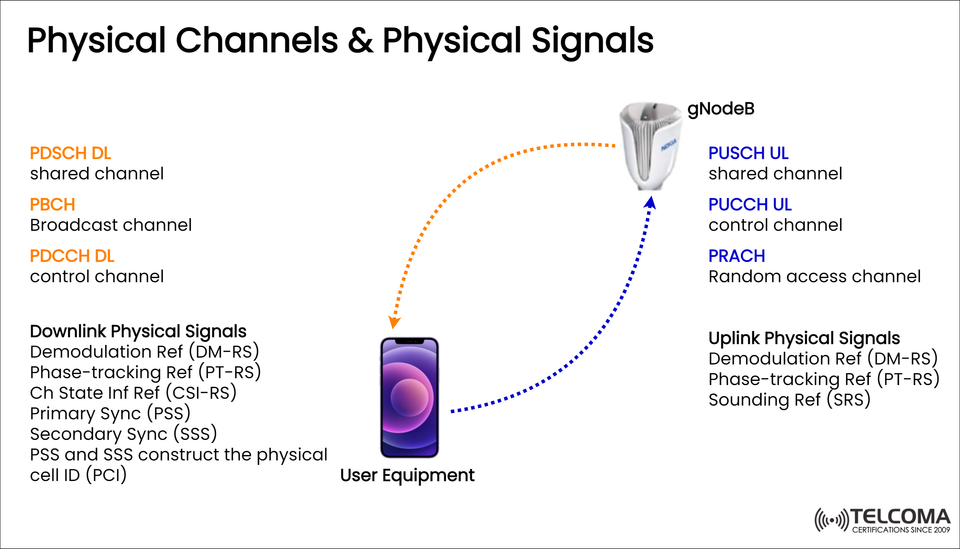
The image above gives a snapshot of the key physical channels and signals used in both uplink and downlink communication, highlighting how 5G networks facilitate information exchange between devices and the network. Let’s take a closer look at each component and how they function together.
What Are Physical Channels in 5G?
In 5G NR, physical channels are responsible for sending user and control information across the air interface. They sit at the lowest level of the protocol stack — the Physical (PHY) layer. Each type of channel is tailored for specific tasks, whether that's broadcasting system info, managing control signals, or transferring user data.
You can categorize physical channels into:
Downlink Channels (from gNodeB to UE)
Uplink Channels (from UE to gNodeB)
Downlink Physical Channels
Downlink physical channels transmit data and control information from the base station (gNodeB) to the user device (UE).
- PDSCH (Physical Downlink Shared Channel)
Purpose: This channel carries user data, system info, and higher-layer signaling messages.
Handles multiple users through OFDMA resource allocation.
Transmits both unicast and broadcast data.
Adjusts resources dynamically to optimize bandwidth use.
Key Role: It’s essential for high-speed data transfers like streaming videos, browsing, or downloading files.
- PBCH (Physical Broadcast Channel)
Purpose: This channel broadcasts key system information essential for users to access the network initially.
Transmits the Master Information Block (MIB).
Helps the UE understand parameters like subcarrier spacing and system bandwidth.
Found in the Synchronization Signal Block (SSB), alongside PSS and SSS.
Key Role: It lets devices identify and sync with a 5G network during the cell search and selection process.
- PDCCH (Physical Downlink Control Channel)
Purpose: This channel sends control info necessary for scheduling communications.
Transmits Downlink Control Information (DCI), informing the UE about where and how to receive or send data.
Offers multiple formats for flexible scheduling of uplink and downlink.
Utilizes techniques like beamforming to enhance reliability.
Key Role: Acts as the command channel between gNodeB and UE, ensuring smooth coordination of data transfers.
Uplink Physical Channels
Uplink physical channels handle data and control information that the UE sends back to the gNodeB.
- PUSCH (Physical Uplink Shared Channel)
Purpose: Carries user data and control info from UE back to gNodeB.
Supports multiple users using SC-FDMA or DFT-s-OFDM to reduce peak-to-average power ratio (PAPR).
Key for fast data transfers like uploading files or VoNR (Voice over New Radio).
Key Role: The main channel for sending uplink data, maximizing power efficiency in user devices.
- PUCCH (Physical Uplink Control Channel)
Purpose: This channel transmits uplink control information (UCI), such as acknowledgments and scheduling requests.
Sends Hybrid ARQ acknowledgments (ACK/NACK), CSI reports, and various control signals.
Designed for low-latency transmission of small data packets.
Key Role: Provides accurate feedback to gNodeB, crucial for maintaining transmission reliability and adapting to link changes.
- PRACH (Physical Random Access Channel)
Purpose: This channel facilitates initial access and timing synchronization.
Used by UE to connect with gNodeB.
Sends the Random Access Preamble during the connection setup.
Vital for handovers and reconnecting.
Key Role: It’s the first step in accessing the network, allowing UE to request communication resources.
Downlink Physical Signals
Physical signals are predefined reference signals that help with synchronization, channel estimation, and tracking.
- DM-RS (Demodulation Reference Signal)
Helps estimate channels for demodulating data on PDSCH or PUSCH.
Each user has unique DM-RS sequences to ensure precise decoding.
Use Case: It’s essential for coherent demodulation and managing interference.
- PT-RS (Phase-Tracking Reference Signal)
Aids in tracking and correcting phase noise in high-frequency bands like mmWave.
Boosts demodulation accuracy at high data rates.
Use Case: Enhances signal quality under challenging RF conditions.
- CSI-RS (Channel State Information Reference Signal)
Gives channel quality feedback to gNodeB.
Supports beam management, MIMO optimization, and link adjustment.
Use Case: Essential for advanced features like Massive MIMO and beamforming.
- PSS and SSS (Primary and Secondary Synchronization Signals)
PSS (Primary Sync Signal): Helps UE find the timing of a 5G cell.
SSS (Secondary Sync Signal): Offers additional details like the physical cell ID (PCI).
Use Case: Critical for initial cell detection and syncing during network access.
Downlink Summary Table
Channel/Signal Full Name Purpose PDSCH Physical Downlink Shared Channel User data & signaling PBCH Physical Broadcast Channel Network information broadcast PDCCH Physical Downlink Control Channel Scheduling & control info DM-RS Demodulation Reference Signal Channel estimation PT-RS Phase Tracking Reference Signal Phase correction CSI-RS Channel State Information RS Channel quality feedback PSS/SSS Sync Signals Cell detection & synchronization
Uplink Physical Signals
Like the downlink, the uplink makes use of reference signals that support synchronization, power control, and channel estimation.
- DM-RS (Demodulation Reference Signal)
Utilized by gNodeB to assess the uplink channel for data demodulation.
Helps enhance accuracy in scenarios with multiple users.
- PT-RS (Phase-Tracking Reference Signal)
Fixes phase errors in uplink transmissions, particularly in mmWave bands.
- SRS (Sounding Reference Signal)
Lets gNodeB measure the quality of the uplink channel across various frequencies.
Helps fine-tune scheduling and beam selection.
Key Role: It’s vital for adapting uplink connections and managing interference.
How Physical Channels and Signals Work Together
The way channels and signals interact creates a seamless flow of information in 5G networks:
Cell Discovery: UE uses PSS and SSS to detect and align with a 5G cell.
Network Access: PBCH sends the MIB, while PRACH kicks off random access.
Control Exchange: PDCCH and PUCCH manage scheduling and acknowledgements.
Data Transmission: PDSCH and PUSCH handle user data, with reference signals ensuring link quality.
Optimization: CSI-RS and SRS fine-tune channel understanding for adaptive beamforming and resource management.
Conclusion
Grasping 5G physical channels and signals is crucial to understanding how 5G networks achieve extraordinary data rates, reliability, and flexibility. From synchronization (PSS/SSS) to dynamic scheduling (PDCCH/PUCCH) and efficient data transfer (PDSCH/PUSH), every component plays a significant role in realizing the 5G vision.
For telecom engineers, these elements form the backbone of 5G NR’s PHY layer design, while for enthusiasts, they reveal the complex coordination that enables 5G's lightning-fast connectivity.
As we look ahead to 5G-Advanced and beyond, innovations in reference signal design and channel optimization will keep enhancing performance—setting the stage for 6G’s intelligent, ultra-connected future.