
Understanding 5G Standalone Access and gNB Interactions: Context Setup, Security, and RRC Reconfiguration

Understanding 5G Standalone Access — What’s Up with gNB?
The shift from 4G LTE to 5G has really changed the game when it comes to mobile architecture. In 5G Standalone (SA) mode, the gNB (the 5G base station) talks directly to the 5G Core (5GC) without needing the old 4G EPC. This setup allows for some serious benefits, like ultra-low latency, network slicing, and higher data rates.
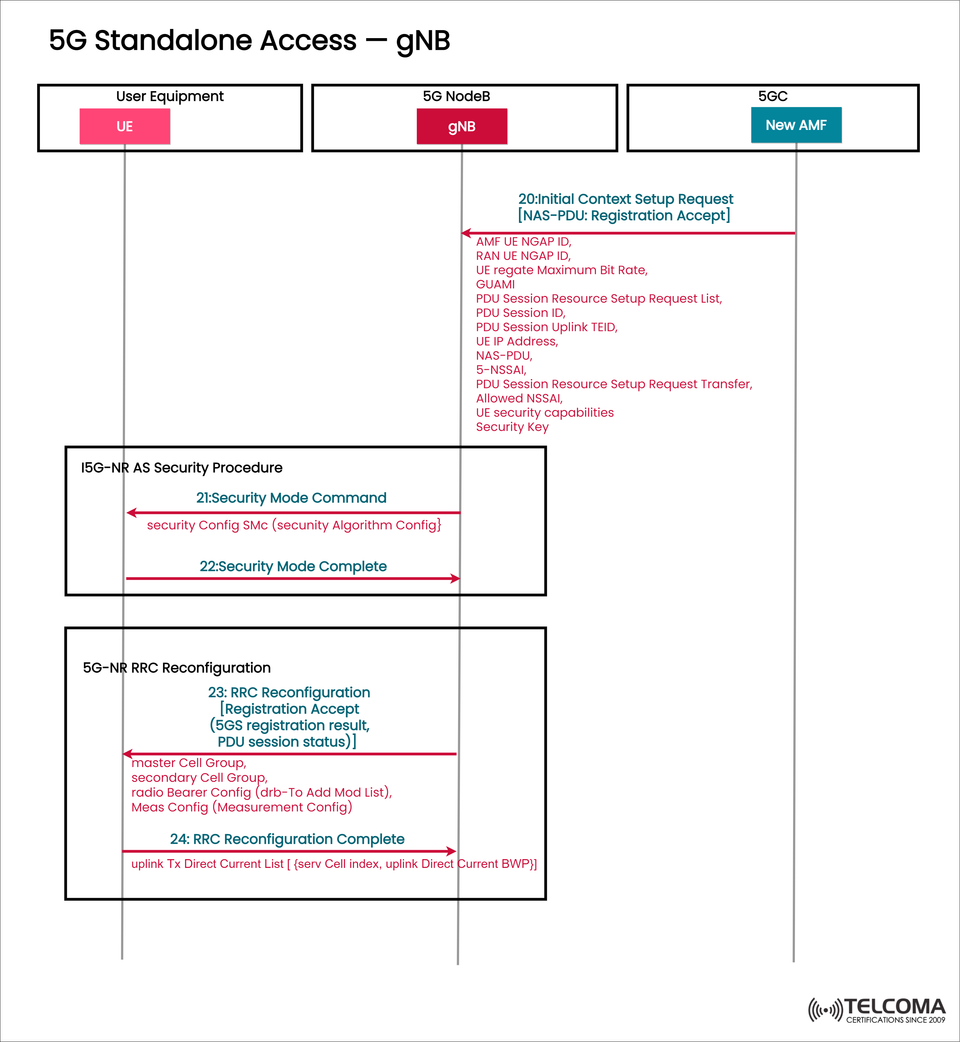
The image you shared explains the 5G Standalone Access process, showing how messages are exchanged between the User Equipment (UE), 5G NodeB (gNB), and 5G Core (5GC).
Let’s break down the key stages—Initial Context Setup, Security Procedure, and RRC Reconfiguration—to get a better grip on how a 5G SA connection is set up and made secure.
Getting to Know 5G Standalone Access
In a 5G Standalone setup:
The UE connects straight to the gNB, which works with the 5G Core (5GC).
There’s no LTE eNB anchor, meaning it’s a “pure” 5G access mode.
The gNB handles both control plane and user plane signaling for the UE.
The access procedure makes sure that the UE is authenticated, security is turned on, and radio bearers are set up for data transfer.
Initial Context Setup Request (NAS-PDU: Registration Accept)
The whole process kicks off when the UE starts its 5G registration, and the AMF (Access and Mobility Management Function) sends back a Registration Accept message through the gNB.
Then, the Initial Context Setup Request (which is Step 20 in the image) goes from the 5GC (New AMF) to the gNB. This message carries important context and configuration info needed to set up a secure, functional connection.
2.1 What’s in the Message?
The Initial Context Setup Request includes:
AMF UE NGAP ID and RAN UE NGAP ID — these are unique identifiers for UE context at both the AMF and gNB.
UE aggregate Maximum Bit Rate (AMBR) — this defines the maximum rate for all data flows.
GUAMI (Globally Unique AMF Identifier) — identifies the AMF that’s serving the UE.
PDU Session Resource Setup Request List — details about the PDU sessions to be established.
PDU Session ID and PDU Session Uplink TEID — these are transport layer identifiers for data tunneling.
UE IP Address — assigned by the SMF for data communication.
5-NSSAI (Single Network Slice Selection Assistance Information) — specifies network slice allocation.
Security Capabilities — lists supported algorithms for encryption and integrity protection.
Security Key (Kgnb) — derived from 5G authentication to secure communication.
2.2 Why Does This Matter?
The gNB uses this info to:
Set up the user plane tunnel to the UPF (User Plane Function).
Configure radio bearers for the UE.
Get ready for security configuration and RRC signaling.
This step is key because it connects the 5GC’s logical session control to the gNB’s physical radio management.
4.1 Message 23: RRC Reconfiguration
This message is for setting up or changing radio bearers and configuring measurement and mobility parameters.
It includes:
Master Cell Group — identifies the main serving cell (PCell).
Secondary Cell Group — adds or configures secondary cells (SCells) for dual connectivity.
Radio Bearer Configuration (drb-To Add Mod List) — details DRBs (Data Radio Bearers) for PDU sessions.
Measurement Configuration (MeasConfig) — tells the UE how to do network measurements for mobility and beam management.
Registration Result and PDU Session Status — gives feedback from the 5GC on whether registration was successful and if data sessions are ready.
4.2 Message 24: RRC Reconfiguration Complete
The UE sends this message to confirm that the radio resources were successfully configured.
It might include details like uplink transmission configuration, serving cell index, and uplink Direct Current Bandwidth Part (BWP) parameters.
4.3 Why RRC Reconfiguration Matters
This wraps up the setup for user-plane data transfer.
Makes sure the UE is synced up with the gNB’s radio and scheduling settings.
Enables dual connectivity and helps manage mobility features.
Message Flow Overview
Stage Message Direction Purpose
Context Setup Initial Context Setup Request 5GC → gNB Transfers UE context and session info from AMF to gNB
2. Security Setup Security Mode Command gNB → UE Activates encryption and integrity protection Security Mode Complete UE → gNB Confirms activation of security algorithms
3. RRC Reconfiguration RRC Reconfiguration gNB → UE Configures radio bearers, measurement, and cell parameters RRC Reconfiguration Complete UE → gNB Confirms final RRC and radio setup
Key Takeaways for Telecom Experts
The 5G SA architecture cuts out LTE dependencies, with the gNB connecting right to the 5G Core.
The Context Setup Request combines core network session management with radio resource management.
The Security Mode Command makes sure AS-level encryption and integrity protection keeps air interface communication safe.
The RRC Reconfiguration gets bearers, measurement, and dual connectivity configurations up and running so the UE can transmit data effectively.
In all this,
The AMF is in charge of access and mobility management.
The SMF keeps an eye on PDU session control.
The gNB handles the radio and user-plane setups.
Real-World Uses and Optimization
In real implementations:
Network Slicing: 5-NSSAI makes sure each UE gets the right slice for its service (eMBB, URLLC, or mMTC).
Dynamic Spectrum Sharing: RRC reconfiguration supports flexible spectrum use between LTE and NR.
Beamforming and Mobility: Measurement setups in the RRC message help with accurate handovers and beam management.
Security Enhancements: 5G’s key hierarchy (KAMF → KgNB) improves overall communication integrity.
Operators can boost signaling efficiency by:
Cutting context setup delays with preconfigured profiles.
Focusing on low-latency slices for critical UEs.
Sharpening RRC and AS security handling in the gNB software.
Wrapping It Up
The 5G Standalone Access process using gNB is central to creating a solid 5G connection. Through Initial Context Setup, Security Configuration, and RRC Reconfiguration, the network makes sure each UE connects safely, smoothly, and with precise resource management.
For telecom pros, understanding these procedures is essential for boosting network performance and tackling connectivity challenges. As 5G networks grow, getting a handle on gNB-level interactions is critical for delivering seamless service across various applications—everything from enhanced mobile broadband (eMBB) to mission-critical communications (URLLC).