
Understanding 5G UDM Registration and Subscriber Data Management Process
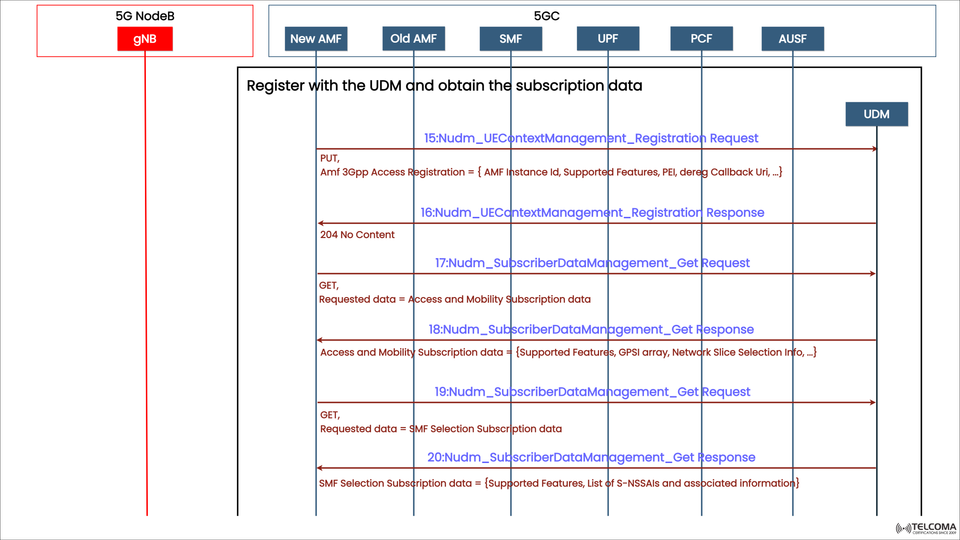

Understanding 5G Core: UDM Registration and Managing Subscriber Data
In the 5G Core Network (5GC), Unified Data Management (UDM) is super important for managing subscriber information, verifying identities, and authorizing services. When a user registers, the Access and Mobility Management Function (AMF) communicates with the UDM to set up the subscriber and gather essential subscription details.
This whole process makes sure that user equipment (UE) is accurately recognized, authenticated, and given the right parameters for mobility and session management.
The graphic above illustrates how these components interact, showing how the AMF leverages the Nudm service interfaces to talk to the UDM. Let’s dive into this process step by step to clarify the technical aspects.
Overview of Key Players
Entity | Full Form | Function
gNB | Next Generation Node B | 5G radio base station that connects to the 5G Core
AMF | Access and Mobility Management Function | Handles registration, mobility, and connection management
UDM | Unified Data Management | Manages user subscriptions, authentication, and network policies
SMF | Session Management Function | Handles PDU sessions and IP allocation
PCF, UPF, AUSF | Policy Control, User Plane, and Authentication Servers | Support data routing, authentication, and policy enforcement
Purpose of UDM Registration in 5G
The UDM registration process makes sure that:
The AMF instance taking care of a specific UE gets registered with the UDM.
The network identifies which AMF is overseeing the UE.
The subscription and mobility data are fetched to set up network operations for that user.
This is vital for managing mobility and ensuring a smooth experience across network slices and various access technologies.
Step-by-Step Breakdown of the UDM Registration Process
The sequence kicks off right after successful security checks and verifying the equipment's identity. At this point, the AMF starts communicating with the UDM through the Nudm_UE Context Management and Nudm_Subscriber Data Management service interfaces.
Step 15: Nudm_UE Context Management_Registration Request
Message Direction: AMF → UDM
Here, a PUT request is sent to register the AMF for the UE’s 3GPP access context.
Parameters include:
AMF Instance ID: A unique ID for the AMF instance managing the UE.
Supported Features: Highlights the AMF’s capabilities.
PEI (Permanent Equipment Identifier): Helps identify the device.
Deregistration Callback URI: This is used if the UDM needs to let the AMF know about deregistration.
This step makes sure the UDM is aware of which AMF instance is in charge of the UE’s mobility and session management.
Step 16: Nudm_UE Context Management_Registration Response
Message Direction: UDM → AMF
The UDM confirms that registration was successful by sending back an HTTP 204 No Content response, which means:
The AMF is now successfully linked with this subscriber.
The UDM is ready to provide subscription data upon request.
This quick response avoids clutter while confirming that registration went through.
Step 17: Nudm_Subscriber Data Management_Get Request
Message Direction: AMF → UDM
After the registration step, the AMF grabs subscriber-specific information.
In this instance, the AMF queries the Access and Mobility Subscription Data, which covers:
Mobility restrictions
GPSI (Generic Public Subscription Identifier) arrays
Network Slice Selection Information (NSSAI)
Supported network features
This info ensures the AMF can implement the right mobility policies for the UE.
Step 18: Nudm_Subscriber Data Management_Get Response
Message Direction: UDM → AMF
The UDM sends back the requested Access and Mobility Subscription Data. This data typically includes:
Supported Features: Details on the subscriber's supported functions.
GPSI Array: Identifiers such as MSISDN or other external IDs.
Network Slice Selection Info: Information regarding which network slices the user can access.
This data is essential for the AMF to manage the user’s registration appropriately and select the right network slices for service delivery.
Step 19: Nudm_Subscriber Data Management_Get Request (SMF Selection)
Message Direction: AMF → UDM
Next up, the AMF requests information for the Session Management Function (SMF) Selection Subscription Data. This data helps in choosing the right SMF instance for handling the user’s PDU sessions (data connections).
The request specifically asks for:
Supported features related to SMF
A list of available S-NSSAIs (Single Network Slice Selection Assistance Information)
Step 20: Nudm_Subscriber Data Management_Get Response (SMF Selection Data)
Message Direction: UDM → AMF
The UDM replies with:
Supported Features: Features related to SMF that this subscriber can use.
List of S-NSSAIs: Each one representing a network slice identifier and associated service types.
This allows the AMF to carry out slice-aware registration and ensure that the UE connects to the correct data network.
Understanding Key Nudm Interfaces
Interface | Purpose | Used By
Nudm_UE Context Management | Registers and manages AMF context in UDM | AMF ↔ UDM
Nudm_Subscriber Data Management | Retrieves subscriber data like mobility and SMF selection | AMF ↔ UDM
Nudm_UE Authentication | (Not shown here) Used for user authentication | AMF ↔ UDM/AUSF
These Nudm APIs, based on RESTful principles, use the Service-Based Architecture (SBA) model for greater scalability and flexibility in 5G Core communications.
Why This Process Matters
This pro cess of registration and data retrieval is crucial for:
Mobility Continuity: Keeps the UE's movement across cells and slices smooth.
Subscriber Policy Enforcement: Pulls policies and access restrictions from the UDM.
Network Slice Management: Helps match UEs to the right network slices based on service needs.
Efficient Resource Utilization: The AMF only fetches necessary subscription data from the UDM when needed.
Simplified Flow Summary
AMF registers with UDM using Nudm_UEContext Management (PUT).
UDM acknowledges registration with a 204 No Content response.
AMF requests Access and Mobility subscription data.
UDM delivers mobility and network slice information.
AMF requests SMF Selection data.
UDM returns the list of supported slices and SMF features.
This wraps up the UDM registration and subscriber data acquisition phase.
- Example: Data Structures in 3GPP TS 29.503
As per 3GPP TS 29.503, these requests and responses adhere to standardized JSON structures. Here’s a sample of data fields:
{ "amfInstanceId": "amf-001", "pei": "356789123456789", "supportedFeatures": "001001", "amfRegistrationUri"}
This ensures that different vendors’ 5GC components can work together seamlessly.
Conclusion
The UDM registration and subscriber data retrieval process are vital components in the 5G Core Network. It connects each UE with the right AMF instance and provides accurate subscription and slice data.
Using the Nudm interfaces, 5G networks gain modularity, flexibility, and efficiency—which allows operators to manage user profiles dynamically, enforce mobility rules, and deliver services across tailored network slices.
Grasping this flow is essential for telecom professionals aiming to design, troubleshoot, and enhance next-generation networks capable of supporting vast connectivity and ultra-low latency services.