
Understanding 5GMM States in 5G Core Network: Deregistered, Registered, and Common Procedure Initiated

Understanding 5G Mobility Management (5GMM) States: Registration, Deregistration, and Common Procedures
The 5G Mobility Management (5GMM) layer is crucial for overseeing user equipment (UE) registration, session management, and mobility actions within the 5G Core Network (5GC).
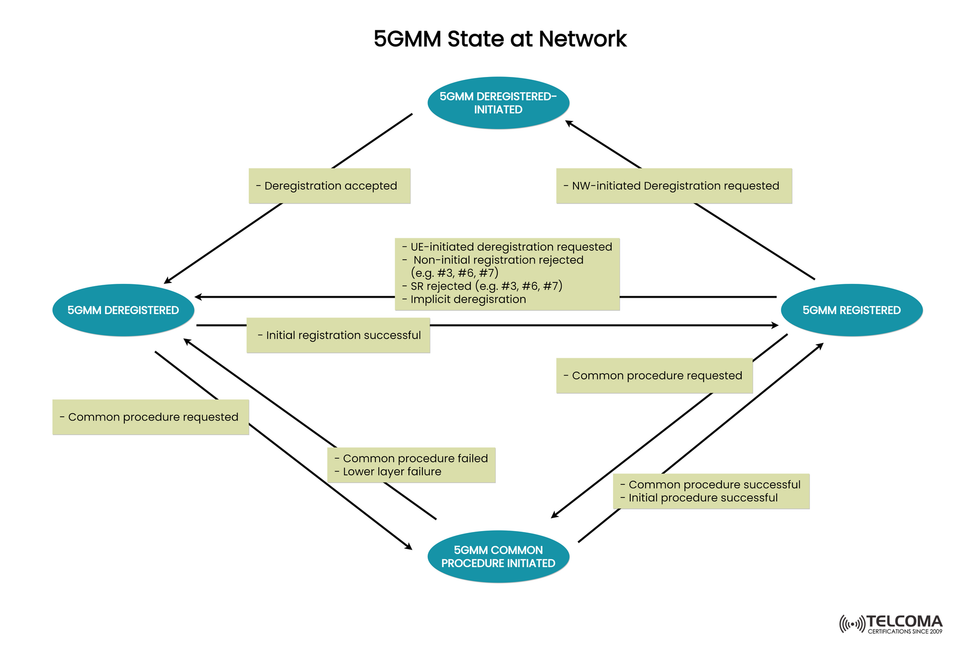
The diagram provided — “5GMM State at Network” — illustrates how a UE shifts through different 5GMM states like Deregistered, Registered, and Common Procedure Initiated, based on actions from the network and the UE itself.
In this article, we’ll explore these states in detail, covering their transitions and their role in ensuring smooth connectivity within 5G networks.
- What is 5GMM (5G Mobility Management)?
In the 5G setup, Mobility Management (MM) is overseen by the Access and Mobility Management Function (AMF) within the 5G Core Network (5GC). The 5GMM layer operates between the UE and AMF, managing:
UE registration and deregistration,
Connection management,
Mobility events, and
Security procedures.
The 5GMM process keeps the network informed about the location, state, and capabilities of the UE, which is essential for things like handovers, authentication, and paging.
- Overview of 5GMM States
The 5GMM protocol outlines several states that show the UE’s registration status with the 5GC.
The diagram displays four primary 5GMM states from the perspective of the network:
5GMM Deregistered
5GMM Deregistered-Initiated
5GMM Registered
5GMM Common Procedure Initiated
Each state represents a specific phase in the UE’s interaction with the 5G core, which we’ll explain below.
- 5GMM Deregistered State
A UE is in the 5GMM Deregistered state when it’s not registered with any Public Land Mobile Network (PLMN).
In this state:
The UE has no active session with the network.
There’s no user plane connection.
The UE needs to go through initial registration to access services.
Triggers for Entering Deregistered State:
UE-initiated deregistration request
Non-initial registration rejected (for example, rejection causes #3, #6, #7)
Service Request (SR) rejected (due to causes like #3, #6, #7)
Implicit deregistration (like network timeout or loss of connectivity)
Once in the deregistered state, the UE must re-register to access services.
- 5GMM Deregistered-Initiated State
This intermediate state signifies a transition phase where the deregistration process has started but isn’t finished yet.
Transition Scenarios (as shown in the image):
UE-initiated deregistration: When the UE asks to deregister (like when powering off or switching PLMNs).
Network-initiated deregistration: When the network enforces deregistration (like if the subscription has expired or the UE is unreachable).
Once the deregistration is accepted, the UE moves to the 5GMM Deregistered state.
- 5GMM Registered State
When the UE successfully completes initial registration, it enters the 5GMM Registered state.
In this state, the UE:
Is authenticated by the 5G Core Network.
Has an established AMF context.
Can send Service Requests, Session Management messages, and NAS signaling.
Key Characteristics:
The UE can carry out normal data transfers and mobility actions.
It can initiate or respond to common procedures (like authentication refresh, configuration updates).
Transitions back to Deregistered State:
The UE can revert to the Deregistered state due to:
Explicit deregistration (either initiated by the user or the network).
Registration or service request rejection (specific cause values).
Implicit deregistration (like idleness or failure).
- 5GMM Common Procedure Initiated State
This state indicates that common procedures are ongoing between the UE and the network.
Examples of 5GMM Common Procedures include:
Identity request/response,
Authentication and security updates,
Configuration update procedures,
Modifications to services initiated by the network.
State Transitions:
The UE enters this state when a common procedure is requested from either the Registered or Deregistered states.
Upon successful completion, it will shift back to 5GMM Registered.
If the procedure fails or there’s a lower-layer failure, the UE will revert to 5GMM Deregistered.
This design strengthens network resilience by keeping integrity during failures.
- State Transition Summary
Here's a summary table that illustrates the transitions shown in the image:
From State | Event/Trigger | To State
5GMM Deregistered | Initial registration successful | 5GMM Registered
5GMM Deregistered | Common procedure requested | 5GMM Common Procedure Initiated
5GMM Registered | UE-initiated deregistration / registration rejected / implicit deregistration | 5GMM Deregistered
5GMM Registered | Common procedure requested | 5GMM Common Procedure Initiated
5GMM Common Procedure Initiated | Common procedure successful / initial procedure successful | 5GMM Registered
5GMM Common Procedure Initiated | Common procedure failed / lower-layer failure | 5GMM Deregistered
5GMM Deregistered-Initiated | Deregistration accepted | 5GMM Deregistered
This clearly illustrates the cyclical, event-driven nature of 5GMM state transitions.
- Key Procedures Related to 5GMM States
The 5GMM states govern several NAS-level (Non-Access Stratum) signaling procedures:
A. Registration Procedure
UE kicks off the registration (either initial or periodic) in the Deregistered state.
Once authentication and configuration succeed, it moves to the Registered state.
B. Deregistration Procedure
This is triggered by the UE (either manually or during power-off) or by the network.
This causes a shift to Deregistered-Initiated, and then to Deregistered state.
C. Service Request Procedure
This kicks in when the UE asks for user plane resources while in the Registered state.
D. Configuration Update Procedure
This is for updating AMF or network configurations while keeping registration intact.
All these procedures are closely tied to the state transitions shown in the diagram, which aids in effective session management.
- Handling Failures and Recovery
The 5GMM Common Procedure Initiated state serves as a buffer for managing failures.
If any common procedure fails (like authentication timeouts or message losses):
The UE shifts back to the Deregistered state.
It can retry registration using back-off timers outlined by 3GPP (like T3510–T3512).
This approach avoids endless loops while ensuring network efficiency.
- Comparing 5GMM and EMM (LTE Mobility Management)
Although 5GMM is similar to EMM (EPS Mobility Management) in LTE, it brings significant enhancements:
Aspect | LTE (EMM) | 5G (5GMM)
Core entity | MME (Mobility Management Entity) | AMF (Access and Mobility Management Function)
Service access | EPC | 5G Core (Service-Based Architecture)
Registration types | Attach/Detach | Initial/Periodic/Update Registration
Flexibility | Fixed procedure | Modular common procedures
Efficiency | Higher signaling overhead | Reduced NAS signaling
These updates make way for network slicing, low-latency services, and scalability for IoT in 5G systems.
A Practical Example: UE’s Journey through 5GMM States
Let’s take a look at a typical 5G UE lifecycle:
Power On: The UE begins in the 5GMM Deregistered state.
Initial Registration: The UE sends a Registration Request → gets to Registered after acceptance.
Data Transfer / Mobility: While registered, the UE executes common procedures (like authentication refresh, configuration update).
Network-Initiated Deregistration: If the network initiates deregistration → moves through Deregistered-Initiated → Deregistered.
Re-Registration: The UE starts the registration process again to reinstate service.
This sequence follows the arrows and transitions depicted in the image.
Conclusion
The 5GMM State Machine outlines how UEs operate with the 5G Core Network regarding registration, mobility, and session continuity.
From initial registration to deregistration and common procedures, these state transitions guarantee that every 5G device is managed by the network effectively and securely.
By grasping these states — Deregistered, Registered, Deregistered-Initiated, and Common Procedure Initiated — telecom engineers can enhance troubleshooting, optimization, and the overall design of robust 5G systems that meet the demands of next-gen networks.