
Understanding 6 GHz Spectrum Allocation: U-NII-5 to U-NII-8 Explained

📡 Analyzing the 6 GHz Spectrum: Usage, Allocations & Impacts for Wireless Networks
6 GHz, which includes the frequency of 5.925 - 7.125 GHz is now at the forefront of a spectrum revolution. Previously, much of the band was occupied by licensed incumbents, and now we have begun to see some limited unlicensed access leading to technologies such as Wi-Fi 6E and soon 5G NR-U (unlicensed) applications.
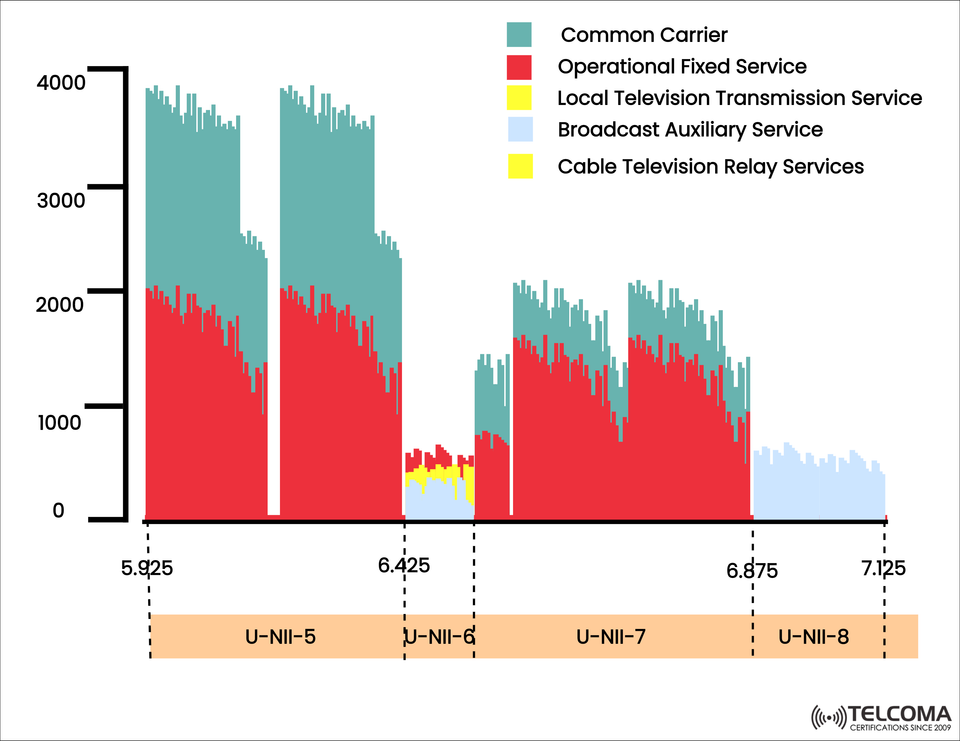
In this blog post, we will be interpreting the spectrum allocation as seen in the chart provided by Telcoma, going into detail on the type of usage presented, spectrum utilization pressures, and the indication for where this leaves us and our future wireless deployments for all of the U-NII sub-band's (U-NII-5 to U-NII-8).
🧭 What is the 6.0 GHz Band?
Frequency Range: 5.925 GHz to 7.125 GHz
Bandwidth: 1200 MHz
Responsibilities: This band is regulated by national bodies such as the FCC (USA), TRAI (India), Ofcom (UK), and so forth.
Unlicensed Access: In many areas it has opened for unlicensed since 2020 supporting Wi-Fi 6E and onward
📊 The Chart Reconnaissance:
Services Across 6.0 GHz Spectrum Colour Legend (From Chart):
Colour Service
🟩 Teal Common Carrier
🟥 Red Operational Fixed Service
🟨 Yellow Local Television Transmission Service
🟦 Light Blue Broadcast Auxiliary Service
🟧 Light Yellow Cable Television Relay Services
Each of the bars are indicating how many active licenses or instances of service operation exists in the band.
📶 U-NII Bands Description (Unlicensed National Information Infrastructure)
🔸U-NII-5 (5.925 - 6.425 GHz) Very congested with Operational Fixed Services and Common Carrier activity
Protected in most areas, automated frequency coordination (AFC) is needed for unlicensed access.
No immediate options available for indoor Wi-Fi without dealing with interference mitigation.
🔸U-NII-6 (6.425 - 6.525 GHz) Broadcaster Auxiliary Systems (BAS) and Television Transmission with limited number of channels, and shorter band.
Indoor Wi-Fi 6E allowed in many parts of the world, but needs to be shared very cautiously with legacy systems.
🔸U-NII-7 (6.525 - 6.875 GHz) Another very congested area of fixed service and common carrier activity.
A key target area for outdoor Wi-Fi and enterprise-level deployments in the future.
Can be made available under dynamic frequency selection, or AFC in unlicensed applications such as indoor Wi-Fi.
🔸U-NII-8 (6.875 - 7.125 GHz) This band has the lowest usage density, with Broadcast Auxiliary Services being the primary content partner.
Generally free and available for indoor unlicensed use.
This provides clean spectrum and establishes where very good high-throughput Wi-Fi 6E/7 can be found and utilized.
⚙️ Why This is Important for Telecom & Networking
📈 Implications for Wi-Fi 6E & Wi-Fi 7 Wi-Fi 6E was the first wave of the Wi-Fi standard to go into the 6 GHz frequency space.
This added the possibility of using 160 MHz and 320 MHz channels that will be ideal for very high-definition video, AR/VR applications, and in very dense environments.
In addition to providing clean spectrum, the space will provide a competitive advantage over similar offerings as if properly deployed would almost eliminate contention issues and provide lower latency and higher reliability than traditional Wi-Fi deployments.
📡 Future of 5G NR-U and Wireless Backhaul
Unlicensed spectrum 5G NR will have upper hand with cleaner, higher frequency spectrum
Good for private 5G, FWA (Fixed Wireless Access), and backhaul.
🔒 Incumbent Protection
High-residential users (e.g., broadcasters) and incumbents will maintain primary rights
Regulated new devices for unlicensed use, both operationally and spectrum, like AFC to not cause interference
📌 Insight from the Chart
U-NII-5 and U-NII-7 are extremely congested, upset by existing fixed services and common carrier link ages
U-NII-8 is the cleanest spectrum we have, ideal for launching Wi-Fi 6E earlier
Coordination processes (AFC) are crucial to share the band safely with incumbents.
Despite extreme incumbent densities, regulators are rather creative in how we open the spectrum
🧠 Considerations for the Technical Deployment
- Aware of local regulations. Always! (e.g., FCC Part 15 rules in the US)
- Use low-power indoor (LPI) mode when permissible to limit interference
- Expect standard power Wi-Fi to start meeting the lower requirement via AFC, when approved in your area
- Expect mesh and enterprise APs to start using more and more of 6 GHz in 2025 and beyond
🔬 Technical Deep Dive: Charting out the 6 GHz Band
The uniqueness of the 6 GHz band is that it has contiguous, non-overlapping wide channels, which is a fundamental building block to making new wireless applications like the ones we present here with high throughput requirements for the most modern and immediate use.
📐 Channel Widths Available
Channel Width # of Channels Use
20 MHz 59 IoT, legacy devices
40 MHz 29 Standard video, VoIP
80 MHz 14 Video streaming, HD
160 MHz 7 VR/AR, 4K/8K
320 MHz (Wi-Fi 7) 3 Ultra-low latency, multi-Gig
Even 320 MHz channels (coming with Wi-Fi 7) would only be made possible because of the amount of clean bandwidth in the 6 GHz band—an impossible job when using very congested 2.4 GHz and 5 GHz bands.
💡 Final Thoughts: Future-Proofing Wireless Networks
The opening of the 6GHz band represents a paradigm shift in wireless communications and enables:
Next-gen Wi-Fi performance (Wi-Fi 6E & 7)
Private 5G deployments on shared spectrum
Scalable enterprise connectivity with wider channels
Reduced interference in high-density environments
However, this power, comes with responsibility—understanding the regulatory environment and how to protect incumbents such as through AFC will be important.
✅ Conclusion:
The 6GHz Band is the Future of High-Performance Wireless
The 6GHz spectrum is a game-changing resource. Although previously occupied heavily by licensed operations like common carrier backhaul and television auxiliary services, regulators globally are unlocking its potential to be used unlicensed.
It offers an ideal combination of performance, cleanliness and availability, and will ultimately play a key role in the success of Wi-Fi 6E and 7. That said, understanding how incumbents are using the band, and ensuring that we are working within coexistence frameworks such as AFC, will be critical.
Thanks to Telcoma's visual and the proper training, telecom professionals and network architects will be able to plan more intelligently, deploy faster, and scale securely in the 6GHz future.