
Understanding Access Requirements in Telecom Networks: Urban to Rural Connectivity Explained

Access Requirements in Telecom Networks: From Urban Hubs to Rural Frontiers
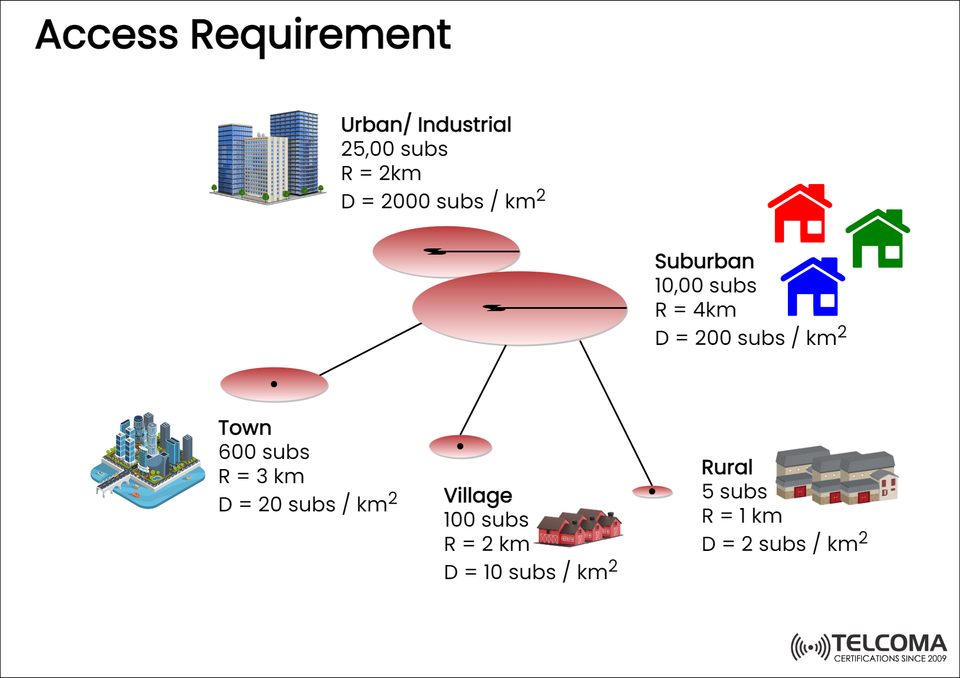
In telecom network design, access requirements outline how operators strategize, set up, and optimize their infrastructure to ensure reliable connectivity. The image shows significant differences across environments — from urban centers to rural areas — in terms of subscriber densities, coverage areas, and deployment priorities.
Grasping these differences is key for 5G, fiber, and wireless network planners who are juggling costs, performance, and accessibility.
Let’s dive into how access requirements shift across various geographical zones: Urban/Industrial, Suburban, Town, Village, and Rural — and what that means for network design and planning.
What Are Access Requirements in Telecom?
Access requirements refer to the connectivity needs and standards that influence the design of access networks (the part that connects end users to the core network).
These needs hinge on a few crucial factors:
Subscriber density (D): The number of users per square kilometer.
Coverage radius (R): How far a single cell or access node can effectively serve.
Total subscribers (Subs): The anticipated number of users in the area.
Bandwidth demand: The capacity each subscriber requires.
Planning access networks means balancing these factors to ensure that every user experiences a consistent level of service, no matter where they’re located.
The Urban and Industrial Access Challenge
Urban/Industrial Areas
Subscribers: 25,000
Radius (R): 2 km
Density (D): 2,000 subs/km²
Urban and industrial areas are the most data-hungry and capacity-reliant environments. They feature high population densities, clusters of businesses, and dense IoT setups, leading to countless simultaneous connections and the need for ultra-low latency.
Design Implications:
High-capacity small cells: Set up to manage large data volumes over short distances.
Dense fiber backhaul: Fiber networks are essential to support 5G connections for small cells.
Multi-band spectrum usage: Utilizing low, mid, and high-band frequencies (like mmWave for high data needs and sub-6GHz for broader coverage).
Network slicing: Adjusting network resources for specific applications (like industrial automation vs. streaming).
Urban networks are built for throughput and reliability, typically focusing on 5G NR and fiber-to-the-home solutions.
Suburban Connectivity: Balancing Coverage and Capacity
Suburban Areas
Subscribers: 10,000
Radius (R): 4 km
Density (D): 200 subs/km²
Suburban areas strike a balance between bustling cities and less populated rural areas. Their access requirements demand both ample coverage and enough capacity for moderate data needs.
Design Implications:
Macro cells with small cell enhancements: Large towers cover wide areas, while small cells address capacity shortages.
Fixed Wireless Access (FWA): An economical choice for delivering broadband in suburban settings.
Fiber distribution hubs: Act as main points for both mobile and broadband traffic.
Smart spectrum management: Mid-band frequencies (2.5–3.5 GHz) provide the best mix of coverage and capacity.
Networks in suburban areas often blend LTE Advanced and 5G mid-band spectrum to keep user experiences consistent.
Town-Level Access: Expanding Connectivity to Small Communities
Towns
Subscribers: 600
Radius (R): 3 km
Density (D): 20 subs/km²
Towns are small population pockets that need efficient yet cost-effective connectivity solutions. Here, priority goes to cost-efficiency and reliability.
Design Implications:
Limited macro base stations: One or two sites can often cover the entire town.
Microwave backhaul links: Used instead of fiber when costs are a concern.
Hybrid access technologies: Mixing fiber-fed stations with wireless local access.
Community networks: Local ISPs or cooperative models often step in to fill service gaps.
The big challenge for town-level networks is providing consistent service at low costs while ensuring growth can be accommodated as populations increase.
Village Networks: Extending Access to the Edge
Villages
Subscribers: 100
Radius (R): 2 km
Density (D): 10 subs/km²
Villages are sparsely populated areas that require broad coverage without heavy infrastructure investments. Traditional expansion methods rarely make sense here.
Design Implications:
Low-power base stations: Often run on solar or hybrid power.
Wireless backhaul: Satellite or microwave links replace expensive fiber.
Shared network infrastructure: Operators may collaborate using Network-as-a-Service (NaaS) models.
Edge computing: Set up locally to ease backhaul traffic and enhance service quality.
Connectivity equity is the main goal here — ensuring low-density populations can access digital services.
Rural Access: Bridging the Connectivity Divide
Rural Areas
Subscribers: 5
Radius (R): 1 km
Density (D): 2 subs/km²
Rural areas present the toughest challenge for network operators. With extremely low subscriber density and wide geographical spans, the cost per connection shoots up.
Design Implications:
Long-range communication options: Like Low Power Wide Area Networks (LPWAN), satellite broadband, or TV white space.
Community Wi-Fi and shared spectrum projects: Help provide connectivity more efficiently.
Government subsidies and universal service funds: Often back rural expansion efforts.
Cloud-based management: Cuts down on the need for on-site maintenance.
Rural strategies focus on connectivity inclusion rather than super-high performance — ensuring access to essential services like communication, education, and health.
Comparative Summary of Access Requirements
Environment Subscribers Coverage Radius (R)Density (subs/km²)Key Technologies Primary Focus Urban/Industrial25,0002 km2,0005G, Fiber, Small Cells Capacity & PerformanceSuburban10,0004 km200Macro + Small Cells, FWA Balanced CoverageTown6003 km20LTE, Microwave Cost EfficiencyVillage1002 km10Hybrid, Satellite Connectivity ReachRural51 km2LPWAN, TVWS, Satellite Access Inclusion
This comparative overview shows how each setting calls for a unique approach to network design — from optimizing for high density to catering to long-range connectivity needs.
The Role of 5G and Multi-Access Edge Computing (MEC)
As networks advance, 5G and Edge Computing are changing access requirements.
In urban and industrial areas, 5G standalone (SA) networks provide ultra-reliable low-latency communication (URLLC) and enhanced mobile broadband (eMBB).
In rural and village contexts, 5G non-standalone (NSA) and Fixed Wireless Access (FWA) help extend affordable broadband without needing extensive fiber deployment.
Edge computing supports these setups by bringing computing resources closer to users, which reduces latency and improves responsiveness for time-sensitive applications like IoT and AR/VR.
Planning Considerations for Access Networks
When designing access networks across different regions, engineers need to think about:
Spectrum availability: Matching frequency bands with coverage and capacity needs.
Backhaul integration: Making sure fiber, microwave, or satellite links meet data demands.
Energy efficiency: Using green energy and smart power systems in remote regions.
Scalability: Preparing for future subscriber growth and 5G integration.
Regulatory compliance: Meeting local standards for spectrum and safety.
Good planning is crucial for sustainable growth and keeping operational costs down.
Conclusion
The Access Requirement framework sits at the heart of telecom infrastructure design. Whether dealing with the crowded networks of urban areas or the vast coverage needs of rural spots, each environment has its own strategy.
Urban networks focus on throughput and capacity, while those in rural and village settings prioritize coverage and accessibility. The secret lies in flexible, hybrid setups — combining fiber, wireless, and satellite technologies.
As we step into the 5G era and beyond, the aim for telecom operators is crystal clear: "Connect everyone, everywhere — efficiently and intelligently."