
Understanding Antenna Array Structure: Geometry, Beamforming, and Telecom Applications

In the world of wireless communication, antenna arrays are crucial for technologies like beamforming, massive MIMO, and high-capacity 5G systems. Rather than depending on just one antenna, today’s telecom systems leverage arrays of antennas set up in specific patterns to effectively direct and optimize radio waves.
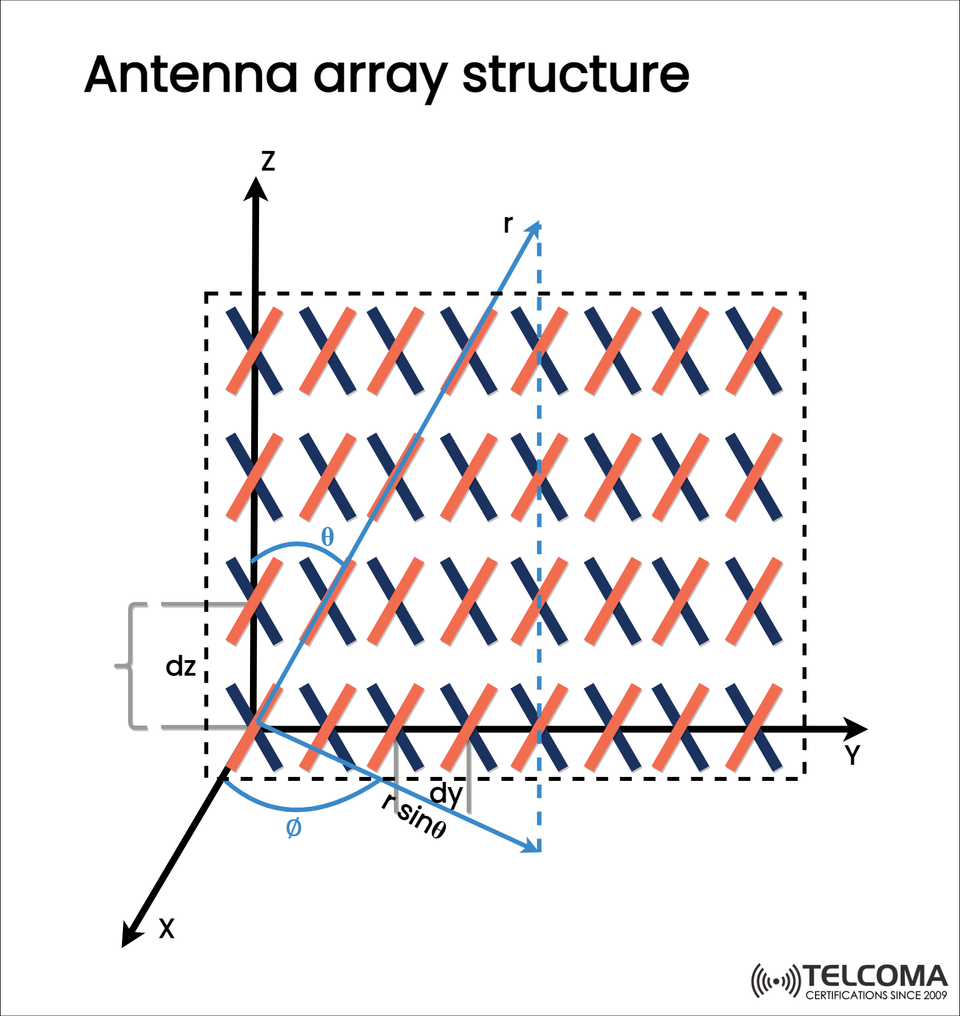
The image uploaded shows a 3D representation of an antenna array, putting a spotlight on how the elements are geometrically arranged, spaced, and oriented. By tweaking things like element spacing, phase, and direction, these arrays facilitate advanced methods such as spatial multiplexing and managing interference.
In this blog post, we’ll dive into what antenna array structures are, their geometry, the significance of the parameters depicted in the image, and how they empower next-gen telecom systems.
What Is an Antenna Array Structure?
An antenna array consists of multiple antenna elements organized in a particular setup. Unlike a single antenna, arrays can steer beams, enhance gain, and cut down on interference.
Key Features of Antenna Arrays:
Multiple Elements: Antennas are lined up in rows and columns.
Geometric Spacing: Defined by dy (spacing along Y) and dz (spacing along Z).
Directionality: Radiation is aimed based on the angle θ (theta) and azimuth φ (phi).
Phase Adjustment: You can electronically steer the beam direction without moving the antennas around physically.
Geometry of Antenna Array Structure
The image clearly illustrates the geometry of the array in three-dimensional space. Let’s break down the elements step by step:
- Coordinate System (X, Y, Z)
X-axis: Indicates the horizontal direction, which is perpendicular to the array plane.
Y-axis: Represents the width of the array.
Z-axis: Represents the height of the array.
- Element Spacing (dy and dz)
dy: The distance between antenna elements along the Y-axis.
dz: The distance between antenna elements along the Z-axis.
Appropriate spacing ensures the constructive interference of signals while steering clear of grating lobes, which are unwanted side beams.
- Angles (θ and φ)
θ (Theta): Elevation angle that measures how much the beam is tilted above the horizontal.
φ (Phi): Azimuth angle that shows how much it rotates in the horizontal plane.
These angles help define where the maximum radiation (beam direction) happens.
- Propagation Vector (r)
The vector r points in the direction the wave travels.
Its projection, r sin θ on the Y-axis, is used to calculate steering and phase alignment.
Working Principle: How Antenna Arrays Steer Beams
The real strength of antenna arrays is their ability to shape and direct beams.
When antenna elements emit signals with precisely adjusted phases and amplitudes, the resulting electromagnetic waves work together to strengthen radiation in the desired direction (constructive interference), while canceling it out in unwanted directions (destructive interference).
This principle is at the heart of beamforming, which is vital for 5G, Wi-Fi, radar, and satellite communications.
Types of Antenna Array Structures
- Linear Array
Elements are set up in a straight line, typically along one axis.
Simple design, but limits control in three-dimensional space.
- Planar Array
Elements are organized in a 2D grid, as illustrated in the image.
This setup allows for beam steering both in azimuth (φ) and elevation (θ).
Commonly used in 5G base stations and radar systems.
- Cylindrical and Circular Arrays
Elements arranged in a circle or cylinder.
Great for providing omnidirectional coverage or 360° scanning.
- Massive MIMO Arrays
Large arrays containing tens or hundreds of elements.
Vital for 5G and beyond, providing unprecedented capacity and reliability.
Applications in Telecom Systems
Antenna arrays have moved past just military radars; they’re now a staple in telecom and consumer technology.
- 5G Networks
Beamforming with planar arrays sends signals to individual users.
Massive MIMO boosts capacity by simultaneously transmitting multiple streams.
- Satellite Communication
Arrays can steer beams to cover various regions without needing mechanical movement.
- Wi-Fi 6/7
Multi-antenna access points can dynamically direct beams to connected devices, enhancing throughput.
- IoT and Smart Cities
Antenna arrays in dense areas improve coverage and reduce interference.
- Radar and Defense
Arrays offer high-precision target detection and tracking.
Advantages of Antenna Array Structures
High Gain: Combining signals from multiple antennas increases effective radiated power.
Beam Steering: Directs energy exactly where needed without moving the hardware.
Interference Reduction: Reduces signals from unwanted directions.
Spatial Multiplexing: Supports multiple users or streams at once.
Scalability: You can expand arrays by adding more elements.
Challenges in Antenna Arrays
Despite the benefits, there are some challenges:
Design Complexity: Requires precise control over phase and amplitude across the elements.
Cost and Size: Bigger arrays lead to higher hardware costs and larger footprints.
Mutual Coupling: Elements that are close together can interfere, impacting performance.
Beam Squinting: At wide bandwidths, beams may misalign from their intended directions.
Comparative Table: Traditional vs. Array Antennas
Feature Traditional Single Antenna Antenna Array Structure Gain Limited High (increases with elements)Beam Steering Mechanical (slow)Electronic (fast and precise)Interference Control Poor Strong interference suppression Application Basic coverage Advanced 5G, radar, satellite Scalability Fixed design Highly scalable with more elements
Future of Antenna Array Structures
As telecom moves towards 6G, antenna array structures will be even more essential. Some emerging trends include:
Ultra-Massive MIMO: Arrays with thousands of elements aiming for terabit-per-second speeds.
Reconfigurable Intelligent Surfaces (RIS): Smart arrays hidden in walls and buildings to redirect signals.
AI-driven Beam Management: Using machine learning for dynamic beam optimization.
Conclusion
The antenna array structure is the backbone of today’s wireless networks. By systematically arranging antenna elements and controlling their phases, networks can steer beams, minimize interference, and maximize spectrum efficiency.
Earlier, technologies like Release 8 and early LTE depended on sectoral transmission, but with 5G and beyond, antenna arrays enable precise beamforming and massive MIMO.
The geometry shown in the image (dy, dz, θ, φ) illustrates the mathematical basis for designing arrays and directing beams.
As we progress towards 6G and smarter networks, antenna arrays will be central to achieving faster, more efficient, and reliable wireless communications.