
Understanding Beamforming and Null Steering in 5G: How Smart Antennas Shape the Future of Wireless Communication

Beamforming and Null Steering: The Smart Antenna Technologies Powering 5G Networks
In the age of 5G and beyond, there's an increasing need for communication that's not just fast, but also low-latency and free from interference. A big part of making this happen is through beamforming, which often works hand in hand with null steering — both of which cleverly manage how antennas send and receive signals.
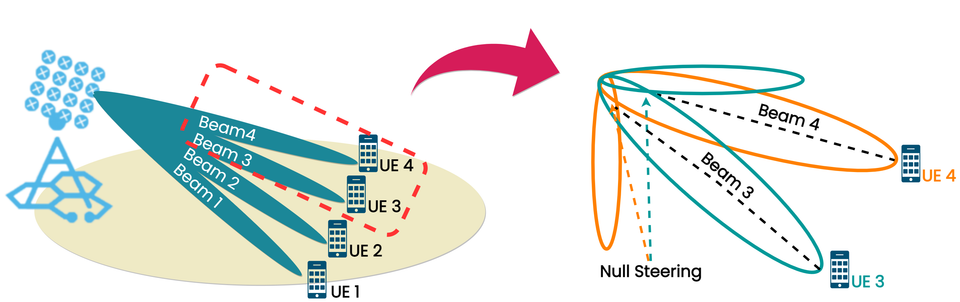
The diagram included shows these ideas in action. On the left, you have several beams (Beam 1–4) aimed at different User Equipments (UEs), standing for users or devices. On the right, you can see how the system adjusts with null steering, which hones in on active users while reducing interference in unwanted directions.
What Is Beamforming?
Beamforming is a technique in signal processing that helps antennas focus radio waves toward specific users instead of just blasting signals everywhere.
In older cellular systems, antennas send out signals in all directions, which wastes energy and creates more interference. Beamforming flips that on its head by focusing the energy of the transmission in the right direction, kind of like how a flashlight condenses light into a beam instead of scattering it all around.
Key Concept: Directional Signal Transmission
Beamforming involves multiple antennas set up in an array. By tweaking the phase and amplitude of the signal at each antenna, the waves combine in certain directions (toward the target receiver) while canceling out others.
Benefits of Beamforming:
Improved Signal Strength: More focused energy leads to a better signal-to-noise ratio (SNR).
Reduced Interference: Energy can be directed away from areas where it’s not needed.
Higher Capacity: Different users can be served at the same time with separate beams.
Extended Coverage: Stronger directional signals enhance both range and quality.
In the diagram, Beams 1 to 4 show how the antenna array directs transmissions toward users UE1 to UE4.
How Beamforming Works in 5G
In 5G networks, beamforming is executed through Massive MIMO (Multiple-Input Multiple-Output) systems, which can have dozens or even hundreds of antenna elements at a base station.
Each element plays a role in shaping super-directional beams that can track users in real-time. This is particularly important in the millimeter wave (mmWave) range, where signals lose strength quickly and need precise focusing.
Types of Beamforming in 5G:
Type Description Use Case Analog Beamforming Uses phase shifters to control phase shifts in the analog domain. Effective for a single beam per RF chain; used in mmWave. Digital Beamforming Adjusts amplitude and phase for each antenna element digitally. Allows multiple beams and MU-MIMO. Hybrid Beamforming Merges analog and digital techniques. Strikes a balance between flexibility and hardware cost.
This setup enables base stations to communicate effectively with multiple UEs at once while reducing interference and maximizing spectral efficiency.
Understanding Null Steering: The Next Step in Beam Optimization
While beamforming focuses energy toward users, null steering complements it by directing nulls (areas of minimal radiation) away from interference sources.
In simpler terms, beamforming decides “where to speak louder,” while null steering decides “where to stay quiet.”
How Null Steering Works
By fine-tuning the signal phase and amplitude among antennas, the system creates destructive interference in certain directions — effectively steering a null to reduce radiation there.
This helps:
Suppress interference from unwanted users or devices.
Improve overall signal quality for target users.
Enhance capacity in crowded environments.
In the diagram, the right side illustrates how the system adjusts beam patterns so that:
Each UE (User Equipment) receives its corresponding beam (Beam 3, Beam 4, etc.).
Interfering directions get nulls — shown by the thin or missing beam lobes.
Beamforming + Null Steering: A Powerful Combination
In today’s 5G base stations, beamforming and null steering work in tandem to ensure top-notch performance.
The Process in Action:
User Identification: The base station finds active UEs and their spatial locations.
Beam Formation: It directs beams toward each UE using array signal processing.
Interference Detection: The system picks up on interference or overlapping signals.
Null Steering: It adjusts beam parameters on the fly to squelch interference.
Continuous Optimization: As users move, beams and nulls are recalibrated in real time.
This collaboration makes sure that every user enjoys strong coverage while keeping interference at bay — a must for technologies like massive MIMO, multi-user beamforming, and spatial multiplexing.
Mathematical Foundation (Simplified)
Beamforming relies on principles of antenna array signal processing.
For an array with N elements, the array factor (AF) is expressed as:
AF(θ)=∑n=1Nwnejkdnsin(θ)AF(θ) = ∑{n=1}^{N} w{n} e^{j k d_{n} ext{sin}( heta)}
Where:
w_n = complex weight (amplitude and phase) for antenna n
k = wave number (2π/λ)
d_n = spacing between antennas
θ = angle of departure (or arrival)
By adjusting w_n, the array can direct main beams or nulls in certain directions — enabling beamforming and null steering.
This adaptability allows for serving multiple users at once and managing interference dynamically.
Applications of Beamforming and Null Steering
These technologies are crucial in various advanced communication and radar systems.
In 5G and Beyond:
Enhanced Mobile Broadband (eMBB): High-speed data delivery.
Massive IoT (mIoT): Reliable connectivity for many devices at once.
Ultra-Reliable Low-Latency Communications (URLLC): Accurate beam control ensures stable, low-latency links.
Vehicular Communication (V2X): Real-time beam tracking between moving vehicles and roadside units.
Beyond Telecom:
Radar Systems: For accurate target detection and interference reduction.
Wi-Fi 6/7: For targeted signal delivery to enhance indoor performance.
Satellite Communications: For focused beam coverage and less cross-interference.
Advantages of Beamforming and Null Steering
Feature Benefit Directional Transmission Improved signal quality through focused energy. Interference Mitigation Null steering helps cut down on unwanted noise. Spectral Efficiency Multiple beams allow for communication with several users at once. Energy Efficiency Less power is wasted on unwanted signals. Dynamic Adaptability Adjusts in real time to user movement and changing environments.
These advantages make the technology essential for dense urban 5G rollouts and future 6G systems.
Challenges and Considerations
Despite the many benefits, rolling out beamforming and null steering comes with its own set of hurdles:
Complex Signal Processing: Adapting beams in real time requires advanced computing power.
Calibration Errors: Differences among antenna elements can mess up beams.
Channel Estimation: Accurate spatial data is vital for effective steering.
Hardware Cost: Large arrays and RF chains can complicate systems.
Modern systems tackle these challenges through AI-driven beam management, hybrid setups, and digital twin simulations to enhance real-time performance.
Conclusion
The image showcases the essence of a smart antenna system — shifting traditional broadcasting into intelligent, adaptable signal delivery.
Beamforming channels energy where it matters, while null steering minimizes interference. Working together, they form the foundation of high-capacity, low-latency wireless networks that are shaping 5G and the future of 6G.
For those in the telecom world, understanding these technologies is crucial for designing efficient, robust networks that can keep up with our ever-growing need for data and connectivity.