
Understanding Contention-Based and Contention-Free Random Access Procedures in 5G NR

Contention-Based and Contention-Free Random Access Procedures in 5G NR
In 5G New Radio (NR), the Random Access (RA) procedure is key for User Equipment (UE) to initially connect with the gNB (Next Generation NodeB). This process ensures that the UE can sync its uplink timing, request system resources, and start data transmission over the air.
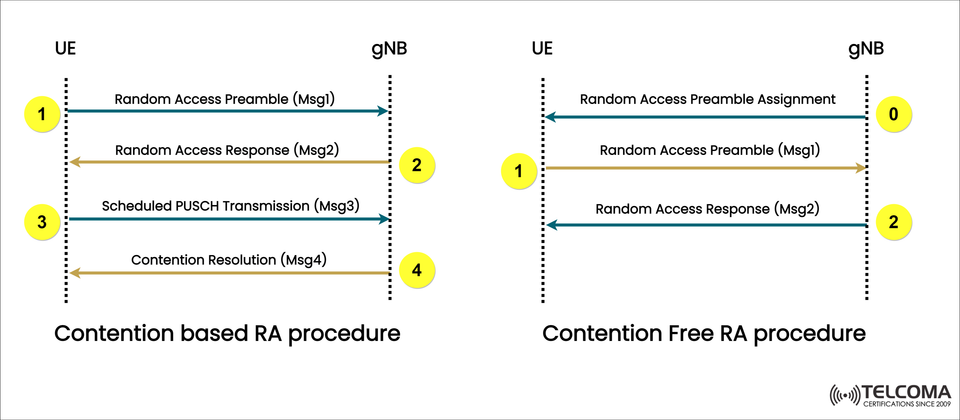
The image uploaded does a great job of illustrating the two kinds of Random Access procedures in 5G:
Contention-Based Random Access (CBRA)
Contention-Free Random Access (CFRA)
Both approaches aim to create a solid connection between the UE and gNB, but they differ in how preambles are chosen and how collisions are handled. Let’s dive into each one.
Introduction to Random Access in 5G
In a 5G network, Random Access comes into play whenever a UE needs to establish or re-establish uplink synchronization with the gNB. This usually happens in a few scenarios:
When accessing the network for the first time after being powered on.
After a handover or a radio link failure.
Transitioning from idle mode to connected mode (like during paging).
When the uplink timing sync is lost.
The Random Access procedure is crucial for the UE to efficiently request uplink resources, which helps with proper scheduling and communication.
There are two types of Random Access (RA) in 5G:
Contention-Based Random Access (CBRA)
Contention-Free Random Access (CFRA)
Both methods rely on a set of well-defined messages exchanged between the UE and gNB.
- Contention-Based Random Access (CBRA)
Contention-Based Random Access (CBRA) is the most commonly used random access type. It’s termed “contention-based” because multiple UEs can end up selecting the same preamble, which might lead to contention or collisions.
2.1 Steps in CBRA Procedure
The CBRA procedure is made up of four steps, as shown in the image with messages Msg1 to Msg4:
Step | Message | Direction | Description
1 | Random Access Preamble (Msg1) | UE → gNB | UE randomly picks and sends a preamble from the available set.
2 | Random Access Response (Msg2) | gNB → UE | gNB replies with timing advance, uplink grant, and temporary identity.
3 | Scheduled PUSCH Transmission (Msg3) | UE → gNB | UE sends data with the resources assigned in Msg2 (this may include an RRC connection request).
4 | Contention Resolution (Msg4) | gNB → UE | gNB resolves contention if multiple UEs used the same preamble.
2.2 Step-by-Step Breakdown
Step 1: Random Access Preamble (Msg1)
The UE selects a preamble from its available pool at random and sends it to the gNB over the Physical Random Access Channel (PRACH).
Since several UEs can choose the same preamble, contention can occur.
Step 2: Random Access Response (Msg2)
The gNB replies with a Random Access Response (RAR) on the Physical Downlink Control Channel (PDCCH).
The RAR includes: * Timing Advance Command (to align uplink timing). * Uplink Grant (for Msg3 transmission). * Temporary C-RNTI (temporary identifier for UE).
Step 3: Scheduled PUSCH Transmission (Msg3)
Using the grant received in Msg2, the UE sends a Scheduled Transmission on the PUSCH (Physical Uplink Shared Channel).
This message can carry RRC Connection Request or other higher-layer info.
Step 4: Contention Resolution (Msg4)
If several UEs used the same preamble, the gNB identifies the correct one by matching the UE’s MAC ID or C-RNTI.
The UE that gets through successfully receives a Contention Resolution Message, confirming that the random access was successful.
2.3 Key Points about CBRA
Advantages: This method is straightforward and works well for initial access or when preambles aren’t reserved.
Disadvantages: It can lead to contention if two or more UEs pick the same preamble, causing retransmissions and delays.
Typical Use Cases: * Getting initial access to the network. * Uplink synchronization after being in idle mode. * Random re-access after a radio link failure.
Contention-Free Random Access (CFRA)
The Contention-Free Random Access (CFRA) procedure avoids contention entirely by using dedicated preambles assigned by the gNB.
CFRA is applied when the gNB assigns a specific preamble to a UE, making sure that no other UE uses it at the same time. This leads to a faster and more reliable access.
3.1 Steps in CFRA Procedure
The CFRA procedure generally has three main steps (or four if you count the preamble assignment).
Step | Message | Direction | Description
0 | Random Access Preamble Assignment | gNB → UE | gNB gives a dedicated preamble to the UE (through RRC or MAC CE).
1 | Random Access Preamble (Msg1) | UE → gNB | UE sends the assigned preamble to the gNB.
2 | Random Access Response (Msg2) | gNB → UE | gNB sends RAR with timing advance and uplink grant.
There’s no contention resolution step because the preamble is unique to the UE.
3.2 Step-by-Step Breakdown
Step 0: Preamble Assignment
Before starting CFRA, the gNB gives a dedicated preamble to the UE, usually through: * RRC Connection Reconfiguration message or * MAC Control Element (CE).
Step 1: Random Access Preamble (Msg1)
The UE sends the assigned preamble straight to the gNB over the PRACH.
Since this preamble is unique, no contention arises.
Step 2: Random Access Response (Msg2)
The gNB reacts with a RAR, which includes: * Timing Advance Command. * Uplink Grant. * Temporary Identifier (C-RNTI).
Now the UE can proceed with data transmission without needing to deal with any contention resolution.
3.3 Key Points about CFRA
Advantages: * Access without collisions. * Lower latency compared to CBRA. * Perfect for handovers or services that need low latency.
Disadvantages: * Limited number of dedicated preambles. * Needs pre-configuration from the gNB.
Typical Use Cases: * Handover between cells (when the UE already has context). * Recovery from beam failure. * Scenarios needing ultra-reliable low-latency communication (URLLC).
Comparison: Contention-Based vs. Contention-Free Random Access
Feature | Contention-Based (CBRA) | Contention-Free (CFRA)
Preamble Selection | Randomly selected by UE | Assigned by gNB
Contention Possibility | Yes | No
Latency | Higher due to contention resolution | Lower (no contention phase)
Signaling Steps | 4 (Msg1–Msg4) | 3 (Msg0–Msg2)
Use Cases | Initial access, RLF recovery | Handover, beam recovery
Collision Handling | Resolved via Msg4 | Not applicable
Why Random Access Matters in 5G
The Random Access procedure is essential for keeping the network efficient and ensuring that UEs can access resources dynamically.
Here are some key reasons for its importance:
Timing Alignment: Ensures uplink signals reach the gNB in sync.
Resource Request: Lets UEs ask for scheduling grants.
Handover Support: Helps provide smooth mobility between cells.
Beam Management: Aids in beamforming alignment in 5G NR systems.
Practical Deployment Considerations
Operators and equipment vendors are optimizing RA procedures to boost access efficiency and minimize collisions.
Dynamic PRACH Configuration: Adjusting the available preambles based on network demand.
Prioritization: Giving dedicated preambles to high-priority services (like URLLC).
Backoff Mechanisms: Reducing repeated access attempts in crowded areas.
In densely populated urban settings, CBRA can lead to contention, while CFRA guarantees access for priority users.
Conclusion
The Random Access Procedure is a central part of 5G NR’s connection process. Both Contention-Based (CBRA) and Contention-Free (CFRA) methods are vital for ensuring reliable and efficient access across various scenarios.
CBRA is flexible for general access but may encounter collisions.
CFRA offers determined and low-latency access, making it perfect for mobility and URLLC applications.