
Understanding Disaggregated RAN (3GPP) Logical Architecture: Components, Interfaces & Functions
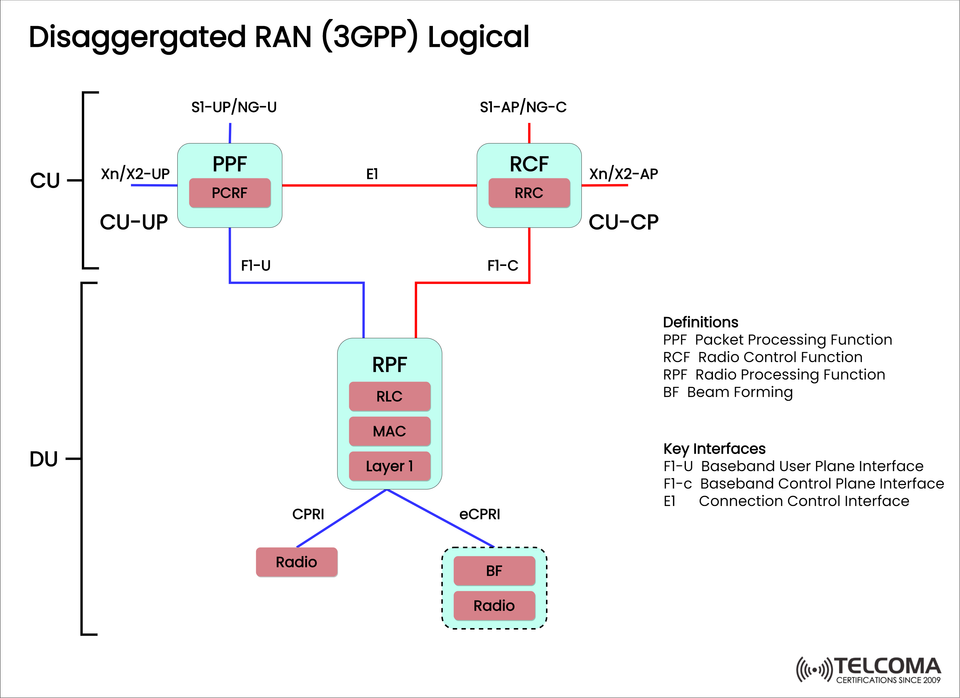

Disaggregated RAN (3GPP) Logical Architecture
The transformation of mobile standards to 5G has changed the design and operational methods of Radio Access Network (RAN). Disaggregated RAN, as defined by the 3rd Generation Partnership Project (3GPP), is an innovation that breaks down the RAN into controllable functional units allowing for greater flexibility, scale, and cloud-native deployments.
In this article, we will be reviewing the Disaggregated RAN (3GPP) Logical Architecture as per the attached diagram. We will break down each functional element, the interfaces, and the role of each one within the Centralized Unit (CU) and Distributed Unit (DU).
📌 What is Disaggregated RAN?
Disaggregated RAN means that the traditional monolithic RAN is broken down into modular parts that can be virtualized and run on commercial-off-the-shelf (COTS) hardware. Disaggregated RAN consists of the RAN functions broken apart primarily as follows:
Centralized Unit (CU)—higher-layer protocols and signaling
Distributed Unit (DU)—lower-layer protocols and time-critical functions
This means that each network operator decides how to deploy each function relative to the user or whether to deploy it in cloud data center(s) based upon the performance and latency that each function requires.
🧱 Major Elements in the Disaggregated RAN Logical Model
As shown by the diagram, the architecture can be functionally separated into CU-UP, CU-CP and DU.
- Centralized Unit - User Plane (CU-UP)
Component: PPF (Packet Processing Function)
Sub-function/P-Function: PCRF (Policy and Charging Rules Function)
Interfaces:
• S1-UP/NG-U - connection to 5G Core Network (user data).
• Xn/X2-UP - connect to other base stations.
• F1-U - connect CU-UP to the DU.
- Centralized Unit - Control Plane (CU-CP)
Component: RCF (Radio Control Function)
Sub-function/P-Function: RRC (Radio Resource Control).
Interfaces:
• S1-AP/NG-C - connection to 5G Core Network (control signaling).
• Xn/X2-AP - control interface to peer base stations.
• F1-C - Control Plane connectivity to the DU.
• E1 - connection between CU-UP and CU-CP for signaling coordination.
3. Distributed Unit (DU)
Component: RPF (Radio Processing Function)
Sub-functions:
• RLC: Radio Link Control
• MAC: Medium Access Control.
• L1: Layer 1 (Physical Layer) processing.
Interfaces:
• F1-U & F1-C: Baseband interfaces to CU.
• CPRI/eCPRI: link from the DU to the Radio Units (RUs).
Supports:
• Beam Forming (BF) - Use of advanced antenna techniques to increase throughput and improve coverage.
🔗 Key Interfaces and Role of Interfaces
Interface Complete Name Description
F1-U Baseband User Plane Interface Provides user data transfer from CU-UP to DU
F1-C Baseband Control Plane Interface Provides the control signaling connection between CU-CP and DU
E1 Connection Control Interface Provides coordination connection between CU-UP and CU-CP
CPRI/eCPRI Common Public Radio Interfaces/Enhanced CPRI Transport radio signals to and from RUs
⚙️ Functional Separation: Advantages and Implications
Scalability: Control and user planes can scale independently
Flexibility: CU functions are non-location constrained (centralized or cloud-native hosting options)
Interoperability: Standardized interfaces allows vendors to easily integrate architectures
Low Latency: Time-critical tasks remain co-located in the DU near the radio
Cost Effective: Resources are fully utilized with virtualization and reusable hardware.
🎯 Use Cases and Deployment Scenarios:
Cloud RAN or C-RAN: CU functions are hosted in centralized data centers
Edge Computing: DU is hosted close to users for ultra-low latency applications
Open RAN or O-RAN: Leveraging both disaggregation and open interfaces to provide vendor diversity
Private 5G Networks: Deployment scenarios customized to enterprise needs
🔍 Technical Benefits of Disaggregated RAN
A disaggregated RAN design has many architectural and operational advantages over traditional RAN:
✅ Separation of Concerns
By separating CU-CP from CU-UP, CU-CP and CU-UP can be developed and scaled independently.
Real-time and non-real-time processes are cleanly separated.
✅ Better Resource Allocation
Computing resources can be allocated dynamically based on the demand.
More reason to load balance using cloud native.
✅ Reduced Vendor Lock-In
Open interoperable interfaces (F1, E1, Xn) means more of a multi-vendor ecosystem.
Operators can procure the best-in-class solutions for individual component parts.
✅ Support for Future Technologies
We can introduce newer features, including:
Massive MIMO
Beamforming (BF)
Carrier Aggregation
Dynamic Spectrum Sharing
🌐 Real-World Effects for Network Operators
When network operators adopt 3GPP disaggregated RAN, they should see:
🔹 Reduce Total Cost of Ownership (TCO)
Lower capex with COTS hardware.
Lower opex with cloud-native orchestration.
🔹 Increase Speed to Service
Faster time to service deployment, updates, and new features.
Private 5G or enterprise-specific networks are easy to deploy.
🔹 Improve Network Resilience
Easier fault isolation because of modularity.
Faster recovery and upgrades with software-defined networking.
📈 Future Trends in RAN Development
Disaggregated RAN is a start to broader (network) disaggregation and cloudification. Here’s what’s to come:
Trend Description
O-RAN Maturity Open RAN Alliance sees more open, interoperable RAN components.
AI/ML Integration AI powered optimization for RRM (Radio Resource Management) with machine learning.
vRAN & Cloud RAN Expansion More operators will either switch to virtualized or containerized RAN.
Edge-native DU Deployments Latency sensitive DU functions will converge closer to the user.
🛠️ Summary of Key Components and Interfaces
Component Function
PPF Supports user-plane packet processing
PCRF Control for QoS, policy and charging
RCF Control-plane signaling & RRC functions
RPF Physical, MAC, RLC (layers)
BF Beamforming logic for spatial multiplexing
Radio Antenna and RF (transmission/reception) unit
📝 Conclusion
The Disaggregated RAN architecture as outlined by 3GPP represents a leap forward into a flexible, virtualized, scalable 5G network. By logically dividing the CU and DU functions by applying standardized interfaces like F1-C, F1-U, and E1, telecom operators can optimize deployment strategies, enable multi-vendor initiatives using the same infrastructure, and support the next-generation.This architecture is important for telecom professionals, network engineers, and technologies who want to know the foundation of next generation RAN deployments.
The 3GPP Disaggregated RAN architecture is a critical enabler of 5G's promise - ultra-reliable, low-latency communication (URLLC), enhanced mobile broadband (eMBB), and massive Internet of Things (mMTC). 3GPP Disaggregated RAN architecture is an important building block for telecommunications practitioners, systems integrators, and network architects, to adopt and master when building resilient, agile, and high-performing 5G networks.