
Understanding Downlink L2 Protocol Structure in LTE and 5G

Grasping the Downlink L2 Protocol Structure in LTE and 5G
In today's mobile networks like LTE and 5G NR, the Downlink Layer 2 (L2) Protocol Structure is essential for the effective, secure, and reliable transfer of data from base stations (eNodeB/gNodeB) to User Equipment (UE). This L2 stack is made up of PDCP (Packet Data Convergence Protocol), RLC (Radio Link Control), and MAC (Medium Access Control) layers, each with its own role to ensure that downlink traffic flows smoothly.
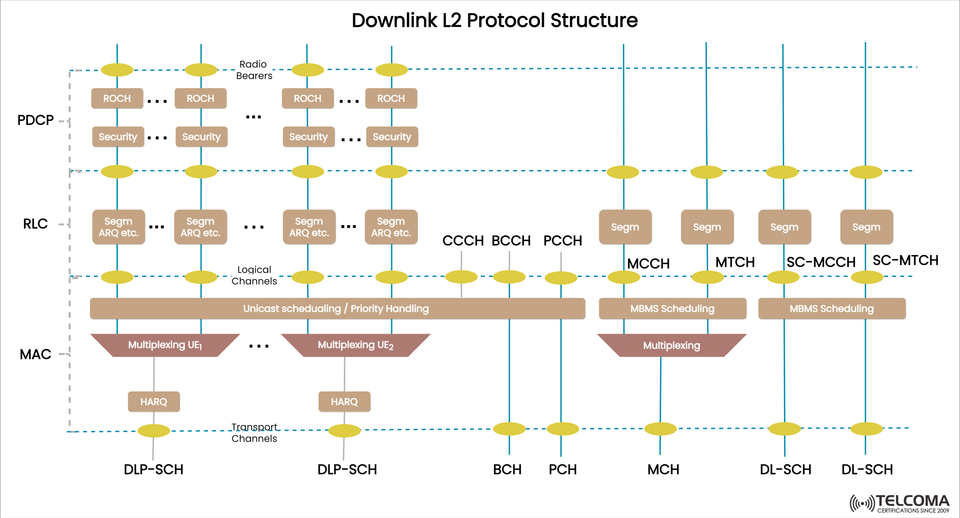
The diagram uploaded shows how various logical and transport channels move through these protocol layers, making sure that user data, signaling, and broadcast information are delivered correctly. Let's break it down step by step.
The Role of L2 in LTE/5G Protocol Stack
The L2 protocol layer is positioned between the Radio Resource Control (RRC)/higher layers (L3) and the physical layer (L1).
Its responsibilities include:
Segmentation and Reassembly of data.
Error correction with ARQ (Automatic Repeat reQuest) and HARQ (Hybrid ARQ).
Security through encryption and integrity protection.
Scheduling and multiplexing for multiple users.
Mapping of logical channels to transport channels to enhance radio transmission.
Breaking Down the Downlink L2 Protocol Structure
PDCP (Packet Data Convergence Protocol) Layer
The PDCP layer is the first stop in L2, where it processes data before sending it down to RLC. Its key functions are:
Header compression (ROHC): Compresses IP/UDP/RTP headers to optimize radio usage.
Security (Ciphering & Integrity Protection): Safeguards the confidentiality and integrity of user data and signaling.
Reordering and duplicate elimination: Keeps packets in the right order, especially during handovers.
In the diagram:
Several Radio Bearers connect through PDCP.
Functions like ROHC and Security are highlighted.
PDCP ensures that data is both compact and secure before it reaches RLC.
RLC (Radio Link Control) Layer
The RLC layer focuses on making the data stream reliable. Its main duties include:
Segmentation and Reassembly: Takes large PDCP SDUs and breaks them into smaller RLC PDUs, then reassembles them on the receiving end.
Error correction with ARQ: Guarantees the retransmission of lost packets in Acknowledged Mode (AM).
Modes of operation:
TM (Transparent Mode) – used for broadcast signaling (like system information).
UM (Unacknowledged Mode) – used for time-sensitive traffic (like voice and video).
AM (Acknowledged Mode) – for reliable traffic (like file downloads).
In the figure, the “Segm ARQ etc.” blocks illustrate these segmentation and ARQ functions for various users and logical channels.
MAC (Medium Access Control) Layer
The MAC layer is crucial for scheduling and resource allocation. Its responsibilities include:
Mapping logical channels to transport channels.
Scheduling and priority handling:
Unicast Scheduling for individual UEs.
MBMS Scheduling for multicast/broadcast services.
Multiplexing of multiple users: Collects data streams from various UEs.
HARQ (Hybrid ARQ): Facilitates quick retransmissions at the physical layer to boost reliability.
From the diagram:
Unicast scheduling is shown for UE1, UE2, and more.
MBMS scheduling takes care of broadcast/multicast channels (MCH).
HARQ is linked to how data is sent onto transport channels (like DL-SCH, BCH, PCH, MCH).
Logical and Transport Channels in Downlink
The figure demonstrates how logical channels get mapped to transport channels through the MAC layer.
Logical Channels:
CCCH (Common Control Channel): Used during initial access.
BCCH (Broadcast Control Channel): Contains system information.
PCCH (Paging Control Channel): Used for paging messages.
MCCH (Multicast Control Channel): Manages MBMS services.
MTCH (Multicast Traffic Channel): Carries multicast data.
SC-MCCH / SC-MTCH: Secondary multicast channels for advanced MBMS services.
Transport Channels:
DL-SCH (Downlink Shared Channel): The main data channel for unicast traffic.
BCH (Broadcast Channel): For system information blocks (SIBs).
PCH (Paging Channel): Used for paging UEs in idle mode.
MCH (Multicast Channel): For multicast/broadcast transmissions.
These mappings ensure every type of data, whether unicast, broadcast, or multicast, is handled efficiently.
Downlink L2 Protocol Flow (Step by Step)
Data goes into PDCP:
Compression (ROHC) cuts down on overhead.
Security provides encryption and integrity checks.
Data packets are reordered if needed.
Moves to RLC:
Data is broken down into smaller units.
ARQ ensures missing packets are retransmitted.
Depending on the service type, AM/UM/TM mode is employed.
Sent to MAC:
Logical channels are associated with transport channels.
Scheduler allocates radio resources based on QoS, priority, and load.
Multiplexing combines data from multiple UEs.
HARQ makes sure retransmissions are fast and reliable.
Passed to the Physical Layer (L1):
Data gets modulated, coded, and sent over the radio interface.
Why the Downlink L2 Protocol Structure Matters
The effectiveness of L2 protocols significantly affects the user experience in mobile networks. Here’s why it’s so important:
QoS Assurance: Guarantees that both delay-sensitive applications (like VoIP, video streaming) and those needing reliability (like file transfers) receive proper service.
Resource Optimization: The scheduler makes sure that limited spectrum resources are used efficiently.
Error Recovery: ARQ and HARQ provide resilience against channel issues.
Security: Ciphering keeps user privacy and data integrity safe.
Support for Broadcast/Multicast: Allows for efficient delivery of identical content to multiple users (think mobile TV or emergency alerts).
Key Takeaways for Telecom Professionals
PDCP focuses on compression, security, and sequencing.
RLC manages segmentation and ARQ-based error correction.
MAC is responsible for scheduling, multiplexing, and HARQ.
Logical Channels link user/control data to the right Transport Channels.
Scheduling and multiplexing are essential for effective downlink transmission across various users and services.
Conclusion
The Downlink L2 Protocol Structure forms the foundation of LTE and 5G data transmission. By coordinating the PDCP, RLC, and MAC layers, networks ensure that every data packet—whether for unicast, multicast, or broadcast—gets to the user in a secure, efficient way with the necessary Quality of Service (QoS).
For those in telecom, understanding this layered approach is vital for optimizing networks, troubleshooting issues, and ensuring the best experience for end-users. As networks continue to evolve toward 5G and beyond, these principles will remain key to reliable and scalable wireless communication.