
Understanding Downlink Structure with Carrier Aggregation (CA) in LTE/5G

The Importance of Carrier Aggregation
Carrier Aggregation (CA) is a standout feature in LTE-Advanced (LTE-A) and has seen further enhancements in 5G NR. It enables a user device (UE) to leverage multiple component carriers (CCs) at once, which boosts total bandwidth and overall data rates.
For example:
Without CA: A UE is limited to just one 20 MHz carrier.
With CA: A UE can combine several carriers (for instance, 5 × 20 MHz = 100 MHz) for considerably higher speeds.
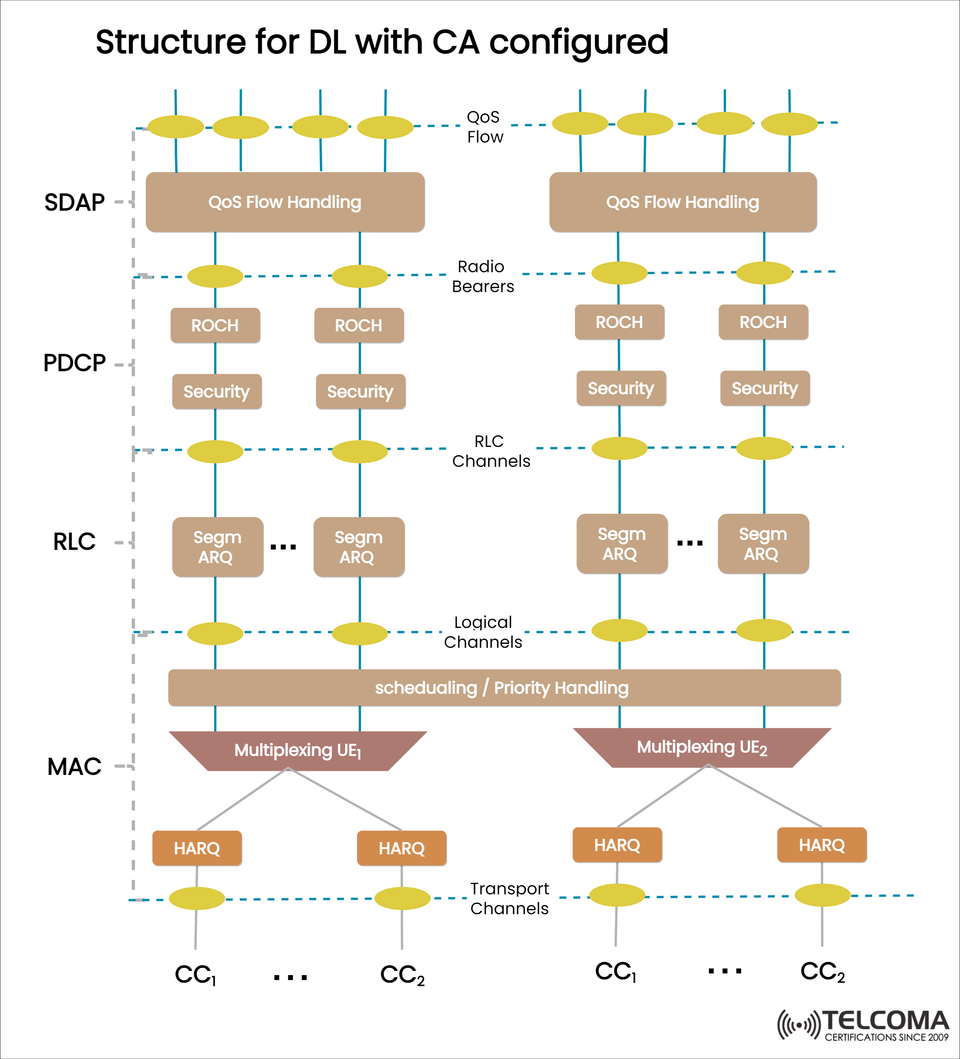
The accompanying diagram shows how downlink data is processed across various layers when CA is set up, illustrating the connections from SDAP (QoS handling) down to MAC and HARQ (transport channels).
Layered Structure in Downlink with CA
The flow of downlink data can essentially be divided into four main layers:
SDAP (Service Data Adaptation Protocol)
PDCP (Packet Data Convergence Protocol)
RLC (Radio Link Control)
MAC (Medium Access Control)
Each layer plays a vital role in ensuring that data is transmitted efficiently, securely, and with the necessary QoS across different carriers.
- SDAP Layer – QoS Flow Management
The SDAP layer takes charge of translating higher-layer IP flows into QoS flows. While this wasn't part of LTE-A, 5G NR brought in SDAP for more detailed management of QoS needs.
What SDAP Does:
It establishes the connection between QoS flows and radio bearers.
It ensures service differentiation (such as distinguishing between video and voice).
It prioritizes traffic based on QoS Class Identifiers (QCI/5QI).
So, it makes sure that a Netflix stream and a VoIP call are treated according to their specific QoS needs, even if they share the same physical resources.
- PDCP Layer – Security and Header Compression
The PDCP layer is positioned below SDAP and plays a key role in securing and optimizing transmission.
Key Responsibilities:
ROHC (Robust Header Compression): Cuts down on IP/UDP/TCP header size, saving bandwidth.
Security Functions: It handles encryption and integrity protection.
In-sequence delivery: Guarantees packets arrive in the right order, even with retransmissions.
With Carrier Aggregation, PDCP ensures that packets distributed across multiple carriers can still come together correctly and securely at the UE.
- RLC Layer – Segmentation and ARQ
The RLC (Radio Link Control) layer is in charge of breaking down and reassembling PDCP PDUs into smaller RLC PDUs that are suitable for radio transmission.
RLC Modes:
TM (Transparent Mode): For broadcasting/system information.
UM (Unacknowledged Mode): For time-sensitive data like video.
AM (Acknowledged Mode): For reliable transmission that allows for retransmissions.
Functions:
Segmentation and Reassembly: Divides large packets into manageable sizes.
ARQ (Automatic Repeat Request): Offers retransmission for lost PDUs in AM mode.
In CA, RLC ensures a smooth distribution of data across different carriers while keeping packet order intact.
- MAC Layer – Scheduling, Multiplexing, and HARQ
The MAC layer is crucial for Carrier Aggregation because it manages resource allocation and multiplexing among various component carriers.
Responsibilities:
Scheduling and Priority Management: Decides which UE receives which resources at each TTI.
Multiplexing: Combines data from several bearers into transport blocks.
HARQ (Hybrid ARQ): Provides a fast way to retransmit data at the PHY-MAC interface.
HARQ in Downlink:
Each carrier (CC1, CC2, etc.) has its own HARQ processes.
The UE maintains parallel HARQ entities for aggregated carriers.
This ensures robustness and quick recovery from errors.
It's essential in CA setups, where data is shared across multiple carriers and needs to be reassembled at the UE seamlessly.
Downlink Data Flow with CA
Here’s a look at the flow of downlink data as represented in the diagram:
QoS Flow Management (SDAP): IP packets are matched to QoS flows.
ROHC & Security (PDCP): Headers are compressed and packets are encrypted.
Segmentation & ARQ (RLC): Data is divided into RLC PDUs, with ARQ ensuring reliability.
Scheduling & Multiplexing (MAC): Data from different UEs is prioritized and combined into logical channels.
HARQ Processing (MAC-PHY): Transport blocks are sent via HARQ processes for each CC.
Carrier Aggregation: Multiple carriers (CC1, CC2, etc.) transmit transport blocks at the same time.
At the UE Side: Data from all carriers is merged, errors corrected, and packets reassembled.
Technical Benefits of CA in Downlink
Carrier Aggregation brings along several advantages:
Higher Throughput: Aggregating various carriers increases the total bandwidth.
Better Spectrum Use: Operators can merge fragmented spectrum bands.
Smooth User Experience: It supports high-data-rate applications like 4K streaming and AR/VR.
Backward Compatibility: Works well with older LTE devices using a single carrier.
Challenges with CA Implementation
While CA enhances performance, it adds some complexity:
UE Capabilities: Not all devices support multiple carriers.
Signaling Overhead: Coordinating scheduling and HARQ across CCs raises processing demands.
Types of Carriers: CA can include intra-band contiguous, intra-band non-contiguous, or inter-band aggregation, each presenting unique RF challenges.
Power Consumption: UEs need extra power to monitor and process multiple carriers at once.
LTE vs 5G Carrier Aggregation
Feature LTE-A CA5G NR CA Max Carriers Up to 5 CCs (100 MHz)Up to 16 CCs (1600 MHz in mmWave) Coding Turbo Codes LDPC/Polar Codes Scheduling Centralized at eNodeB Flexible, gNB can dynamically assign carriersSpectrumSub-6 GHz focusSub-6 GHz + mmWave QoS Management Bearer-based QoS Flow-based with SDAP
5G CA is significantly more powerful, allowing for multi-gigabit speeds by combining wide carriers across different frequency ranges.
Real-World Scenario
Let’s say you’re streaming a 4K video on a 5G smartphone:
SDAP: Differentiates the video QoS flow from background application traffic.
PDCP: Encrypts the video packets and compresses headers.
RLC: Breaks video data into smaller segments with support for retransmission.
MAC: Scheduler allocates resources across two combined carriers (like 3.5 GHz + 28 GHz).
HARQ: Instantly corrects any errors.
Outcome: You enjoy smooth 4K video playback without buffering, even during peak usage times.
Conclusion
The downlink structure with Carrier Aggregation (CA) in both LTE and 5G showcases how layered protocols work together to deliver high data rates, reliability, and QoS assurance.
SDAP ensures effective QoS differentiation.
PDCP takes care of security and compression.
RLC handles segmentation and retransmission needs.
MAC oversees scheduling, multiplexing, and HARQ operations.
These layers, working in harmony, allow several component carriers to act as a single high-capacity channel for users.
For telecom professionals, grasping this layered structure is crucial for optimizing network performance and providing a seamless, high-speed user experience as we move into the world of LTE-Advanced and 5G NR.