
Understanding Fiber Optic Communication System: Working, Components, and Advantages

Getting to Know Fiber Optic Communication Systems: How They Work, Their Parts, and Benefits
The need for fast, high-capacity data transmission is on the rise, thanks to 5G technology, cloud computing, and a growing number of data-intensive applications. Fiber optic communication systems are key players in this shift, providing incredible speed, bandwidth, and signal integrity over long distances.
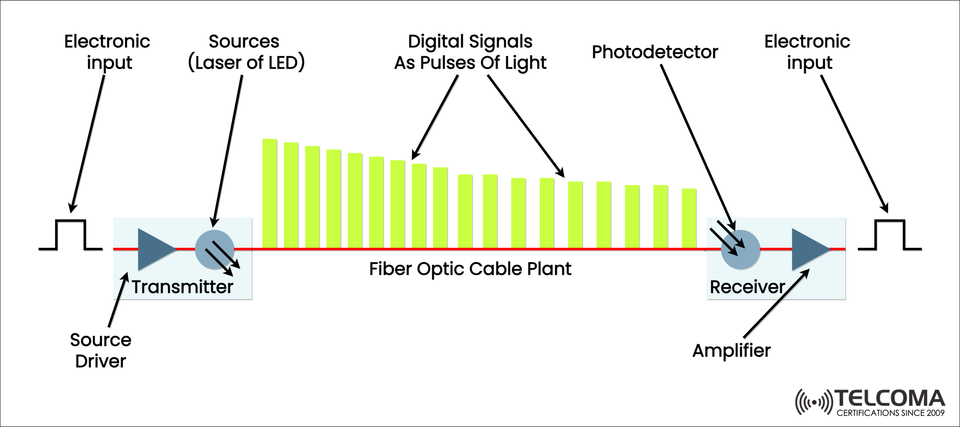
The diagram above shows how electronic input signals get transformed into light pulses, travel through a fiber optic cable, and are converted back into electrical signals when they reach the receiver. This entire process underpins optical fiber communication, which is what keeps everything from global internet backbones to local 5G networks running smoothly.
What Is Fiber Optic Communication?
Fiber optic communication refers to a method of transmitting data that utilizes light instead of electrical signals to send information through optical fibers. It works on the principle of total internal reflection, allowing light to move through the fiber with very little loss.
- Electronic Input
The process kicks off with an electronic input signal, usually digital data (binary 1s and 0s) produced by a transmitter circuit, computer, or telecom gear. This signal carries the info that needs to be sent, like voice, video, or data packets.
Before it can make its way through the optical fiber, it needs to be converted into a light signal, which is where the next part comes into play.
- Transmitter and Source Driver
The transmitter converts the electrical input into an optical signal. It comprises a source driver circuit and a light source, typically either a Laser Diode (LD) or Light Emitting Diode (LED).
Source Driver: The source driver boosts the electronic input and powers the optical source, ensuring that each binary signal (“1” or “0”) is reflected in a corresponding light pulse.
- Fiber Optic Cable Plant
Once the signal transforms into light, it travels through the fiber optic cable, also known as the transmission medium.
The optical fiber is made up of three main layers:
Core: This innermost part, made from glass or plastic, is where the light moves.
Cladding: Surrounding the core, it facilitates total internal reflection, keeping light contained.
Coating: This protective layer guards the fiber against physical harm and moisture.
Key Features of Fiber Optic Cable:
Low Attenuation: Allows for long-distance signals with minimal loss.
High Bandwidth: Can handle massive data rates (terabits per second).
Immunity to Electromagnetic Interference (EMI): Unlike copper cables, fibers aren’t affected by electromagnetic noise.
Long Reach: Signals can travel hundreds of kilometers with the help of amplifiers or repeaters.
- Transmission of Digital Signals as Light Pulses
Inside the optical fiber, digital data travels as light pulses. These pulses represent binary “1s” and “0s” and bounce internally along the core, ensuring minimal dispersion and power loss.
The efficiency of transmission relies on various factors:
Fiber Type:
Single-mode fiber (SMF): Ideal for long-distance, high-speed connections (core diameter ≈ 9 µm).
Multi-mode fiber (MMF): Suited for shorter distances (core diameter ≈ 50–62.5 µm).
Wavelength: Common transmission windows like 850 nm, 1310 nm, and 1550 nm are chosen for minimal attenuation.
Dispersion Management: Techniques such as Wavelength Division Multiplexing (WDM) help minimize signal distortion over long distances.
- Receiver and Photodetector
At the receiving end, light pulses need to be translated back into electrical signals. This is where the receiver steps in, which includes a photodetector and an amplifier.
Photodetector: This component (often a PIN photodiode or avalanche photodiode) detects incoming light pulses and converts them into electrical signals.
When light is detected, it generates a current (binary “1”).
When light isn’t present, no current flows (binary “0”).
Amplifier: This boosts the weak electrical signal from the photodetector so it can be used by communication devices or network systems.
The output is an electronic signal that closely mirrors the original input from the source.
Summary of the Working Process
Here’s a simplified look at how everything functions, as shown in the diagram:
Stage Component Function
1 Electronic Input Data in electrical form (binary code)
2 Source Driver & Laser/LED Converts electrical signal into light
3 Fiber Optic Cable Transmits light pulses over distance
4 Photodetector Converts light pulses back to electrical signals
5 Amplifier Strengthens the received signal for output
Advantages of Fiber Optic Communication
Fiber optics have changed the game by overcoming the limitations of copper systems. Here are the standout benefits:
- Extremely High Bandwidth
Optical fibers can manage terabits of data per second, making them perfect for things like 5G backhaul, cloud computing, and big data centers.
- Long-Distance Transmission
Optical fiber signals can go up to 100 km without needing repeaters, thanks to low attenuation.
- Resistance to Interference
Fiber optics don’t suffer from electromagnetic interference, guaranteeing stable data transmission even in noisy environments.
- Enhanced Security
It’s tough to tap optical fibers without getting noticed, which adds an extra layer of security for data.
- Lightweight and Durable
Fibers are lighter and more flexible than copper cables, making them easier to install and reducing maintenance costs.
- Energy Efficient
Fiber optic systems require less power for transmission and amplification compared to traditional electrical systems.
Uses of Fiber Optic Communication
Fiber optic systems are crucial for today’s communication infrastructure. Some key applications include:
Telecommunication Networks – Backbone for mobile broadband, 5G, and international data links.
Internet and Data Centers – Supports rapid data transfer between servers.
Cable Television (CATV) – Efficiently distributes digital video content.
Military and Aerospace Communication – Provides secure, interference-free communication.
Medical Imaging and Sensors – Used in procedures like endoscopy, precision sensing, and diagnostics.
Challenges Facing Fiber Optic Communication
Even with its advantages, fiber optic systems have their challenges:
Installation Costs: Setting up fiber optics can be pricier upfront compared to copper networks.
Fragility: Fibers can be more delicate and necessitate careful handling.
Splicing and Connectorization: Requires accurate equipment and skilled technicians to connect.
Signal Dispersion: Without proper compensation, long distances can lead to signal distortion.
Still, advances in technology, like optical amplifiers, WDM, and AI-driven network management, are helping to tackle these issues.
Conclusion
The fiber optic communication system illustrated in the diagram is essential to the digital age. It takes electrical signals, turns them into light, transmits them through glass fibers, and converts them back to deliver fast, reliable, and secure data transfer.
By using lasers, photodetectors, amplifiers, and optical fibers, this tech makes everything from global internet connectivity to 5G mobile networks and cloud infrastructure possible.
As the demand for data skyrockets, fiber optics will continue to be at the forefront of modern communication, driving innovation and connectivity for years to come.