
Understanding Functional Split Options in 5G RAN: DL and UL Explained

Understanding Functional Split Options in 5G RAN: DL and UL Explained
The shift to 5G New Radio (NR) has really changed the game for mobile network design, moving away from those rigid structures to more flexible, cloud-native setups. One of the major innovations in this transformation is the functional split between different elements in the Radio Access Network (RAN).
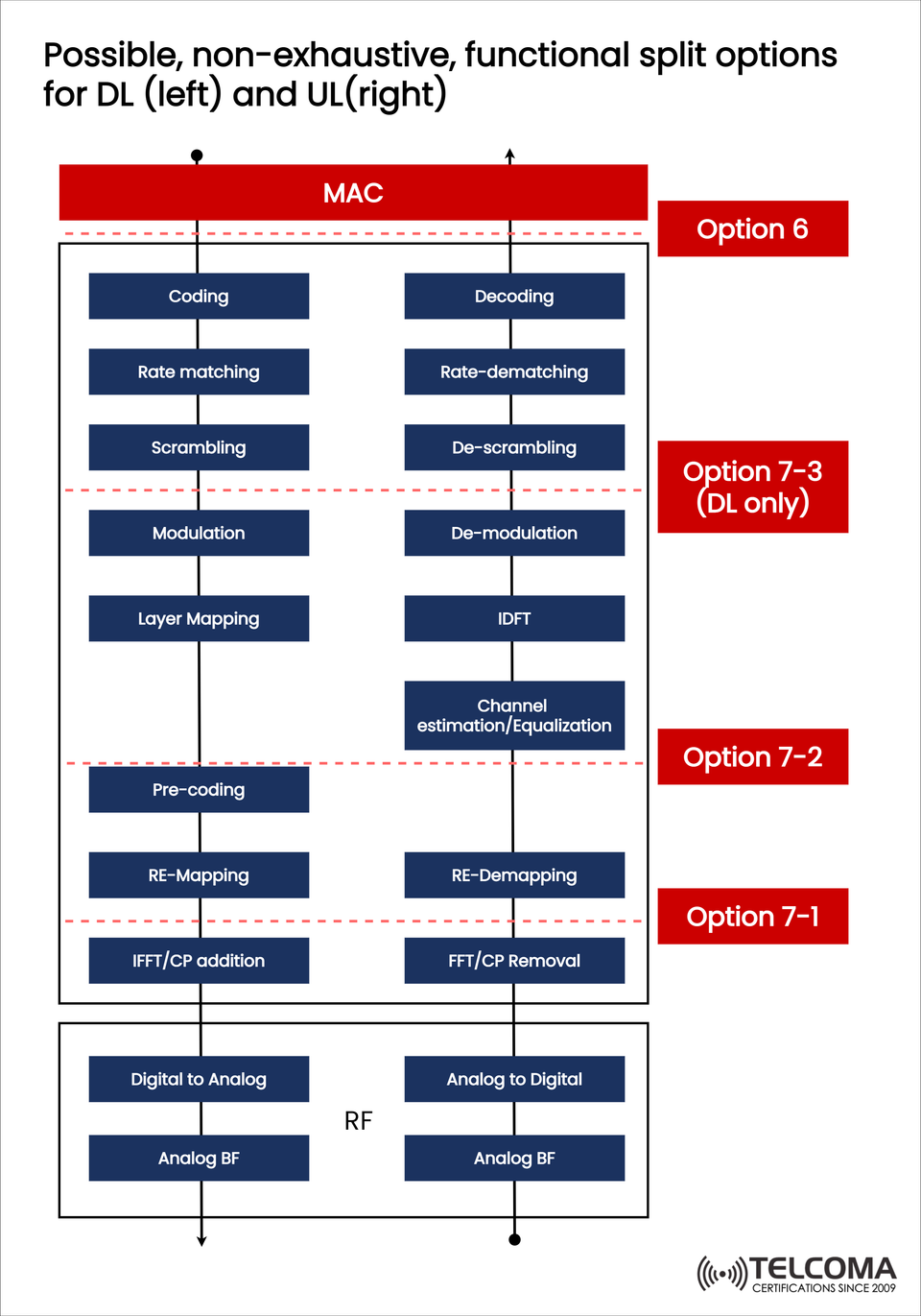
The diagram posted shows the downlink (DL) and uplink (UL) processing chain, outlining where various functional split options (like Option 6, Option 7-1, Option 7-2, and Option 7-3) can be used. These splits determine how processing responsibilities are divided among the Central Unit (CU), Distributed Unit (DU), and Radio Unit (RU), and they play a big role in optimizing performance, latency, and cost efficiency.
In this blog, we’ll break down these split options, explain the technical details behind them, and discuss what they mean for operators.
What Are Functional Splits in 5G RAN?
Functional splits involve breaking down signal processing tasks between centralized and distributed network components:
Central Unit (CU): Takes care of higher-layer functions like MAC, RLC, and PDCP.
Distributed Unit (DU): Handles lower-layer tasks that are closer to the radio.
Radio Unit (RU): Focuses on RF processing, converting analog signals to digital, and beamforming.
The choice of where to split affects several factors:
Latency (time-sensitive functions need to stay near the radio).
Bandwidth needs (some splits can require a lot of fronthaul capacity).
Flexibility (centralization can help with resource pooling and cost reduction).
Breakdown of Functional Split Options
The diagram highlights steps in processing for both DL and UL, along with potential split points. Let’s go through them one by one.
Option 6: Split at MAC-PHY Boundary
DL Path: Centralized tasks include MAC scheduling, coding, rate matching, and scrambling. Modulation and later stages happen at the DU/RU.
UL Path: Starts with demodulation at DU/RU and decoding at CU.
Pros: * Moderate fronthaul bandwidth requirements. * Good mix of centralization and latency management.
Cons: * Some loss of flexibility as DU manages important PHY functions.
Use Case: Works well for non-URLLC situations where fronthaul quality is limited.
Option 7-1: Split at IFFT/FFT Boundary
DL Path: Most processing is centralized until resource mapping. IFFT and CP addition happen at DU.
UL Path: FFT/CP removal occurs at DU, with higher PHY tasks done centrally.
Pros: * Keeps most PHY work at CU. * Less fronthaul demand compared to Option 7-2.
Cons: * Slightly more complexity at the DU.
Use Case: A balanced choice for when fiber resources are available but not in excess.
Option 7-2: Split at Pre-coding/RE-Mapping Boundary
DL Path: The central unit performs all baseband functions leading up to pre-coding. RE-Mapping, IFFT, and CP addition are done at the DU.
UL Path: The DU handles FFT/CP removal and RE-Demapping, while higher PHY tasks are taken care of by the CU.
Pros: * Supports advanced centralization features like coordinated multipoint (CoMP). * Ideal for Massive MIMO setups.
Cons: * Demands high fronthaul capacity and very low latency (below 100 μs).
Use Case: Best for Dense Urban and 5G Advanced scenarios that require high spectral efficiency.
Option 7-3 (DL Only): Split at Modulation Boundary
DL Path: Centralized tasks include coding, rate matching, scrambling, and modulation, while layer mapping and further tasks are handled at the DU.
UL Path: Not applicable since this is a DL-only option.
Pros: * Lightens the load on the DU for DL. * Enables central optimization of modulation strategies.
Cons: * Doesn’t work for uplink processing (as it's a DL-only split).
Use Case: For special situations with DL-heavy traffic demands (like video streaming).
Functional Split Options in Context
Here’s a quick comparison:
Option Split Point Pros Cons Best For
6MAC/PHY boundary Balanced, moderate bandwidth needs Limited flexibility Rural or suburban areas
7-1IFFT/FFT Centralized PHY control, lower fronthaul load Higher DU complexity Mid-sized cities, balanced deployments
7-2Pre-coding/RE-Mapping Optimal for Co MP, Massive MIMO High fronthaul demand, tight latency Dense urban networks, advanced 5G
7-3Modulation (DL only)Reduces DU DL load Not UL compatible DL-heavy apps like video streaming
Deployment Challenges
Even with their benefits, functional splits come with their own set of challenges:
Fronthaul Capacity: High-split options (7-2, 7-3) need multi-Gbps fiber links.
Latency: Strict requirements (as low as 100 μs) can limit deployment flexibility.
Cost: More complex splits might lead to higher initial CAPEX and OPEX.
Standardization: Operators have to stick to O-RAN Alliance standards for compatibility.
Benefits of Functional Split Flexibility
Choosing the right functional splits can offer several benefits to operators:
Customizable Deployments: Adjust split points based on traffic patterns and geography.
Efficient Resource Use: Centralize tasks to save costs while letting latency-sensitive tasks remain decentralized.
Enhanced Services: Tailor splits to support URLLC, mMTC, and eMBB.
Future-Proofing: Flexible designs set networks up for the evolution toward 6G.
Future Outlook
As we look ahead to 5G-Advanced and 6G, we can expect functional splits to evolve even more:
Dynamic Splitting: Real-time adjustments of split points based on network load and user needs.
AI-Enhanced RAN: Machine learning will help in selecting optimal splits for reducing latency and maximizing throughput.
Open RAN Integration: Standardized interfaces will support a multi-vendor environment.
Satellite and NTN Support: Functional splits will extend to include non-terrestrial networks for worldwide coverage.
Conclusion
Picking the right functional split options in 5G RAN is more than just a technical choice—it’s a strategic move that can significantly affect cost, performance, and service innovation. Options 6, 7-1, 7-2, and 7-3 each come with their own trade-offs regarding latency, bandwidth requirements, and deployment adaptability.
For telecom pros, really understanding these split points is essential for crafting efficient, future-proof networks.
For tech buffs, it shows just how much thought goes into 5G architecture to meet a variety of application needs.
As networks keep advancing, functional split flexibility will continue to be a key feature of innovation, leading us toward smart, adaptable, and scalable 6G RANs.