
Understanding H-CRAN Architecture: A Hybrid Approach to Efficient 5G and Beyond Networks
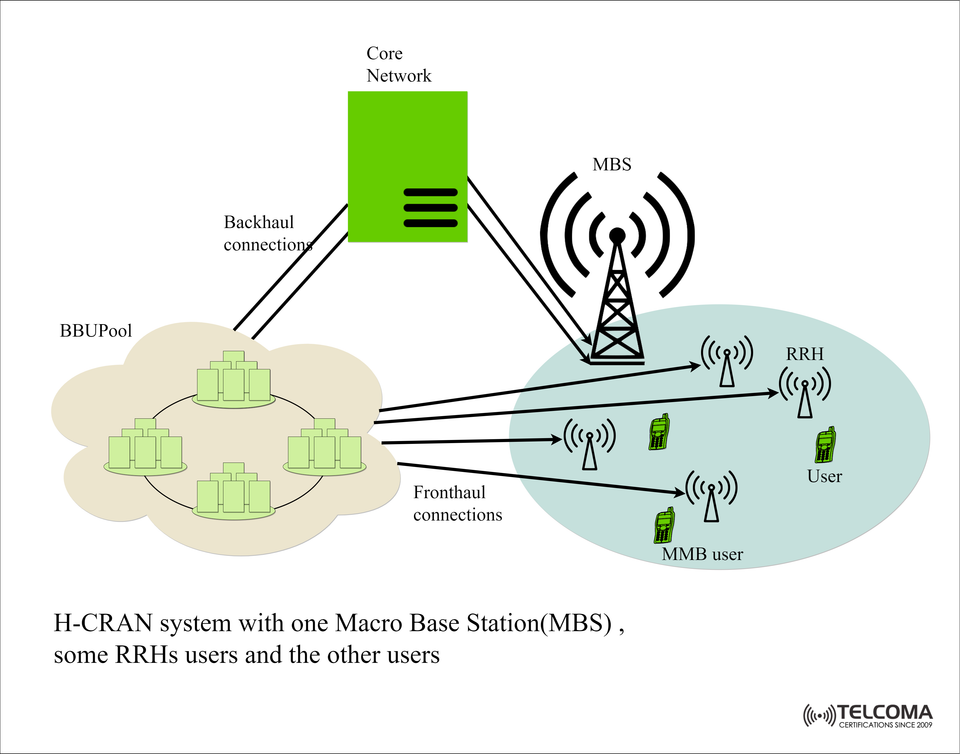

🔍 H-CRAN Architecture: The Future of 5G from Clouds and Radios
Heterogeneous Cloud Radio Access Network (H-CRAN) technology is primed as the next tool needed to support the evolution of mobile networks as they develop the capabilities to support a massive number of connected devices with ultra-low latency, and the ability to transmit data at unprecedented speeds. This post will focus on the attributes of H-CRAN, the components that form H-CRAN, and why it is a necessary technology for 5G and beyond.
📡 What Is H-CRAN?
H-CRAN (Heterogeneous Cloud-RAN) is a form of cloud RAN that allows a decoupling of radio from baseband processing that creates:
Macro Base Stations (MBS) that provide wide-area coverage,
Remote Radio Heads (RRHs) permit high-density small cell coverage,
Centralized Baseband Unit (BBU) Pools that facilitate cloud-based signal processing,
Core Network allows transport data routing, and management.
This hybrid architecture allows for opportunistic use of spectrum, diminishes interference, and maintains scaling of the network.
🧠 Components Explained
The diagram provides insight:
Component Definition
Macro Base Station (MBS) - Provides broad coverage and manages control signaling.
Remote Radio Heads (RRHs) - Stationed radio nodes that connect BBU. Serve as localized high-speed access.
BBU Pool (BBUPool) - Centralized processing pool in the cloud that manages multiple RRHs.
Core Network - Provider's primary data backbone that connects MBS and BBU with backhaul.
Fronthaul Transmission - Transmission connection to pool of BBU's, a transmission layer.
⚙️ How H-CRAN Works
The MBS transmitter, unlike traditional RANs, accepts control plane traffic and some user data to provide coverage.
The RRHs enable the network to reach users within the high-demand area of the MBS with signals sent to the BBU pool.
The BBU Pool handles all baseband functions, locates service instances better to allocate resources, and reduces overhead costs.
The Core Network is the centerpiece to manage mobility, sessions, and data packet routing.
Due to this design, centralized control can be achieved with coordinated centralized management, interference can be reduced, and spectral efficiency can be improved.
🚀 Benefits of H-CRAN for Next Generation Networks
✅ Improved Network Efficiency through centralized baseband processing
✅ Reduced Operational Costs with resource pooling through H-CRAN can reduce OPEX
✅ Improved Spectral Efficiency centralized interference and control coordination
✅ Support for Ultra-Dense Deployments, well-suited for smart city IoT
✅ Flexible scalability, ready for 5G and beyond - 6G
🔄 H-CRAN vs RAN
Feature Traditional RAN H-CRAN
Baseband Location Distributed Centralized (BBU Pool)
Signal Coordination Local Cloud-based
Resource Utilization Less Efficient Most Efficient
CAPEX/OPEX High Lower as a result of virtualization
Interference Greater with traditional RAN Advanced coordination
🧩 Use Cases
🌆 Smart Cities: Centralized orchestration to manage large amounts of mobile traffic in a dense space.
🚗 Connected Vehicles: Provide Ultra-reliable low-latency communication (URLLC)
🏢 Enterprise Campuses: Provide an effective, directed, scalable coverage.
📡 Massive IOT: Manage thousands of devices in connected states in limited spaces.
📌 Conclusion: H-CRAN as a Cornerstone for Future Networks
H-CRAN provides a foundational blend of conventional RAN and cloud-native architectures, which is essential for the future complexity of 5G, 6G, and post-6G networks. H-CRAN's flexibility, scale and optimization make it a good choice for urban areas with ultra-dense users, and also more affordable from a capital and operational cost perspective.
As telcos continue to push the boundaries of the possible with connectivity, H-CRAN will underpin the construction of smart, efficient, responsive wireless ecosystems.
🔧Technical Challenges in H-CRAN
H-CRAN has a multitude of opportunities, but there are also key challenges surrounding the deployment of H-CRAN:
- Fronthaul Latency and Bandwidth
Fronthaul links must provide high-bandwidth and low-latency connectivity from RRHs to their centralized BBU pool. - Synchronization
RRHs need to be synchronized tightly to their corresponding BBUs for the timing and symbols, as well as how they utilize CoMP. - Virtualization and Cloud Preparedness
BBU pools would require high-performance computing infrastructure for cloud capabilities.
Integration with Network Functions Virtualization (NFV) and Software-Defined Networking (SDN) is imperative for resource repurposing and isolation.
📡 H-CRAN and 6G: A Future-Ready Architecture
H-CRAN is not just relevant for 5G. It provides the necessary foundational architecture for 6G networks. Here’s how:
6G Requirement H-CRAN Benefit
Terabit-per-second throughput Scalable RRH/BBU pool architecture
Micro-second handover latency Optimized fronthaul with centralized coordination
AI-native networking AI/ML processing at centralized BBU level
Hyper-dense device connectivity Efficient RRH deployment and spectrum reuse
Sustainability goals Reduced power consumption from cloud pooling
🧠 Professional Opinion: H-CRAN Matters
H-CRAN delivers on the core pillars of next-gen mobile networks:
Agility: Virtualized, cloud-native architecture
Efficiency: Optimal resource utilization across layers of the network stack
Performance: High-speed, low latency, and ultra-reliable communication
Reduced Cost: Centralized processing reduces network hardware footprint
Regardless if you are a telecom or network engineer, a network planner, or a CTO of an enterprise, H-CRAN is important in preparing your current infrastructure for future demands.
✅ The Bottom Line
The H-CRAN architecture creates a seamless interface between the advantages of cloud-computing with the demands of high-performance wireless networks. Furthermore, differentiating the control plane from the radio plane enables smarter, faster, and more scalable networks, which are imperative for the eventual realization of 6G applications.
🔄 Summary Table of Comparison: Traditional RAN vs. H-CRAN
To provide more context on H-CRAN's strengths, below compares it to traditional RAN:
Parameter Traditional RAN H-CRAN
Architecture Distributed base stations Centralized BBUs + RRHs
Resource Utilization Static and under utilized Dynamic and pooled
Scalability Limited High, cloud-native
Latency Moderate Low with centralized coordination
OPEX and CAPEX Higher with hardware needs Lower through virtualization
Support for AI/ML Minimal Strong (supports intelligent control)
📈 Who Should Care About H-CRAN?
✅ Telecom Operators
To lower costs, boost spectral efficiency, and position themselves for the 6G evolution.
✅ Network Engineers and Planners
To have flexible and software-defined infrastructure that can support densification and edge intelligence.
✅ Academic Researchers
To continue researching advancements in cloud-native RAN and fronthaul optimization, along with AI-driven networking.
✅ Enterprises or smart cities focused on Industrial IoT
To support large-scale device provisioning, low latency, and a more resilient network.