
Understanding Information Synchronization Between Component Carriers in 5G Networks

Understanding the Complexity of Information Synchronization in 5G Networks
With the rollout of 5G, mobile communication has transformed into a complex, layered structure that can handle huge bandwidth, low latency, and varied connectivity needs. A key technology enabling this is Carrier Aggregation (CA), which combines several frequency bands, or component carriers (CCs), to enhance overall data throughput and improve spectrum efficiency.
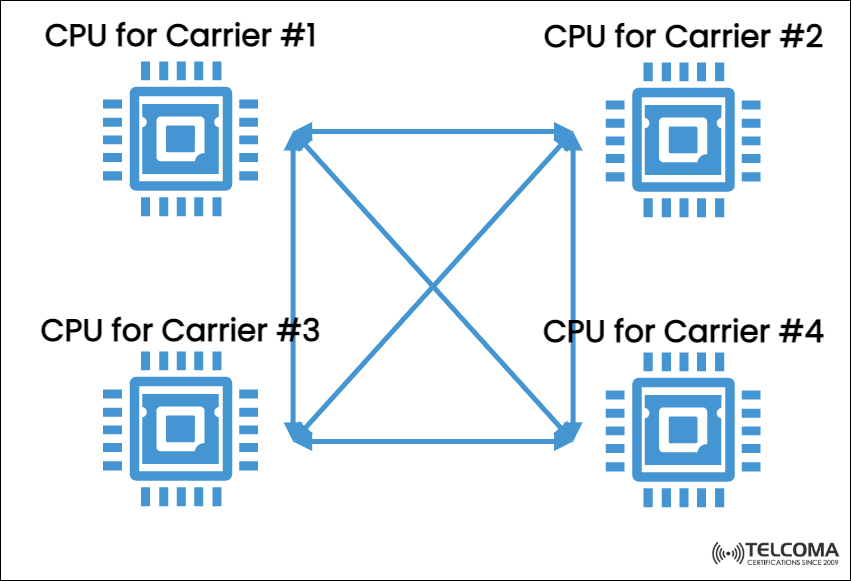
But here’s where it gets tricky: the information synchronization among these component carriers adds a hefty dose of complexity. The diagram we uploaded shows this well: each CPU is in charge of a different carrier, and they all need to sync simultaneously and bidirectionally to keep everything running smoothly.
In this article, we’ll explore the principles, challenges, and engineering techniques related to information synchronization among multiple component carriers in 5G networks.
What Exactly Are Component Carriers (CCs)?
In the context of 5G (and previously LTE-Advanced), a component carrier refers to a specific frequency band used for sending data. Each CC has its own bandwidth, frequency, and scheduling parameters, and when they’re combined, they function as a larger single logical channel.
Types of Component Carriers:
Primary Component Carrier (PCC):
Handles signaling, control, and data transfer.
Maintains the RRC (Radio Resource Control) connection.
Secondary Component Carriers (SCCs):
Used mainly for boosting data throughput.
Activated and deactivated dynamically based on network load and user equipment (UE) capabilities.
By combining multiple CCs, operators can significantly ramp up total data rates — a crucial factor for achieving Gigabit LTE and 5G NR performance.
Why Syncing Component Carriers Matters
When you blend multiple carriers, the user data is sent and received at the same time over different frequency bands. This process requires tight timing and information synchronization to ensure:
Smooth data reassembly on the receiving end.
Consistent QoS (Quality of Service) across carriers.
Coordinated resource scheduling across bands.
Accurate HARQ (Hybrid Automatic Repeat Request) and buffer management.
If synchronization is off, you could face:
Out-of-order packet delivery
Data loss or corruption
Lower throughput efficiency
Higher latency and retransmissions.
So, to sum it up, synchronization is what makes all carriers work together as a single integrated communication channel.
Real-Time Coordination
Each CPU handles data from its own carrier in real time. Delays in synchronization can lead to:
Data misalignment.
Buffer overflow or underflow.
Missed scheduling opportunities.
- Latency Requirements
In 5G, slot durations can be as short as 125 μs (microseconds). This means the synchronization processes need to function within microseconds, keeping timing accurate across carriers.
- Distributed Processing
In virtualized or cloud-based RAN setups (vRAN, O-RAN), different carriers might be processed on different compute nodes, which complicates synchronization even further due to:
Varied network latency.
Clock drift between processors.
Delays in data packet transmission.
- Inter-Carrier Interference
If carriers close in frequency aren't synced properly, they can create phase noise and interference, harming signal quality and spectrum efficiency.
- Dynamic Carrier Activation
In Carrier Aggregation, secondary carriers (SCCs) are activated and deactivated dynamically based on demand. Each time a carrier is activated, there's an immediate need to resynchronize the control and data plane info.
Ways to Sync Information
To tackle these challenges, 5G uses several advanced synchronization techniques:
- Common Timing Reference
Using a shared clock source (often GPS-based or IEEE 1588v2 Precision Time Protocol) helps keep all carriers’ timing aligned.
This is key for coherent symbol transmission and reception across carriers.
- Cross-Carrier Scheduling (CCS)
One carrier (usually the PCC) manages the scheduling for other carriers.
The scheduler directly communicates between CPUs to ensure unified allocation of resources.
- Coordinated HARQ
All HARQ processes across carriers are coordinated to ensure that retransmissions align correctly with their corresponding data blocks on different frequencies.
- Buffer Synchronization
Shared memory or fast inter-CPU data buses keep buffer states consistent, preventing underflow or overflow during multi-carrier packet assembly.
- Synchronization Over Fronthaul (O-RAN Context)
In O-RAN Distributed Units (DUs), fronthaul links use low-latency Ethernet connections to sync carrier data.
Standards like eCPRI and IEEE 802.1CM ensure precise timing transfer.
How Synchronization Affects 5G Performance
- Boosted Throughput
Synchronized carriers allow for smooth parallel data transmission, enhancing overall throughput and efficient spectrum use.
- Lower Latency
Precise timing sync means quicker retransmissions and scheduling, reducing end-to-end delays.
- Better Spectral Efficiency
Exact carrier alignment minimizes inter-carrier interference, ensuring a cleaner and more efficient use of the spectrum.
- Reliable Multi-Connectivity
Synchronization plays a crucial role in supporting Dual Connectivity (DC) and Carrier Aggregation (CA) scenarios, enabling devices to maintain multiple connections at the same time.
Engineering Strategies to Ease Sync Complexity
As networks grow, the overhead for synchronization also rises. Engineers employ various strategies to keep it manageable:
Approach Description Advantage Centralized Processing All carriers managed by one CPU cluster. Simplifies synchronization and cuts latency. Time-Sensitive Networking (TSN)Ethernet-based precise timing. Ensures deterministic delays. Hardware Acceleration (FPGAs, ASICs)Specialized circuits for synchronization tasks. Real-time performance with low power usage. Machine Learning (ML) Optimization Predicts scheduling and timing shifts. Cuts down re-sync overhead. Cloud-Native Coordination Kubernetes-based container orchestration. Promotes scalability in vRAN/O-RAN.
These strategies help telecom systems maintain synchronization, even as the number of carriers, frequency range, and data rates rise dramatically.
Syncing in Carrier Aggregation vs Dual Connectivity
It’s crucial to differentiate the synchronization needs in:
Carrier Aggregation (CA): Multiple carriers managed by the same base station (gNB), requiring tight synchronization within microseconds.
Dual Connectivity (DC): Different carriers may be controlled by different gNBs or even different RATs (like LTE + NR), where synchronization can be looser, generally within milliseconds.
Thus, the synchronization approach must adapt to the specific deployment scenario.
A Real-World Example: 4-Carrier Aggregation (4CC) Setup
In a typical 4CC 5G setup:
Each carrier functions on a separate band (e.g., n78, n41, n1, n3).
Each carrier’s CPU works on MAC/PHY functions separately.
Syncing between CPUs ensures:
Consistent HARQ feedback.
Coherent MIMO operation.
Accurate scheduling alignment.
The accompanying diagram illustrates this well: four CPUs in a fully interconnected setup, ensuring all-to-all communication for real-time synchronization.
Final Thoughts
The complexity of information synchronization between component carriers is a major challenge in modern 5G network design. Each CPU or processing unit responsible for a carrier must keep real-time, bi-directional synchronization with the others to maintain coherent communication and optimal performance.
Thanks to strategies like cross-carrier scheduling, shared timing references, and real-time buffer synchronization, 5G can achieve the flexibility and performance necessary for multi-gigabit speeds and ultra-reliable connectivity.