
Understanding Inter-Cell Interference Coordination (ICIC) in LTE and 5G Networks
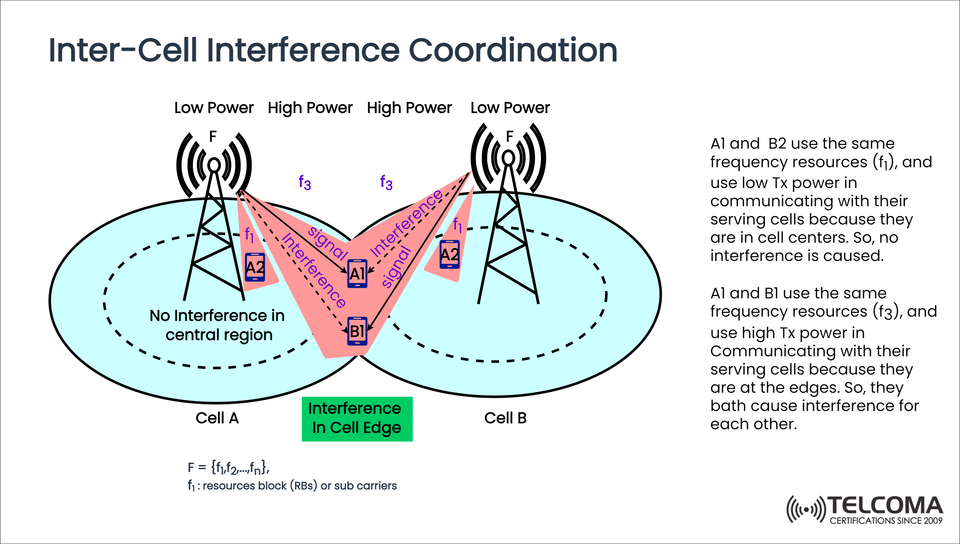

Understanding Inter-Cell Interference Coordination (ICIC) in LTE and 5G Networks As wireless networks continue to develop, ensuring that once a user leaves one cell and gets coverage by another cell in a wireless network with minimal interference remains a challenge that is especially important at the cell edge. When users access the network at the cell edge, their performance will suffer in the following ways as interference becomes significant: -
Poor signal quality (- 3 dB)
-Low throughput
-Higher packet loss
-Connection Instability
When using Inter-Cell Interference Coordination (ICIC) in LTE and 5G, it manages interference from neighboring cells and maintains performance for Edge Users and Center users. The image above illustrates the interference related to Cell A and Cell B as we think through how interference occurs, and how ICIC performs.
📡 What is Inter-Cell Interference (ICI)?
Inter-Cell Interference (ICI) exists whereby ‘cells’ or base stations will transmit at the same frequency using overlapping frequency resources. The impact is greatest at the cell edges, when the signals from the neighboring cells will overlap the Edge User's signal, causing the following performance difficulties:
-Poor Quality of Service (QoS)
-Lower throughput
-Higher packet loss
-Unstable connections
🧠 How ICIC Works:
Power and Frequency Coordination
📍 Example identified in the Image:
A1 and B1 (Edge Users) sent on high power and same frequency resource (f3) --> Interference, because they are at the cell edge, and signals will overlap.
A2 and B2 (Center Users) sent on low power and same frequency resource (f1) --> No interference, because both are in the mid-region of their cells.
🛠️ Techniques of ICIC in LTE and 5G
Technique Description Use Case
Static ICIC Fixed Resource Partitioning (e.g., frequency reuse) LTE, low mobility scenarios
Semi-Static ICIC Periodic updates based on loads and interference LTE-A and 5G NSA
Dynamic ICIC (eICIC/FeICIC) Real-time effort using signalling 5G NR, HetNet environments
Key Concepts
Frequency Reuse Allocation of non-overlapping frequencies from one cell to adjacent cells to mitigate interference.
Power Control Decrease the power levels of users in the central region of the cell to increase the power of edge users.
Time Domain ICIC Utilization of Almost Blank Subframes (ABS) as a scheduling benefit to have opportunities for transmission without interference from neighbour cells.
✅ The benefits of Inter-Cell Interference Coordination
📶 Improved Cell Edge Performance
→ Improves throughput and quality of service for users located at cell edge
📊 Higher Spectral Efficiency
→ Achieved through improved reuse of frequencies without degrading performance.
🔄 Improved Network Planning
→ Less aggressive frequency planning and reallocation is required .
🔗 Internal Links Suggestions
LTE Advanced Network Enhancements
5G NR Radio Resource Management
The differences between eICIC, FeICIC
What is Frequency Reuse and how does it work in cellular networks?
🧠 Pro Tip: Use eICIC (and FeICIC) when designing HetNets
In Heterogeneous Networks where macro cells and small cells co-exist, the use of eICIC and FeICIC concepts is particularly advantageous for managing interference across the multiple coverage layers, especially in 5G Non-Standalone deployments.
📌 Reflection
Inter-Cell Interference Coordination (ICIC) is a crucial aspect of LTE and 5G radio resource management that allows operators to maximize the efficiency of the spectrum and to mitigate user experience especially at the edge of coverage.
By managing power levels separated by cell and the allocation of frequency resources, ICIC allows operators to provide a higher quality, more reliable and higher capacity wireless service.
✅ WordPress Tags (SEO)
inter-cell interference coordination, ICIC LTE 5G, cell edge interference, eICIC and FeICIC, frequency reuse in LTE, 5G radio resource management, power control in wireless networks
🔁 Reworking ICIC Blog Post
This technical content explanation can be developed into others high performing content formats:
Format Description Ideal Platform
✅ WordPress Blog (HTML) Clean SEO-ready HTML block WordPress
📊 Infographic Identify cell-edge vs centre interference visually LinkedIn, Instagram, Twitter
🎓 Slide Deck 5 – 8 slides explaining ICIC, its causes, and mitigation Training, client sessions
🧠 Short Explainer Video 60 second animated video explaining f1/f3 interference YouTube Shorts, Instagram Reels
📘 PDF Quick Guide 1 page hard copy printable ICIC cheat sheet Website resource hub
📩 Suggested CTA Block (Lead Magnet)
htmlCopyEdit<div class="wp-block-group" style="background-color:#e0f7e9; padding:20px; border-left:4px solid #27ae60;"> <h3>🚀 Want Better 5G Performance?</h3> <p>Download our free <strong>5G Radio Optimization Guide</strong> to learn about ICIC, power control, and spectrum reuse strategies.</p> <a href="YOUR_PDF_LINK" class="wp-block-button__link" style="background-color:#27ae60; color:#fff; padding:12px 20px; border-radius:4px; text-decoration:none;">Download Now</a></div>
🔧 Next Steps: Choose Your Format
Which of the following would you like to receive now?
- ✅ HTML export of all blog posts (for WordPress)
- ✅ Branded eBook (PDF) with all diagrams and chapters
- ✅ Slide deck for ICIC and core interface training
- ✅ LinkedIn-ready carousel or infographic for ICIC
- ✅ One-page ICIC Cheat Sheet (PDF)
📊 Inter-Cell Interference Coordination (ICIC) — Infographic Content Plan
Title of infographic:
"ICIC in LTE/5G: Control Interference at the Cell Edge"
Outline for visual layout:
🔹 Section 1: What is Inter-Cell Interference?
A short definition (1 sentence)
Visual of two cell coverage zones that overlap (like in the image we are uploading)
Label cell center vs. cell edge
🔹 Section 2: What Is Causing the Interference?
A1 ↔ B1 are using the same frequency f3, both ultimately at high power
Arrows marked "signal" and "interference".
The explanation: High power + same RBs = Interference
🔹 Section 3: ICIC Solution
Region Power Level Frequency Used Result
Cell Center Low f1 (shared) No Interference
Cell Edge High f3 (shared) Interference
🔹 Section 4: Types of ICIC
🟩 Static ICIC: Fixed frequency blocks
🟦 eICIC: ABS (Almost Blank Subframes)
🟥 FeICIC: Enhanced with real time power control
📱 LinkedIn Carousel Post (8 Slide Titles)
Each "slide" should be a swipeable panel optimised for LinkedIn or Instagram:
Slide 1: Why Cell Edge Users Suffer the Most in LTE & 5G
→ High power overlap = clash in signal
Slide 2: What is Inter-Cell Interference?
→ Simple definition + visual from diagram we've uploaded
Slide 3: Who Causes It?
→ A1 and B1 are at edge, using f3
Slide 4: Why Cell Centers Avoid It
→ A2 and B2 are using f1 at low power → no interference
🔚 Conclusion
This multi-form ICIC breakdown allows you to:
Publish long-form blog content for SEO
Create LinkedIn engagement with carousels
Communicate an infographic through social
Create a technical reference that can be printed (PDF)